
ITEM# UJKA437 – Catalogue 41 – Sold
A Shizumoto Katana (豊州高田住平鎮元作)
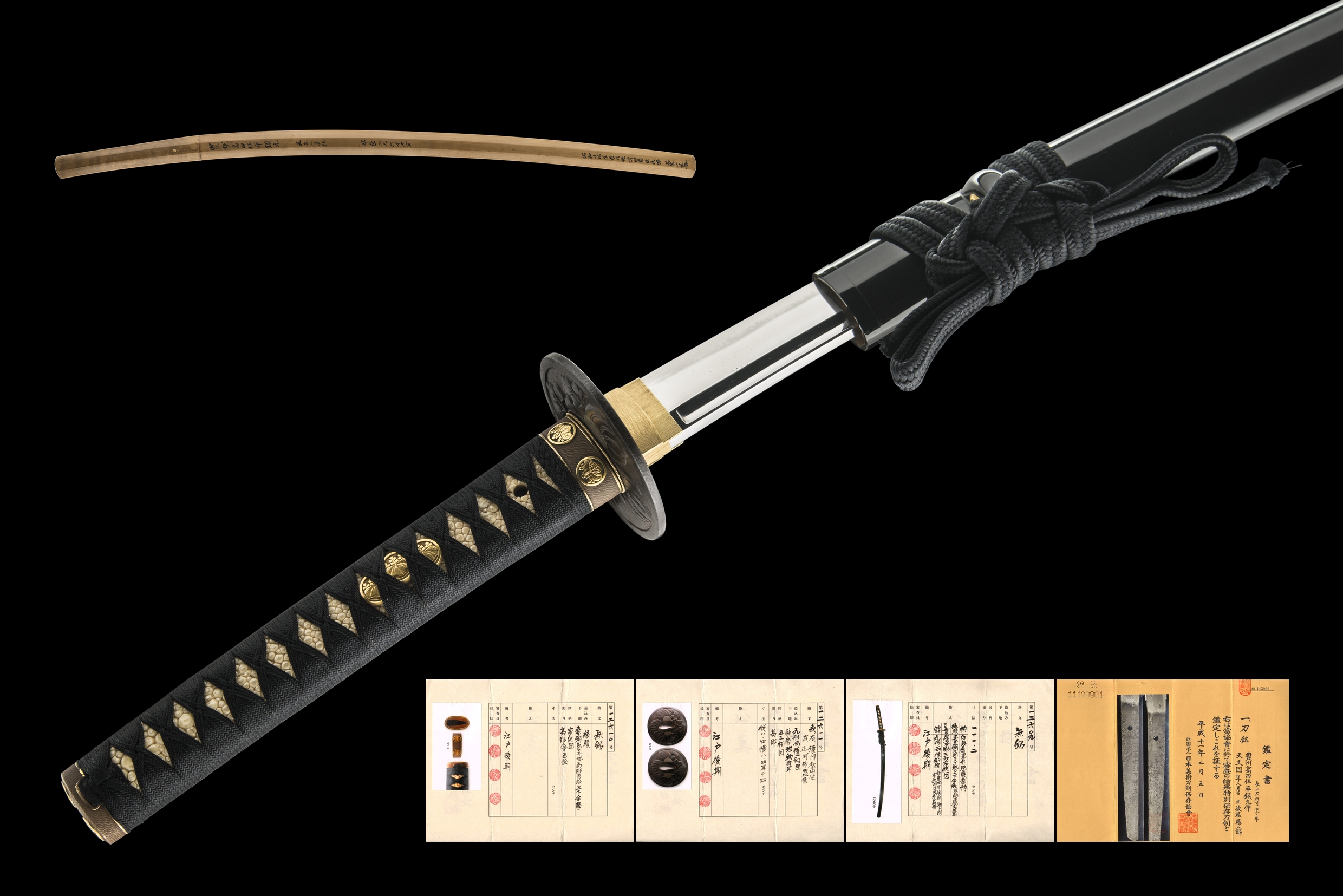
The Takada school of Bungo province in Kyûshû is one of the great workhorses of Japanese sword history – founded around 1334 and still producing blades well into the shintô period. Within this tradition, the Nagamori lineage distinguished itself by adopting the clan name Taira in their signatures, giving rise to the Taira-Takada designation. Shizumoto was among approximately a dozen smiths from this group who shared the character Shizu, alongside Shizumori, Shizutaka, and Shizunori – all of them serving as swordsmiths to the powerful Ôtomo clan. Fujishiro rates Shizumoto at jô-saku, acknowledging genuine skill above the ordinary.
This blade is exceptional by any measure. At 81cm it carries the sweep and presence of a tachi from the Kamakura period – yet it remains fully ubu, the original unaltered nakago intact after nearly five centuries. The inscription confirms it was made in the eighth month of Tenbun 2 (August 1533) for patron Gotô Tôgorô, a member of the Ôtomo clan – the same powerful family who, within a generation, would be hosting Jesuit missionaries and trading with the Portuguese in Kyûshû. The blade was examined and written about by Dr. Honma Junji (Kunzan sensei), former director of the NBTHK, in his diary series published in Tôken Bijutsu No. 387 (April 1989) – an uncommon honour for a provincial sword.
Honma sensei described the kitae as a very densely forged ko-itame that tends to muji, showing fine ji-nie and faint midare-utsuri. The hamon is a densely arranged ko-gunome in ko-nie-deki mixed with ko-ashi and a few chôji, with some ko-notare on the upper blade. The bôshi is midare-komi with kuzure at the tip. A kakudome bô-hi runs the full length of both sides – a structural groove that forms an I-beam cross-section, lightening the blade while maintaining its remarkable rigidity. The accompanying Edo-period koshirae carries a unified kirimon (paulownia) theme across the tsuba, fuchi-kashira, and menuki, with copper mounts accented in gold – a fittingly distinguished setting for an extraordinary sword.
| Item Number | UJKA437 |
| Sword Type | Katana |
| Swordsmith | Shizumoto (first generation) |
| Swordsmith (JP) | 鎮元 |
| Signature | Hôshû Takada jû Taira Shizumoto saku / Tenbun ninen hachigatsu hi – Aruji Gotô Tôgorô |
| Date | Tenbun 2 (1533), 8th month |
| School | Taira-Takada (Sue-Kotô Takada) |
| Province | Bungo (Hôshû / Kyûshû) |
| Period | Late Muromachi – Tenbun era (August 1533) |
| Nagasa | 81.0 cm |
| Sori | 2.2 cm |
| Moto-haba | 3.21 cm |
| Weight | 1,015 g |
| Nakago | Ubu (original, unaltered); katte-sagari yasurime; 1 mekugi-ana |
| Jihada | Tightly forged ko-itame tending to muji-hada, with ji-nie and midare-utsuri |
| Hamon | Ko-gunome in ko-nie-deki with ko-ashi, chôji, and ko-notare; midare-ba overall |
| Boshi | Midare-komi with kuzure at the tip |
| Certificates | NBTHK Tokubetsu Hozon; NTHK-NPO Kanteishô (koshirae, fuchi-kashira, and tsuba certified as Authentic) |
| Fujishiro Rank | Jô-saku |
| Sayagaki | Dr. Honma Junji (Kunzan sensei) – Taira-Takada school, Shizumoto, dated Shôwa, Year of the Dog (1982) |
| Koshirae | Edo-period uchigatana-koshirae; kuro-roiro-nuri saya lacquered in glossy black (Middle Edo, c.1700-1780); NTHK-NPO certified |
| Tsuba | Iron ground with kirimon (paulownia) design; signed Shôami Morizumi, resident of Matsuyama in Yoshû province; Late Edo period (c.1780-1868); NTHK-NPO certified |
| Fuchi-kashira | Attributed to Masamitsu, 7th head of the Nomura Family; copper with gold kirimon accents; Late Edo period; NTHK-NPO certified |
| Menuki | Kirimon (paulownia) design in gilt; matching theme with tsuba and fuchi-kashira |
| Habaki | Gold niju-habaki with kiri file marks |
| Catalogue | Catalogue 41 |
| Status | Sold |
| Includes | Shirasaya with Kunzan sayagaki, Edo-period koshirae with koshirae bag, NBTHK Tokubetsu Hozon certificate, three NTHK-NPO Kanteishô certificates, fabric bags, stand, sword maintenance kit, printed description |