
ITEM# UJKA481 – Catalogue 45 – Sold
A Miike Katana (三池)
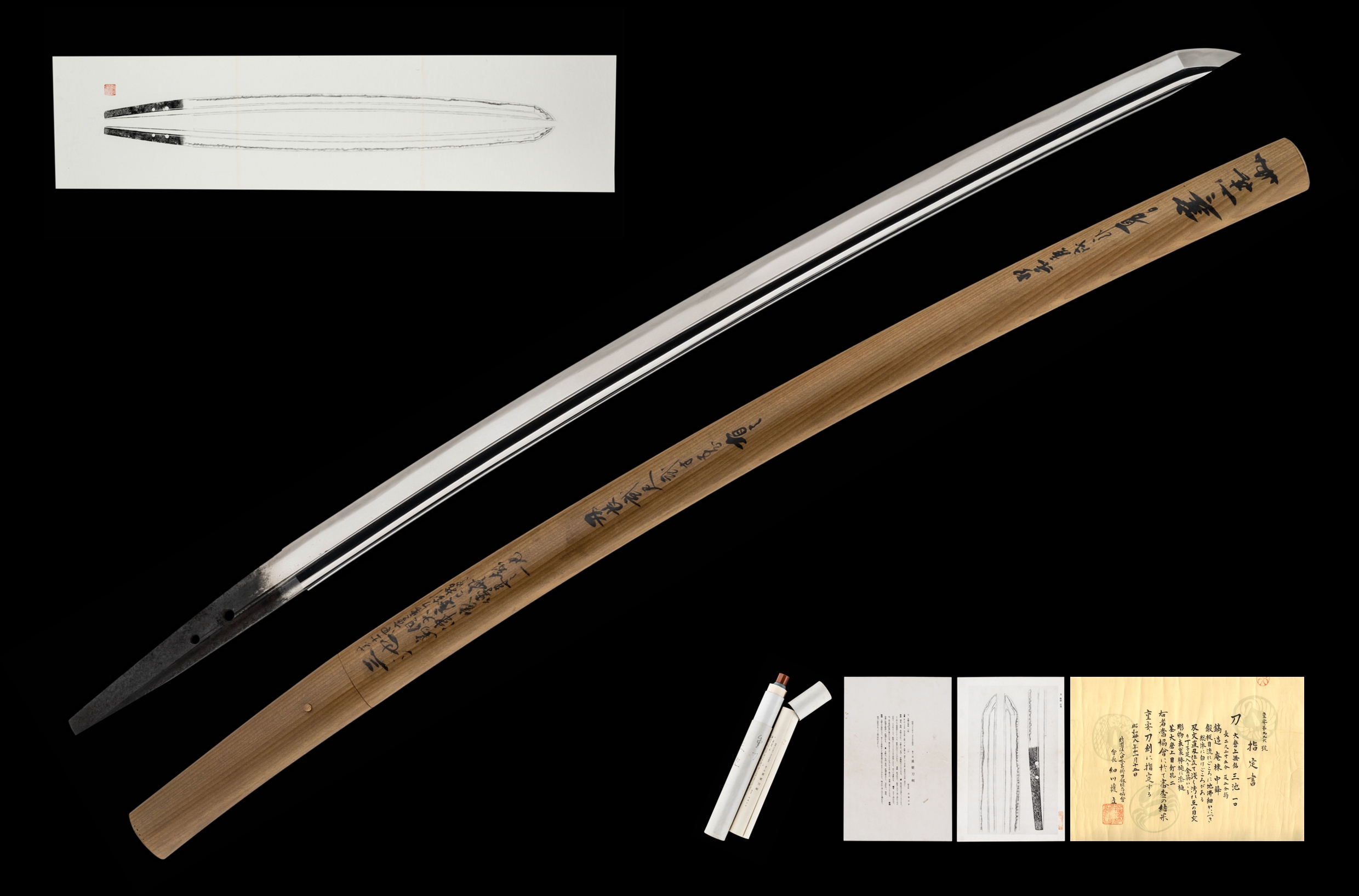
The Miike school, based in Miike District, Chikugo province — present-day Fukuoka Prefecture in Kyûshû — is one of the oldest sword-making traditions in Japan, tracing its origins to the late Heian period. Its founder, Miike Denta Mitsuyo (三池典太光世), flourished in the 11th century, and the school’s most celebrated blade is the Ôdenta Mitsuyo (大典太光世), a National Treasure and one of the legendary Tenka Goken (Five Great Swords) — once held by the Maeda family. By the late Kamakura period the school had evolved to meet the demands of a changing battlefield, producing blades with wide mihaba, thinner kasane, and a slightly extended chû-kissaki that balanced reach with cutting power. Their signature feature — the broad bôhi with soebi carved close to the mune, known as the “Miike bôhi” — is present and boldly executed on this blade, along with the characteristic shirake (whitish tone) in the jihada that collectors instantly recognise as Miike-hada.
The blade itself is broad and commanding: shinogi-zukuri, iori-mune, chû-kissaki, with a powerful sugata that the NBTHK jury described as dating to the end of the Kamakura period. The jihada is a densely forged itame that tends toward nagare, rich with fine ji-nie and the characteristic shirake throughout. The hamon is a large, gently undulating notare tending to suguha-chô, animated by gunome, plentiful chôji-ashi, shimi along the entire ha, sunagashi, and an exceptionally long kinsuji running along the blade — evidence of the precise differential hardening and expert yakiire control for which the Miike school is celebrated. The bôshi is notarekomi with a very small turnback, with nijû-ba visible. The nakago is ô-suriage with katte-sagari-yasurime and a kurijiri (chestnut-shaped) tip.
This katana’s pedigree is exceptional even within the Jûyô tier. It was designated at the 11th NBTHK Jûyô Tôken session on November 15, 1963 — the earliest sessions, held before Tokubetsu Jûyô was introduced, when Jûyô itself was the highest honour the society could bestow. The shirasaya bears a sayagaki by the late Kanzan Satô (寒山), one of the greatest post-war sword scholars, written in the summer of Shôwa kanoe-inudoshi (1970), attesting to the blade as a Miike work and recording it as a treasured heirloom of the powerful Shimazu daimyô family of Satsuma province — Shimazu-ke denrai no hitotsu (島津家傳来之一). A fine Kamakura-period sword with 700 years of history and the impeccable custody of one of Japan’s most storied warrior families behind it.
| Item Number | UJKA481 |
| Sword Type | Katana (ô-suriage) |
| Attribution | Miike School |
| School | Miike (三池) |
| Province | Chikugo |
| Period | Chû-Kotô, Late Kamakura (circa early 1300s) |
| Nagasa | 68.2cm (ô-suriage) |
| Sori | 1.3cm |
| Moto-haba | 3.07cm |
| Weight | 565g |
| Nakago | Ô-suriage, 17.0cm, katte-sagari-yasurime (slanting file marks), kurijiri tip, 2 mekugi-ana |
| Jihada | Densely forged itame tending to nagare, fine ji-nie and shirake throughout (Miike-hada) |
| Hamon | Large gently undulating notare tending to suguha-chô, mixed with gunome, many chôji-ashi, shimi along entire ha, sunagashi and kinsuji |
| Boshi | Notarekomi with very small turnback; nijû-ba present |
| Horimono | Bôhi with soebi on both sides (distinctive Miike-bôhi style) |
| Certificates | 11th NBTHK Jûyô Tôken, Certificate No. 996 (passed November 15, 1963) |
| Sayagaki | Kanzan Satô (寒山) — Miike, ô-suriage mumei, heirloom of the Shimazu family (島津家傳来之一), 11th Jûyô Shinsa, dated Shôwa kanoe-inudoshi (1970) + kaô |
| Habaki | Gold habaki with copper ground |
| Catalogue | Catalogue 45 |
| Status | Sold |
| Includes | Shirasaya with Kanzan sayagaki, fabric bag, stand, kit, printed description |