
ITEM# UJWA260 – Catalogue 40 – Sold
A Masatsune Sunnobi Tantô (相模守藤原政常)
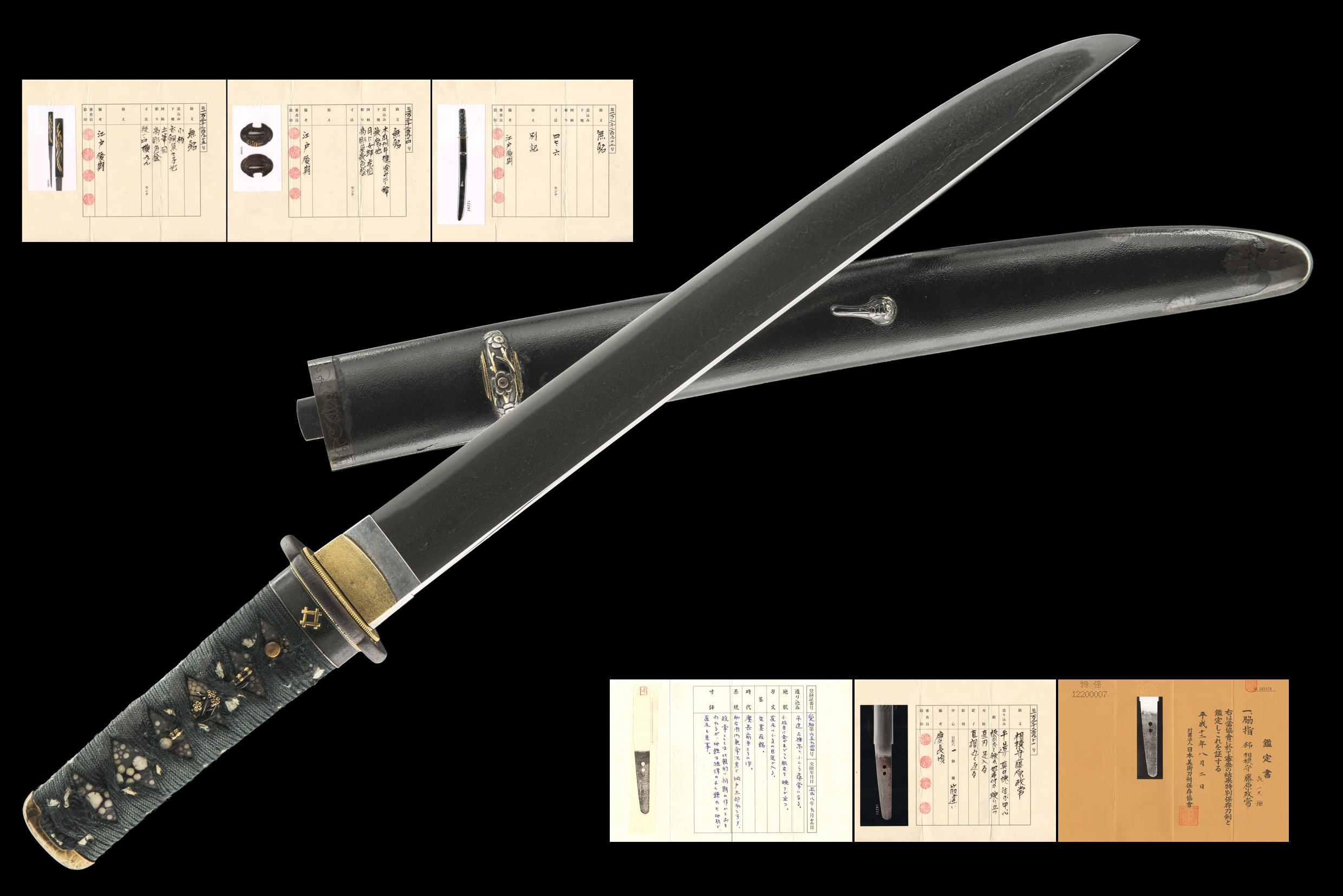
Born Nôshû Tarôsuke in 1535, Masatsune was the second son of the ninth-generation Sukemon Kanetsune and the most accomplished swordsmith of the Owari Shintô group. He initially signed Kanetsune when he established his own branch at Komaki in Mino province, before relocating to Kiyosu in Owari and changing his name to Masatsune in 1592. A year prior, in 1591, he was granted the honorary title of Sagami no Kami by Toyotomi Hidetsugu, alongside Hida no Kami Ujifusa and Hoki no Kami Nobutaka – together known as the Owari san-saku, the three great smiths of Owari province. After the decisive Battle of Sekigahara he entered the service of Matsudaira Tadayoshi, the new lord of the Kiyosu fief, and later moved to the flourishing castle town of Nagoya. He retired in 1607, passing the school to his son Tarôsuke, but Tarôsuke died unexpectedly in 1609. Masatsune resumed work and signed his nakago with the supplement Nyûdô (Buddhist priest name) until his death on February 18, 1619, at the age of 84.
This exceptional sunnobi-tanto is exactly one shaku in length (30.3cm) – almost certainly commissioned to that precise traditional measurement. It carries a wide, healthy body and a bright, straight suguha-hamon with weaving ko-gunome and ashi, with a faint togari element that reveals Masatsune’s Mino roots. The well-forged ko-itame jihada is mixed with mokume, displays standing utsuri, and shimmers throughout with fine ji-nie. The boshi resolves in a clean suguha-chô with a round kaeri. The relatively rare mitsu-mune spine – three surfaces on the ridge, a feature associated with the Sôshû and Yamashiro traditions – adds further distinction. This is prime early-career Masatsune, made before the untimely death of his son changed the character of his later work, and represents a fine example from a swordsmith of the highest calibre.
Accompanying the blade is a superb Late Edo-period toppei-tanto-koshirae lacquered in a kuro-ishime-ji-nuri (black stone-like) finish, its distinctive tapered kojiri evoking the form of a toppai-kabuto helmet bowl. The kojiri is inlaid with the aoi-mon (Tokugawa hollyhock crest), strongly suggesting a historical connection – or homage – to the ruling shogunate, entirely fitting for a smith so closely bound to the Tokugawa’s Owari domain. The tsuba is a charming polished iron lobed example attributed to the Nara school of Edo, decorated with tsuki (moon) and ominaeshi (Japanese golden lace flower) in lovely gold and silver inlay. The fuchi-kashira, attributed to a Kyôto metalsmith, display an elegant powdered gold sensu (fan) motif – a symbol of high court aristocracy. The Edo-period tsuka carries menuki with designs of ume (plum blossoms) and a flute, motifs evoking the Tale of Genji, over black-lacquered samekawa. A kozuka attributed to the prestigious Kyô-Gotô school completes the set, its blade signed Masatsune.
| Item Number | UJWA260 |
| Sword Type | Sunnobi-tanto (registered as wakizashi) |
| Swordsmith | Sagami no Kami Fujiwara Masatsune (first generation) |
| Swordsmith (JP) | 相模守藤原政常 (初代) |
| Signature | Sagami no Kami Fujiwara Masatsune |
| School | Owari Shintô |
| Province | Owari |
| Period | Momoyama – Bunroku~Keichô eras (1591~1607) |
| Nagasa | 30.3cm (1 shaku – ubu) |
| Sori | 0.0cm |
| Moto-haba | 2.89cm |
| Weight | 235g |
| Nakago | Ubu (original, unaltered tang); katte-sagari-yasurime (slanting file marks); 2 mekugi-ana |
| Jihada | Ko-itame mixed with mokume; standing hada (utsuri tatsu) and utsuri; fine ji-nie |
| Hamon | Suguha with ko-gunome and ashi; togari element reflecting Mino roots |
| Boshi | Suguha-chô with round kaeri |
| Certificates | NBTHK Tokubetsu Hozon (issued Heisei 12 / 2000, August 2nd); NTHK-NPO Kanteisho for blade (issued Reiwa 5 / 2023, June 16th); Tokunô Kazuo Kanteisho (issued Heisei 12 / 2000, March 23rd); NTHK-NPO Kanteisho for tsuba, fuchi-kashira and koshirae |
| Fujishiro Rank | Jojo-saku (highly superior swordsmith) |
| Sayagaki | Nozomi-san (shodo artist) – Shodai Sagami no Kami Fujiwara Masatsune; around Keichô period (1596-1615); blade length 30.3cm; written in the month of Yayoi (April), Reiwa 6, Year of the Dragon (2024) |
| Koshirae | Kuro-ishime-ji-nuri saya toppei-tanto-koshirae (黒石目地塗鞘突兵短刀拵); Late Edo period (1780~1867) |
| Tsuba | Polished iron lobed-tsuba; attributed to the Nara school, Edo (Tokyo); tsuki (moon) and ominaeshi motif in gold and silver inlay; NTHK-NPO Kanteisho |
| Fuchi-kashira | Attributed to Kyôto Kanagu-shi (Kyôto metalsmith); Late Edo period (1780~1867); powdered gold sensu (fan) motif; NTHK-NPO Kanteisho |
| Menuki | Ume (plum blossom) and flute motif; Edo period; gold |
| Tsuka | Edo period; black-lacquered samekawa (ray skin); aged teal silk tsuka-maki; igeta kamon on fuchi; kozuka pocket |
| Habaki | Antique gold and silver ni-ju habaki; horizontal file marks |
| Catalogue | Catalogue 40 |
| Status | Sold |
| Includes | Shirasaya, Edo toppei-tanto-koshirae (with kozuka attributed to Kyô-Gotô school), fabric bags, stand, kit, description |