
ITEM# UJWA227 – Catalogue 28 – Sold
A Katayama Ichimonji Wakizashi (片山一文字)
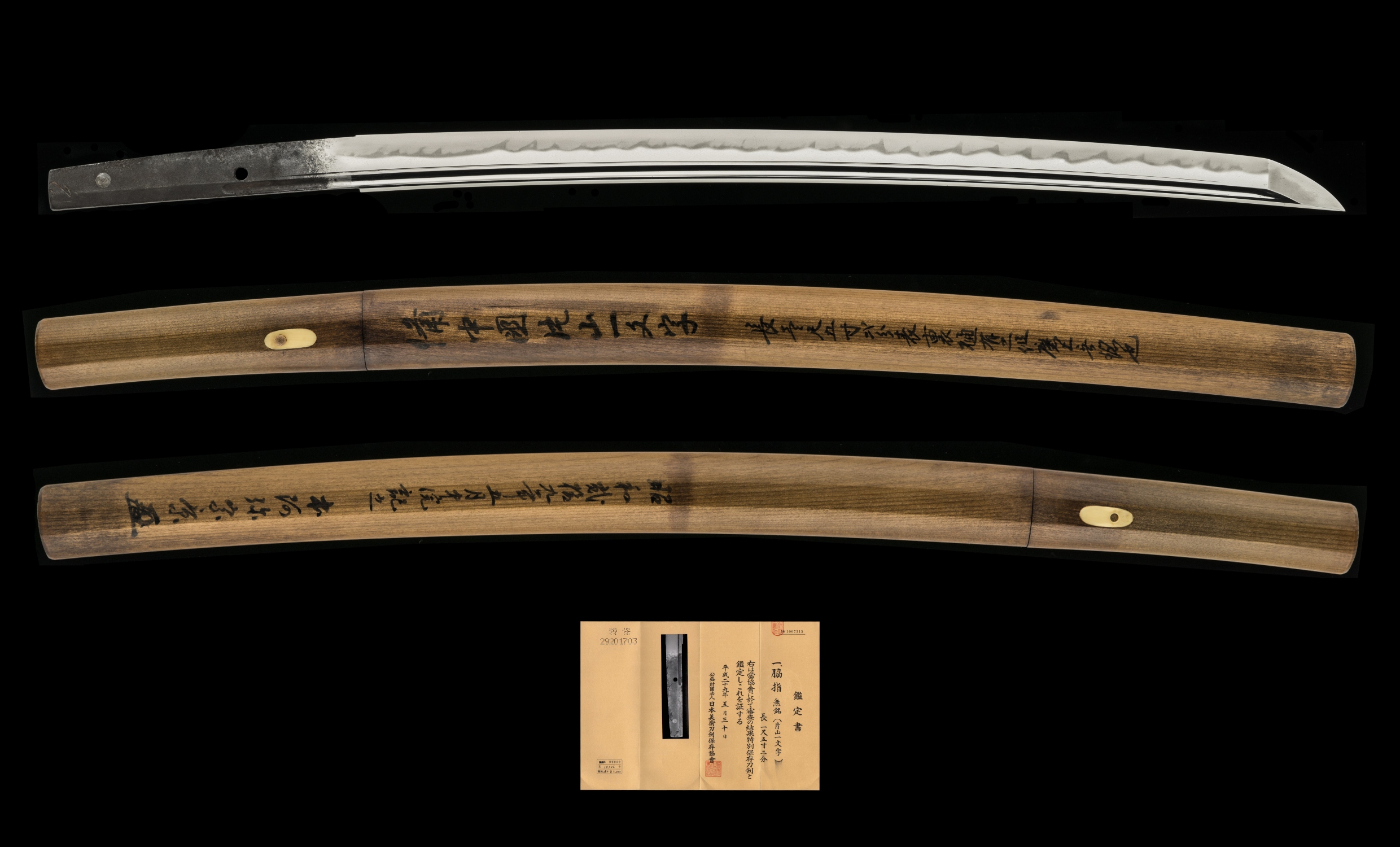
The name *Ichimonji* – written with the single kanji character for “one” – carried a meaning that Fujishiro Yoshio translated as *muteki*: no enemy. No blade and no warrior, the scholar wrote, could hope to stand against one who wielded an Ichimonji sword. The Katayama branch of this celebrated lineage worked from the Katayama area of Bitchu province during the late Kamakura to Nambokucho period, and this extraordinary wakizashi is a textbook example of why the school’s reputation endured for centuries. The blade began life as a *tachi* – the remains of a *bonji* character, saved during the shortening process, can still be seen at the tip of the nakago. It was later reduced to its current form through *o-suriage*, a substantial shortening that left the nakago unsigned.
What makes this blade genuinely special is the *hamon*: a spectacular *saka-choji* (slanted clove blossom) that dances along the entire length of the blade like waves in the ocean, exactly as a Katayama Ichimonji blade should. The hardening pattern flows with long *ashi* and *yo*, sweeping continuously into the *boshi* at the tip. The fine *mokume-hada* carries beautiful *chikei* and a vibrant *midare-utsuri* – the smokey reflection billowing towards the *shinogi* that is the hallmark of the finest Bizen steel. A large *kirikomi* battle scar on the spine, intentionally preserved by successive polishers across the centuries, is a badge of honour. On the other side of the blade, a *bo-bi* with *soe-bi* runs down into the nakago, terminating in a rounded *maru-dome*.
The sword carries two layers of authentication that are beyond question. Honami Soukei, 13th generation of the legendary Honami Koumi family – the foremost sword appraisers in Japanese history – inscribed a *sayagaki* on the shirasaya attributing the blade to Bichu no Kuni Katayama Ichimonji, noting the double groove, the o-suriage mumei status, and the nagasa. He signed and sealed it at the end of May 1954. The NBTHK subsequently confirmed the attribution and awarded NBTHK Tokubetsu Hozon certification in 2017. The sword is fitted with a silver *sou yujo yasuri-habaki* (file-marked habaki) of considerable quality.
| Item Number | UJWA227 |
| Sword Type | Wakizashi |
| Attribution | Katayama Ichimonji (mumei, o-suriage) |
| School | Katayama Ichimonji |
| Province | Bitchu |
| Period | Kotô – Late Kamakura to Nambokucho (1260~1390) |
| Nagasa | 46.0cm (o-suriage) |
| Sori | 0.9cm |
| Moto-haba | 2.6cm |
| Weight | 350g |
| Nakago | 14.5cm, o-suriage mumei, 2 mekugi-ana, bo-bi with soe-bi, maru-dome |
| Jihada | Fine mokume-hada with chikei and beautiful midare-utsuri |
| Hamon | Spectacular saka-choji with long ashi and yo |
| Boshi | Saka-choji continuing into the kissaki |
| Certificates | NBTHK Tokubetsu Hozon |
| Sayagaki | Honami Soukei (13th generation, Honami Koumi family) — Bichu no Kuni Katayama Ichimonji, o-suriage mumei, dated end of May, Showa 29 (1954) |
| Habaki | Silver sou yujo yasuri-habaki |
| Catalogue | Catalogue 28 |
| Status | Sold |
| Includes | Shirasaya, fabric bags, stand, kit, DVD, booklet, description |