
ITEM# UJKA470 – Sold
A Norishige Katana (則重)
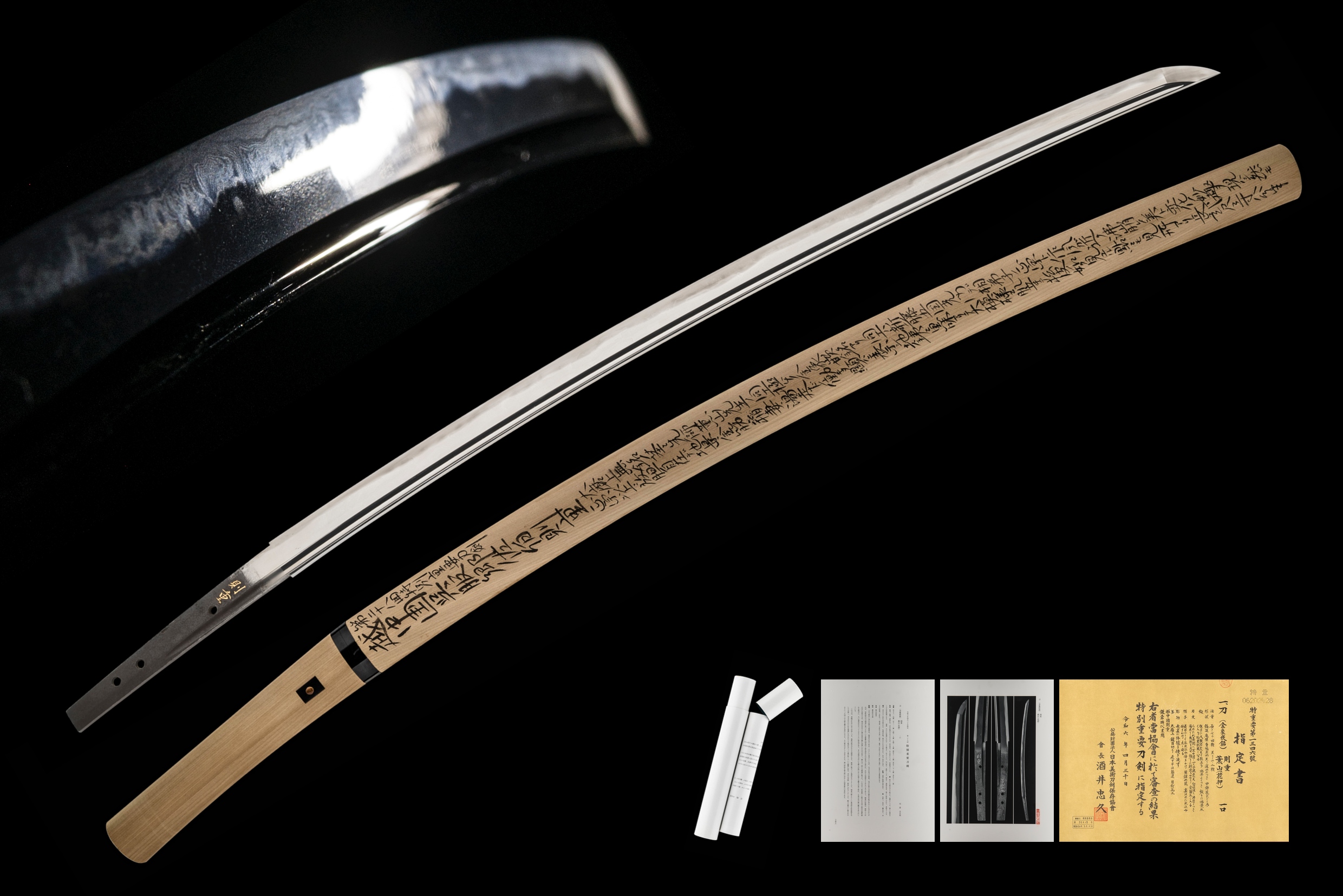
Saeki Norishige (佐伯則重) from Etchû province was one of the most distinguished swordsmiths of the late Kamakura period, active from around the Enkyô era (1308) into the early 1330s. Though occasionally placed among the “Masamune Jittetsu” (Ten Great Disciples of Masamune) in Edo-period texts, modern scholarship more credibly positions him as a direct disciple of Shintôgo Kunimitsu – a peer to Masamune and Yukimitsu rather than a follower, all sharing roots in the powerful Sôshû-den tradition. His hallmark is the matsukawa-hada, a dramatically large, flowing itame with visible layering and prolific chikei – a rugged, tactile surface unlike anything else in Japanese sword-making. His hamon shows vibrant variation: softly undulating notare with mixed gunome and chôji, thick nie breaking into bold sunagashi, kinsuji, and nie-kuzure, the bôshi frequently sweeping up with vigorous hakikake.
This katana is a mature example at the height of Norishige’s artistry. It carries a deep sori, strong matsukawa-hada, and prominent chikei throughout. The steel has a fine wet appearance that speaks clearly to the blade’s overall health. The hamon flows in notare with gunome and chôji elements, densely covered in nie and rich in sunagashi and kinsuji – rhythmic and forceful, the work of a smith in full command. The blade is ô-suriage (greatly shortened) and has been certified by the NBTHK as a Tokubetsu-Jûyô-Tôken at the 28th session in 2024, placing it among Japan’s most important swords.
The nakago bears a kinzôgan (gold-inlaid) inscription preserving the attribution judgment of Honma Kunzan (本間薫山), preeminent 20th-century sword scholar and former head of the NBTHK. The inlay was applied by the 2nd generation Gassan Sadakazu, a Living National Treasure – making this inscription not only a mark of scholarly authority but a highly prized feature in its own right. The shirasaya carries a Kunzan sayagaki (August 1976) and a further sayagaki by Tanobe Michihiro (June 2025). This sword was formerly in the collection of Mr. Koizumi Tomitarô, who once served as Executive Director of the NBTHK.
| Item Number | UJKA470 |
| Sword Type | Katana |
| Attribution | Norishige (mumei, ô-suriage) |
| School | Saeki school, Etchû province (Sôshû-den tradition) |
| Province | Etchû |
| Period | Kotô – Late Kamakura period (Genkô era: 1321-1324) |
| Nagasa | 72.4 cm |
| Sori | 2.2 cm |
| Moto-haba | 2.9 cm |
| Weight | 665 g |
| Nakago | Ô-suriage; kiri-yasurime upper half, sujikai-yasurime lower half (Keichô-suriage style); three mekugi-ana; kinzôgan attribution by Honma Kunzan, applied by 2nd gen. Gassan Sadakazu |
| Jihada | Itame mixed with standing-out ô-itame (matsukawa-hada), plenty of ji-nie, thick chikei; steel is somewhat blackish |
| Hamon | Nie-laden ko-notare-chô mixed with gunome and chôji; deep nioiguchi; thick nie; many yubashiri and tobiyaki; abundant sunagashi and thick kinsuji |
| Boshi | Omote: midare-komi with hakikake tending to yakitsume; ura: notare-komi with hakikake and brief maru-kaeri |
| Certificates | NBTHK Tokubetsu Jûyô Tôken (28th session, April 30, 2024) |
| Sayagaki | Honma Kunzan – Saeki Norishige, ô-suriage, blade length 72.4 cm, dated Shôwa hinoe-tatsudoshi hazuki (August 1976) + monogram; Tanobe Michihiro – Etchû no Kuni Gofuku-gô Saeki Norishige, dated Reiwa kinoto-mi matsukaze-zuki (June 2025) + monogram |
| Habaki | Gold habaki with copper ground |
| Status | Sold |
| Includes | Shirasaya with Kunzan and Tanobe sayagaki, fabric bags, sword stand, maintenance kit, printed description |