
ITEM# UJKA456 – Catalogue 44 – Sold
A Morikuni Katana (和泉守源盛国造之)
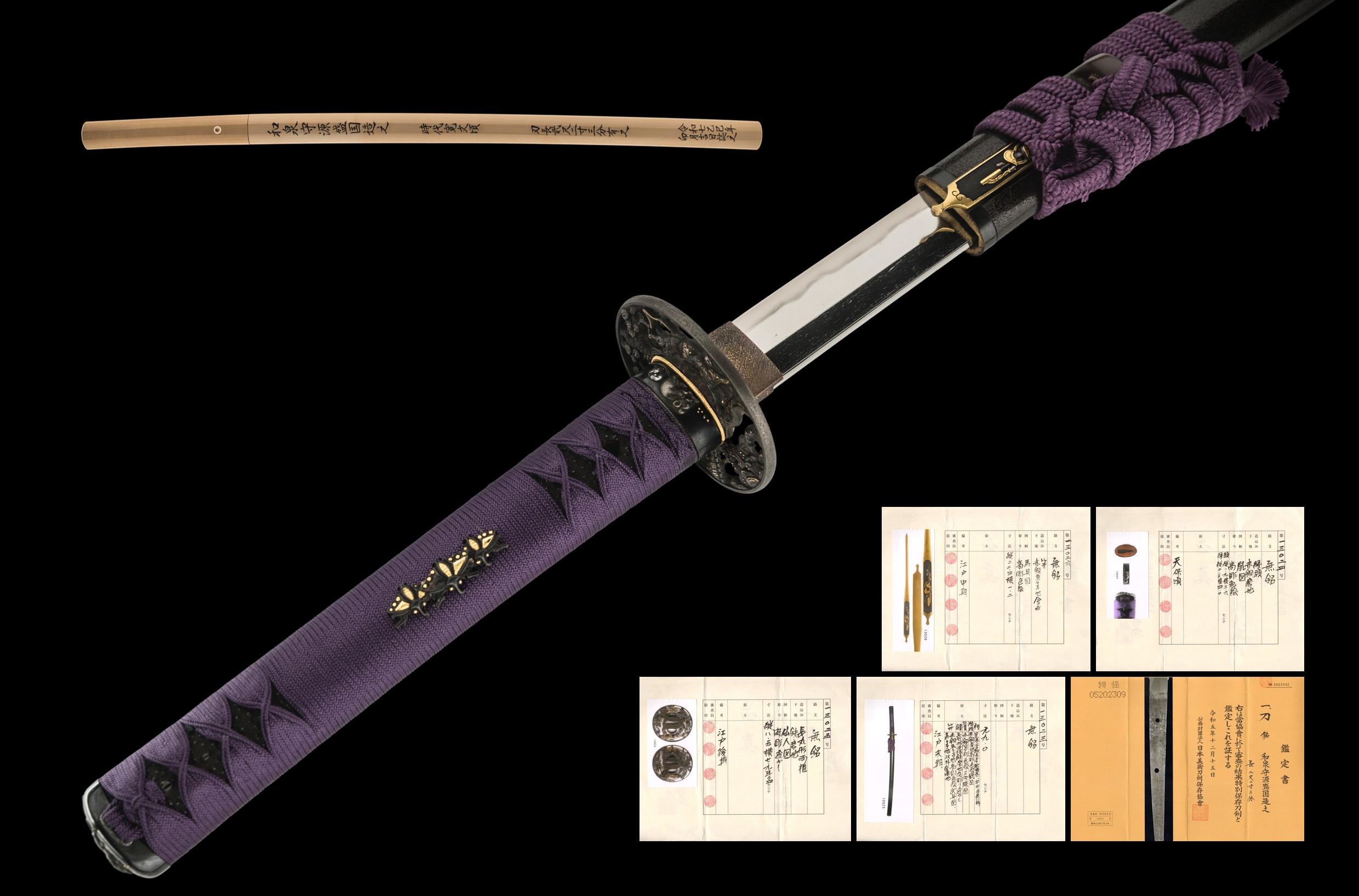
Izumi no Kami Morikuni hailed from Kai province, near Mount Fuji, and was originally a smith of the Akasaka Senjuin lineage. He moved to the capital Edo to study under Izumi no Kami Kaneshige (和泉守兼重), where he was a fellow student of the grandmaster Nagasone Kotetsu (長曾祢虎徹) – a comparison drawn often between the two, as their work shares the same vigour and refinement. Morikuni first signed with the name Namen Morimasa before coming to be known as Edo Senjuin, and he is correctly ranked jô-saku by Fujishiro: a superior swordsmith in every sense.
This katana carries that superiority in plain sight. The expertly forged mokume and itame-hada are alive with chikei, providing a rich and active foundation for the brilliant gunome-midare hamon – its long, pointed ashi driving deep into the blade with impressive energy. The nioguchi is wide and bright, lending the hamon a muscular, confident character that typifies Morikuni at his best. The nakago is suriage – shortened – yet the signature remains perfectly intact, and the fact that NBTHK awarded Tokubetsu Hozon despite the shortening speaks clearly to the quality of the blade.
The Edo koshirae is a delight in its own right. The iron openwork tsuba was crafted by Mogarashi Sôten of Gôshû (Ômi) province, its surface richly inlaid with gold and carved with sages in contemplative thought amid cresting waves and flowering plum. The fuchi-kashira, attributed to Ishiguro Masaaki, depicts a mother rat and young in beautifully detailed shakudô – the rat a symbol of prosperity and good fortune. Three golden butterflies form the menuki on the purple jabara-maki tsuka, representing joy and longevity; together they make this a sword of real character and charm.
| Item Number | UJKA456 |
| Sword Type | Katana |
| Swordsmith | Izumi no Kami Minamoto Morikuni (Shodai, first generation) |
| Swordsmith (JP) | 和泉守源盛国 |
| Signature | Izumi no Kami Minamoto Morikuni kore o tsukuru |
| School | Edo Senjuin (Akasaka Senjuin lineage) |
| Province | Kai (origin); worked in Musashi (Edo) |
| Period | Shintô – Early Edo period (Kanbun era: 1661-1673) |
| Nagasa | 67.6cm (suriage) |
| Sori | 0.45cm |
| Moto-haba | 2.87cm |
| Weight | 705g |
| Nakago | Suriage (shortened tang); sujikai-yasurime (lower), kiri-yasurime (upper); 2 mekugi-ana |
| Jihada | Mokume mixed with itame, with plentiful chikei |
| Hamon | Gunome-midare with sunagashi and long pointed ashi; wide, bright nioguchi |
| Certificates | NBTHK Tokubetsu Hozon; NTHK-NPO Kanteishô (koshirae, fuchi-kashira and tsuba) |
| Fujishiro Rank | Jô-saku |
| Sayagaki | Nozomi-san (shôdo artist) – inscribed in the 4th month, Reiwa 7 (April 2025) |
| Koshirae | Edo koshirae |
| Tsuba | Mogarashi Sôten (Gôshû/Ômi province); iron openwork with gold inlay; sages in contemplative thought; late Edo period; NTHK-NPO Kanteishô |
| Fuchi-kashira | Attributed to Ishiguro Masaaki; rats (prosperity and good fortune); NTHK-NPO Kanteishô |
| Menuki | Three butterflies (joy and longevity); gold |
| Tsuka | Purple jabara-maki braided silk (katate-maki) |
| Habaki | Copper with rainfall file marks |
| Catalogue | Catalogue 44 |
| Status | Sold |
| Includes | Shirasaya, Edo koshirae, fabric bags, stand, kit, printed description |