
ITEM# UJKA397 – Catalogue 37 – Sold
A Nobukuni Yoshimasa Katana (筑前住源信国吉政之作)
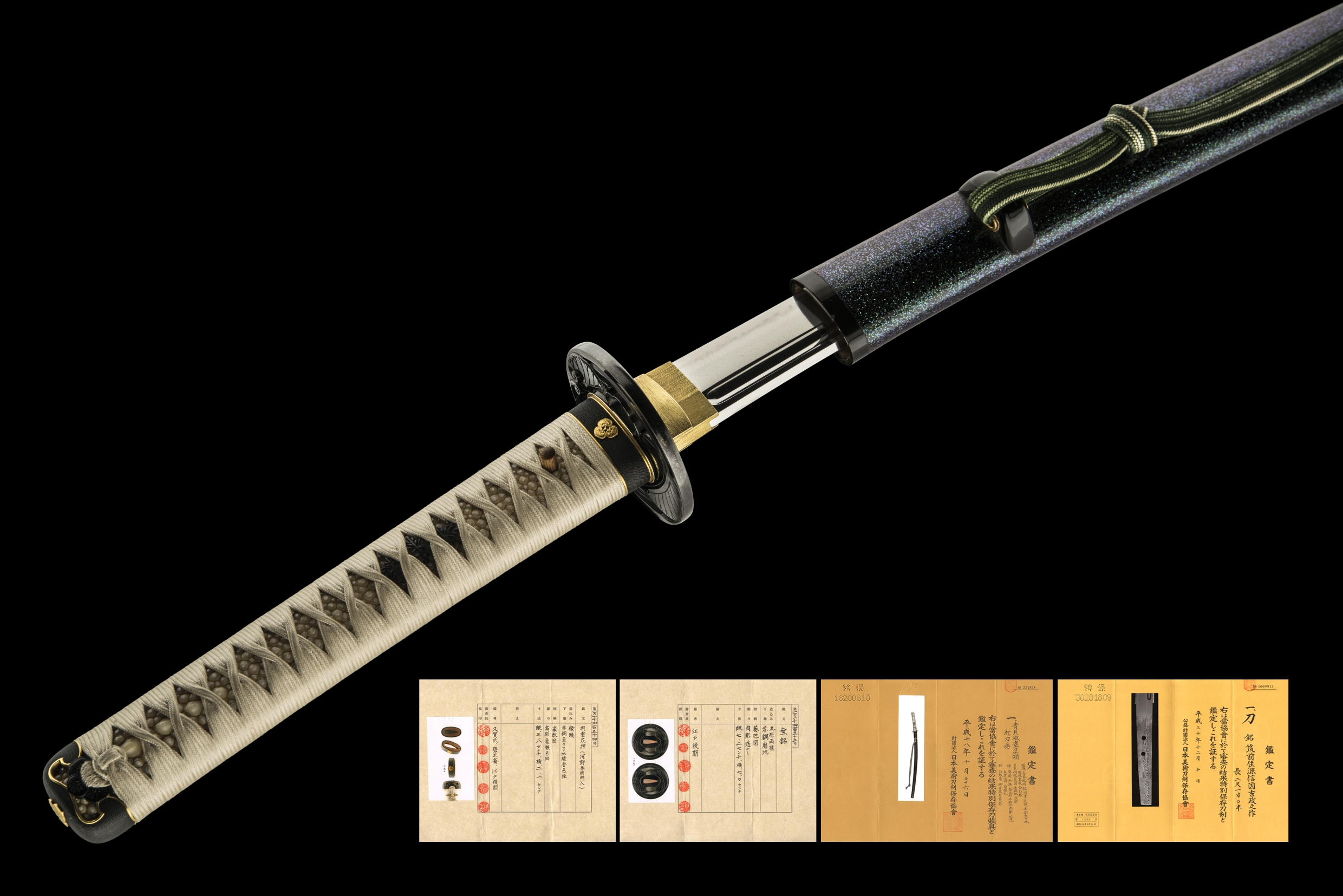
The Chikuzen Nobukuni school was founded during the Shintô era by Nobukuni Yoshisada, who traced his lineage back twelve generations to the legendary smiths of Yamashiro and Tsukushi Nobukuni. Succession ultimately passed to Yoshisada’s younger son, the second-generation Yoshimasa – maker of this katana – after his elder brother abandoned the school to study under the Bizen Ichimonji tradition. Born Nobukuni Heishirô in 1622, Yoshimasa worked through the Kanbun era and died in August 1688. Fujishiro ranks him as a jô-saku smith, a designation borne out in every aspect of this blade.
The steel is immediately commanding. A densely forged ko-mokume hada resembling the rice-bran texture of konuka-hada – closely associated with the neighbouring Hizen tradition – shimmers with ji-nie and flowing chikei. The hamon is a brilliant ko-chôji midare in fine ko-nie deki, characteristically wide for the school, with kinsuji striking through like lightning, diagonal saka-ashi, and drifting sunagashi. A bo-bi groove runs the length of the blade, terminating above the ha-machi in a rounded maru-dome. The nakago is suriage (shortened), with kiri-yasurime file marks, retaining the full signature confirmed against reference oshigata. Both the sword and koshirae carry NBTHK Tokubetsu Hozon certification.
The koshirae is exceptional and carries its own provenance. Trusted sources have confirmed it was inherited through the Owari Tokugawa family, one of the three senior Tokugawa branch families, and the evidence is plain in every fitting: the aoi-mon hollyhock crest of the ruling shogunate appears throughout. The saya is finished in aogai-mijin-nuri lacquer – crushed mother-of-pearl suspended in black lacquer – that erupts into a spectacular iridescent light show from every angle. The polished shakudô tsuba in an interlocked aoi-mon design has been attributed by NTHK-NPO certificate to Umetada Narimasa, who worked in Edo between roughly 1780 and 1820. The fuchi-kashira, signed by Akishige – a student of master Kôno Haruaki, founder of the prestigious Kôno school – displays first-class nanako, gold, and shakudô work. The menuki carry the kiri-mon (paulownia crest) in shakudô. The original torokusho (registration card) survives, numbered just 11,260 – among the very first swords formally registered in Japan in 1951, registered in Tokyo, strongly suggesting it came directly from a prominent former daimyô family.
| Item Number | UJKA397 |
| Sword Type | Katana |
| Swordsmith | Minamoto Nobukuni Yoshimasa (second generation) |
| Swordsmith (JP) | 源信国吉政 (二代) |
| Signature | Chikuzen-jû Minamoto Nobukuni Yoshimasa kore o tsukuru |
| School | Chikuzen Nobukuni |
| Province | Chikuzen |
| Period | Shintô – Early Edo (Kanbun era: 1661-1673) |
| Nagasa | 63.9cm |
| Sori | 2.12cm |
| Moto-haba | 2.87cm |
| Weight | 555g |
| Nakago | Suriage (shortened), kiri-yasurime, 16.0cm, 2 mekugi-ana |
| Jihada | Dense ko-mokume hada resembling konuka-hada, with ji-nie and chikei |
| Hamon | Ko-chôji midare in ko-nie deki with kinsuji, saka-ashi and sunagashi |
| Boshi | Ko-maru |
| Certificates | NBTHK Tokubetsu Hozon (sword & koshirae); NTHK-NPO Kanteisho (tsuba & fuchi-kashira) |
| Fujishiro Rank | Jô-saku |
| Koshirae | Aogai-mijin-nuri saya uchigatana-koshirae, Edo period (attributed Owari Tokugawa provenance) |
| Tsuba | Shakudô, interlocked aoi-mon design; attributed to Umetada Narimasa (Edo, c.1780-1820); NTHK-NPO Kanteisho |
| Fuchi-kashira | Signed Akishige (student of Kôno Haruaki); gold and shakudô nanako work; NTHK-NPO Kanteisho |
| Menuki | Shakudô kiri-mon (paulownia crest) |
| Tsuka | White silk braid over same (stingray skin) |
| Habaki | Gold-wrapped ni-ju habaki |
| Catalogue | Catalogue 37 |
| Status | Sold |
| Includes | Shirasaya (ivory fittings to be replaced with buffalo horn prior to export), Edo period koshirae, bag, stand, kit, booklet, printed description |