
ITEM# UJKA396 – Catalogue 37 – Sold
An Iesuke Tachi (家助)
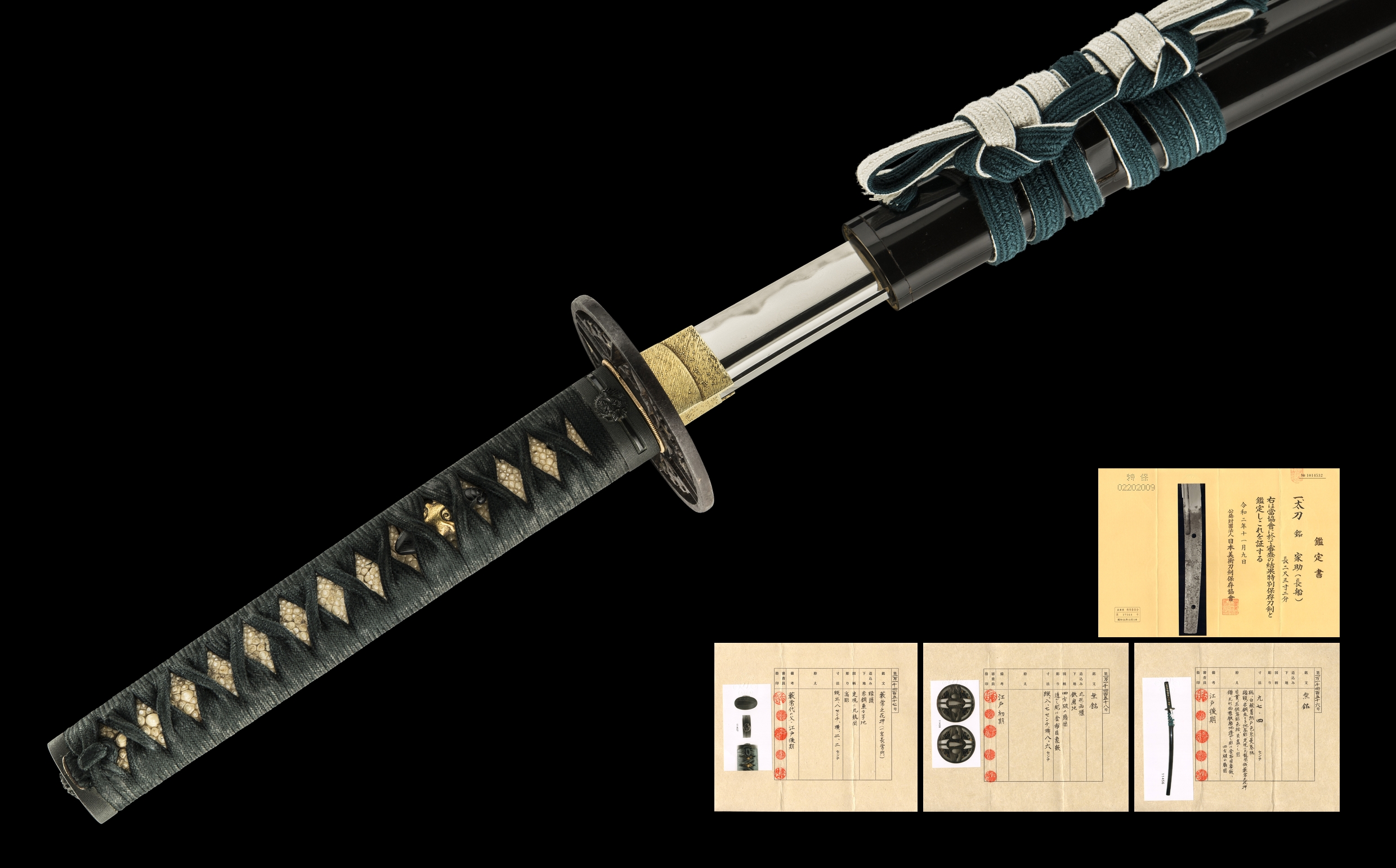
Here is a tachi with nothing left to prove. Forged by swordsmith Iesuke of the Kozori group some 600 years ago, this blade carries the unmistakable hallmarks of the Bizen tradition – a gorgeous flowing jihada of itame and nagare, a bold straight bô-utsuri, and a lively gunome-chôji-midare hamon with the distinctive kanitsume “crab claw” formations in the upper cutting zone. The ko-nie deki work is precise and bright. Iesuke is said to be the son of a latter generation Nagamitsu and studied under Morikage, placing him firmly within the late Osafune lineage as it transitioned into the early Muromachi period.
The blade is a suriage-nakago – slightly shortened, most likely during the late Muromachi or early Edo period to serve as a paired daisho partner. A broad bô-bi groove runs the length of the blade, finished with a rounded maru-dome, lightening the sword for speed and agility. At its original length it would have measured approximately 76-77cm – a cavalry tachi built to reach an opponent from horseback. That past is not entirely hidden: a kirikomi battle scar sits on the mune in the monouchi zone, the mark of a defensive parry in actual combat. Sword polishers have left it untouched, as is tradition.
The accompanying Edo-period koshirae is a lacquered gloss-black uchigatana-koshirae of aristocratic refinement. The circular tsuba, attributed to the Kyô-Shoami school and dated 1600-1700, features four “torn fan” cutouts with remnants of nunome-zôgan gold inlay – a design connected to Tokugawa Ieyasu’s resolution after his defeat by Takeda Shingen. The fuchi-kashira are signed by Yabu Tsuneyuki of Osaka, with a dragon-on-ruler motif set against a nanako ground. Shell-themed menuki in the Late Edo style complete a fittings ensemble that speaks to generations of proud ownership.
| Item Number | UJKA396 |
| Sword Type | Tachi |
| Swordsmith | Iesuke (first generation) |
| Swordsmith (JP) | 家助 |
| Signature | Iesuke (Osafune) |
| School | Osafune, Kozori group |
| Province | Bizen |
| Period | Koto – Early Muromachi (Oei era: 1394-1428) |
| Nagasa | 70.2cm |
| Sori | 2.50cm |
| Moto-haba | 2.71cm |
| Weight | 655g |
| Nakago | Suriage (slightly shortened), 19.9cm, 2 mekugi-ana |
| Jihada | Itame-hada and nagare-hada, bo-utsuri, chikei |
| Hamon | Gunome-choji-midare, koshi-no-hiraita, mixed with kanitsume, ko-nie deki |
| Boshi | Ko-maru |
| Certificates | NBTHK Tokubetsu Hozon; NTHK-NPO Kanteisho (koshirae, tsuba and fuchi-kashira designated as Authentic) |
| Fujishiro Rank | Chu-jo-saku |
| Sharpness Rating | Ryo-Wazamono |
| Koshirae | Edo period uchigatana-koshirae, kuro-roiro-nuri saya lacquered in gloss black (Late Edo, 1780-1867) |
| Tsuba | Large circular iron tsuba, Kyo-Shoami school, four torn-fan cutouts with nunome-zogan gold inlay remnants; NTHK-NPO certified, dated 1600-1700 |
| Fuchi-kashira | Signed by Yabu Tsuneyuki (Osaka); dragon on ruler motif, nanako ground; NTHK-NPO certified |
| Menuki | Shell theme, Late Edo period |
| Habaki | Gold-wrapped with diagonal file marks |
| Catalogue | Catalogue 37 |
| Status | Sold |
| Includes | Shirasaya, Edo period koshirae, bag, stand, kit, booklet, printed description |