
ITEM# UJKA373 – Sold
A Hankei Katana (野田繁慶)
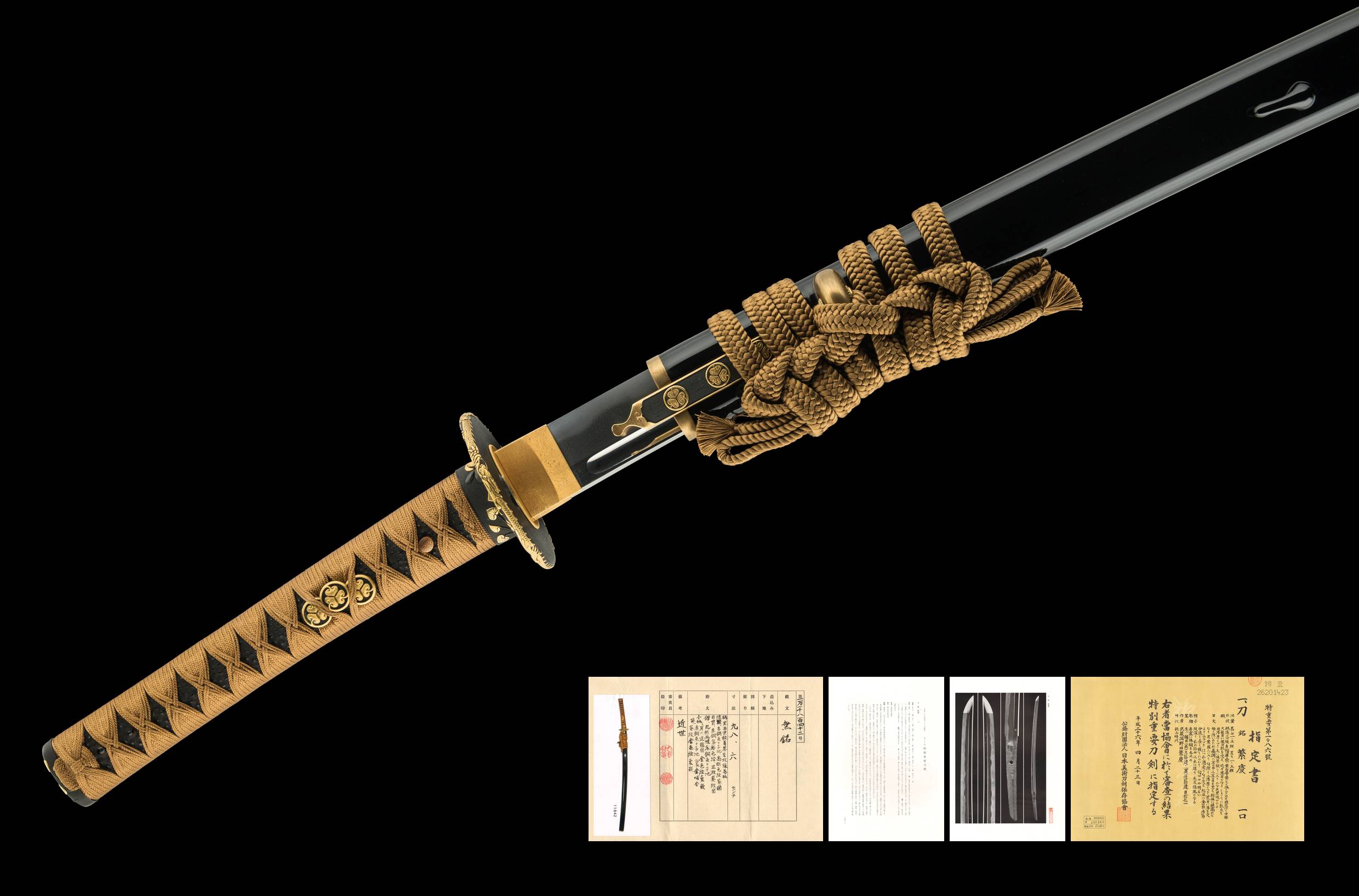
Noda Hankei was born in Mikawa province, his real name Noda Zenshirô Kiyotaka. He began his career as a gunsmith in the service of the Tokugawa family, but with the death of Tokugawa Ieyasu in Genna 2 he moved to Edo and turned his hand to sword-making – one of the pioneers of the new city’s smithing tradition, alongside his contemporary the first generation Yasutsugu. His stylistic ideal was Sôshû Masamune, though in practice his work most closely channels Norishige: a standing-out ô-itame with prominent chikei that gives the steel its uniquely dark, tactile quality, and a notare hamon mixed with gunome laden with nie, sunagashi, kinsuji, and ara-nie.
This katana is a magnificently interpreted masterwork. The jihada is a standing-out itame mixed with mokume and ô-itame, full of ji-nie and thick chikei throughout. The steel is characteristically blackish. The hamon is a gently undulating notare brimming with nie – mixed with gunome, ko-gunome, large midare sections, ashi, yô, ara-nie accumulating to mura-nie in places, hotsure, yubashiri, and long, frequent kinsuji, nie-suji, and sunagashi throughout. The yakiba is wide, with prominent midare. The bôshi is widely hardened with midare-komi, a ko-maru-kaeri, and a tendency to kaen. Both sides carry a bôhi ending in marudome. The NBTHK Tokubetsu Jûyô committee noted this blade as a particularly outstanding example of Hankei’s late work, with its steep mune – another Norishige-derived trait – and its dense yet bold forging structure.
The sword comes in a first-class custom koshirae produced by Unique Japan in the Tokugawa aoi-mon theme, honouring the shogunate the smith once served. The tsuba is a Kyo-kenjo polished iron piece with gold nunome-zogan paulownia blossoms, holding an NBTHK Tokubetsu Hozon certificate and attributed to the mid-Edo period. The fuchi is an aoi-mon fuchi by Inaba no Suke Yoshioka (Yoshioka school, 1700s), holding an NBTHK Hozon certificate for the fuchi-kashira set. The menuki carry a crawling dragon motif, attributed to the Nomura school of the late Edo period. The kozuka and kôgai are an NBTHK Tokubetsu Hozon mitokoromono depicting three hollyhock crests, also attributed to the Yoshioka school.
| Item Number | UJKA373 |
| Sword Type | Katana |
| Swordsmith | Noda Hankei (first generation) |
| Swordsmith (JP) | 野田繁慶 |
| Signature | Hankei (two-character ru-mata style, later career) |
| School | Noda school (Musashi) |
| Province | Musashi |
| Period | Shintô – Momoyama period (around Keichô era: 1596-1615) |
| Nagasa | 71.5 cm |
| Sori | 1.5 cm |
| Moto-haba | 3.0 cm |
| Weight | 670 g |
| Nakago | Ubu; omote side ô-sujikai-yasurime, ura side gyaku-sujikai-yasurime; one mekugi-ana |
| Jihada | Ô-itame mixed with itame and mokume, plenty of ji-nie, thick chikei; steel is blackish |
| Hamon | Nie-laden notare mixed with gunome, ko-gunome, large midare, ashi, yô, ara-nie to mura-nie, hotsure, yubashiri; long kinsuji, nie-suji, and sunagashi throughout; wide, bright nioiguchi |
| Boshi | Deep yaki, widely hardened midare-komi with ko-maru-kaeri and tendency to kaen |
| Certificates | NBTHK Tokubetsu Jûyô Tôken (23rd session, April 23, 2014) |
| Sayagaki | Tanobe Michihiro – designated Tokubetsu-Jûyô, late-career two-character signature, dated Reiwa 2 (May 2020) |
| Koshirae | First-class custom Tokugawa aoi-mon koshirae produced by Unique Japan; black lacquer saya with gold habaki; tan braided ito over black same |
| Tsuba | Kyo-kenjo iron tsuba, gold nunome-zogan paulownia blossoms, mid-Edo period (attributed Kyo-Shoami / Awa-Shoami); NBTHK Tokubetsu Hozon (Reiwa 3, 2021) |
| Fuchi-kashira | Aoi-mon shakudô with gold accents, attributed to Inaba no Suke Yoshioka (1700s); NBTHK Hozon (Heisei 31, 2019) |
| Menuki | Crawling dragon motif, attributed to the Nomura school, late Edo period |
| Habaki | Gold habaki with diagonal file marks |
| Status | Sold |
| Includes | Shirasaya with Tanobe sayagaki, koshirae, fabric bags, sword stand, maintenance kit, printed description |