
ITEM# UJKA358 – Catalogue 33 – Sold
A Ko-Kongôbyôe Katana (古金剛兵衛)
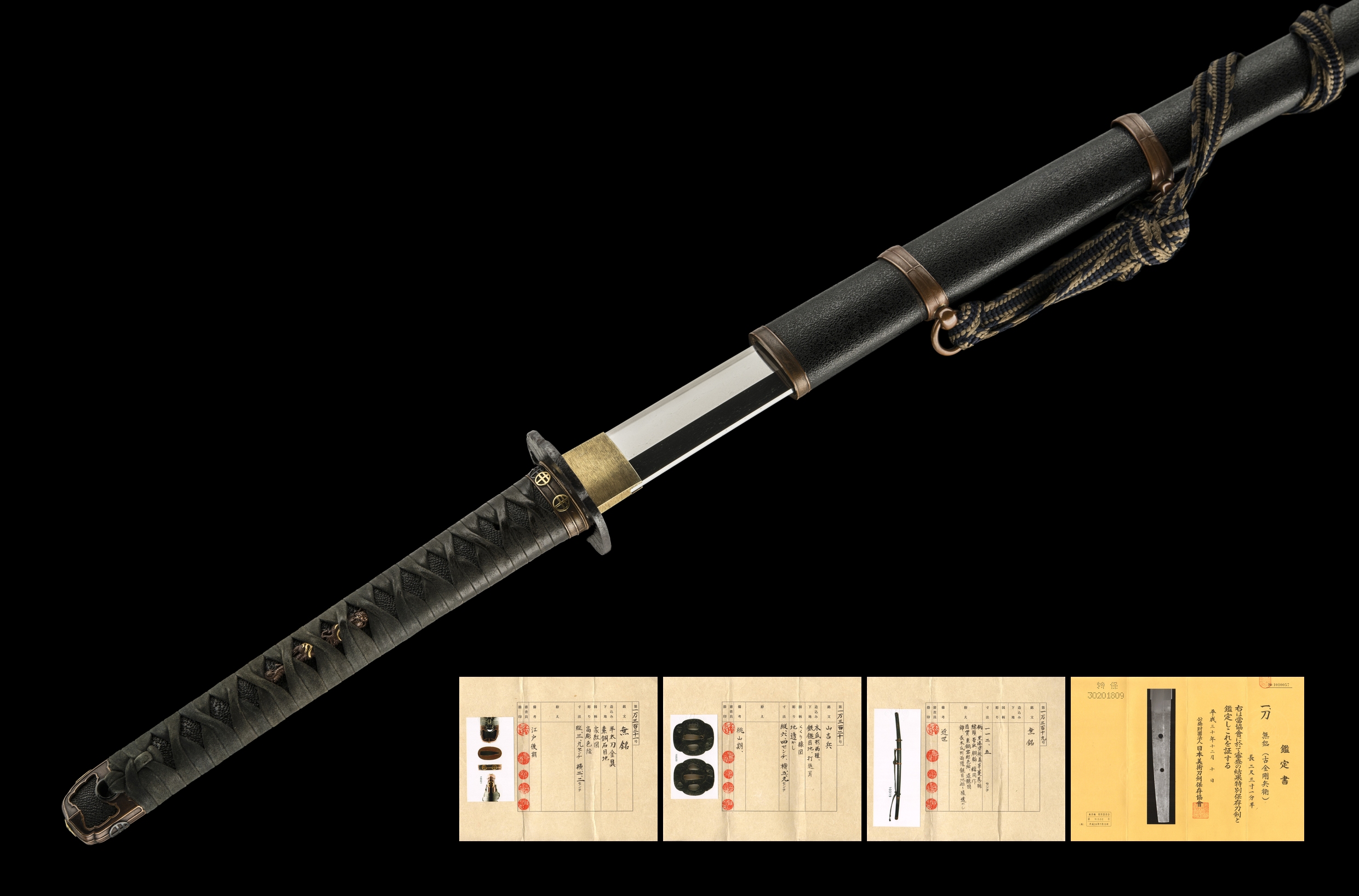
The *Kongôbyôe school* is one of the great warrior-monk traditions of Kyushu, rooted in Chikuzen province where its swordsmiths forged blades for samurai who fought off the Mongol invasions of the Kamakura period. The school was founded by Moritaka and carried on through generations of smiths sharing the “Mori” prefix – Moritoshi, Morikane, Moriyoshi, Morikuni – each inheriting a conservative, highly functional approach shaped by both the Yamato and Yamashiro traditions. The prefix *Ko* places this blade in the early phase of the school, made between the mid-Kamakura period and the end of the Nambokucho period in 1393.
The blade itself is a meaty, authoritative katana with a nagasa of 70.2cm and a confident 1.0cm sori. The *jihada* is a rich mix of mokume and itame that flows into masame-hada, enriched with ji-nie and a light *shirake utsuri* that drifts through the body of the blade. The *hamon* is a precise *hoso-suguha* – a thin, straight temper line held with a tight nioguchi – the signature expression of this school. The nakago is *o-suriage*, greatly shortened at some point in the sword’s long history, with the original signature lost in the process. The shortening was carried out with care; the condition of the tang is clean and gently filed.
The sword comes with a superb set of *Satsuma gunto handachi-koshirae*, its fittings bearing a *kamon* that is a variation of the famous Shimazu daimyo family crest – both the sword’s Naminohira-school attribution via sayagaki and the Satsuma koshirae point to a deep connection with that great southern domain. The rare iron tsuba was made by the second-generation *Yamakichibei* of the Momoyama period, its openwork *kukurizaru* (hanging monkey) design overlaid with rays akin to the Rising Sun. A full set of NTHK-NPO Kanteisho certificates covers the tsuba, kamon fittings, and koshirae. The sayagaki on the shirasaya attributes the blade to *Naminohira Saneyasu*, who worked circa 1352 to 1356.
| Item Number | UJKA358 |
| Sword Type | Katana |
| Attribution | Ko-Kongôbyôe School (mumei, o-suriage) |
| School | Kongôbyôe |
| Province | Chikuzen (Fukuoka, Kyushu) |
| Period | Kotô – Late Kamakura to Nambokucho (mid-1300s) |
| Nagasa | 70.2cm |
| Sori | 1.0cm |
| Moto-haba | 3.2cm |
| Weight | 790g |
| Nakago | O-suriage (greatly shortened, mumei) |
| Jihada | Mokume, itame meeting masame-hada, with ji-nie and light shirake utsuri |
| Hamon | Hoso-suguha (thin straight temper line) with tight nioguchi |
| Sayagaki | Naminohira Saneyasu (薩摩國波平實安) – attributed to Naminohira Saneyasu in Satsuma province, circa 1352-1356; blade length noted as ~70.2cm |
| Certificates | NBTHK Tokubetsu Hozon (blade); NTHK-NPO Kanteisho (tsuba, kamon fittings & koshirae) |
| Koshirae | Satsuma gunto handachi-koshirae with matching stone-surface textured copper fittings bearing Shimazu-variation kamon; crafted in the modern period (Meiji/Taisho era) |
| Tsuba | Iron, openwork kukurizaru (hanging monkey) design with solar rays, signed Yamakichibei (second generation), Momoyama period (circa 1573-1603); NTHK-NPO Kanteisho |
| Fuchi-kashira | Copper with Shimazu-variation kamon in gold and black; NTHK-NPO Kanteisho, attributed to late Edo period (early 1800s) |
| Menuki | Copper with crawling dragon theme; gold accents; hishimaki-style leather wrap |
| Habaki | Not specified |
| Catalogue | Catalogue 33 |
| Status | Sold |
| Includes | Shirasaya, Satsuma gunto koshirae, bags, stand, kit |