
ITEM# UJKA333 – Catalogue 33 – Sold
A Motoshige Katana (元重)
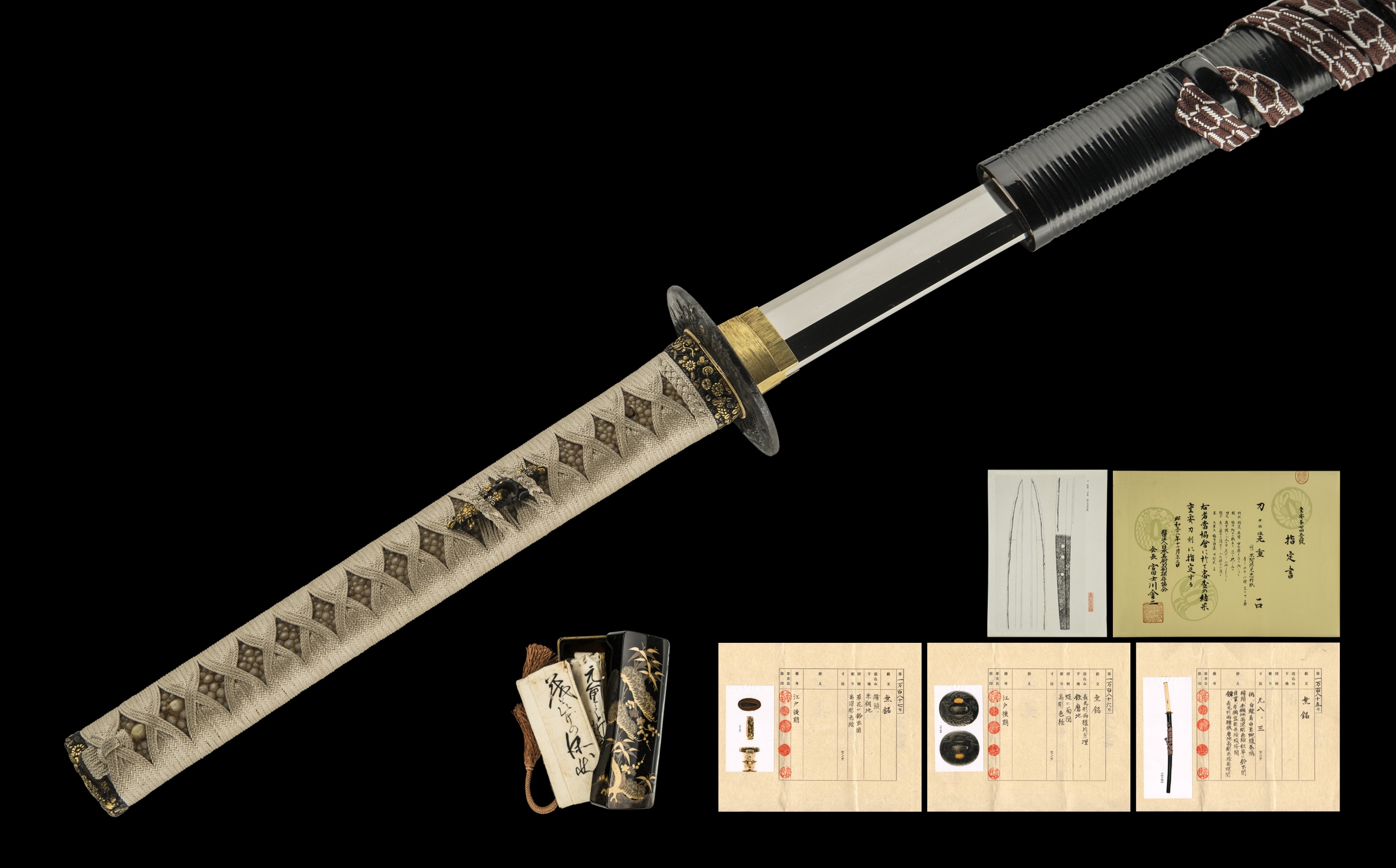
Motoshige is the founder of the Motoshige school in Bizen province, a swordsmith of extraordinary pedigree. The younger brother of Morishige and older brother of Shigezane, he was also the grandson of Moriie – and one of the celebrated “Three Students Great of Sôshû Sadamune,” known as the Sadamune no Santetsu. This lineage shows: Motoshige was a prolific maker with a talent for crafting supremely sharp swords over a long career that began at the end of the Kamakura period and extended into the warring Nambokuchô era, when this katana was produced.
A substantial 10cm ô-kissaki gives this blade an unmistakable aura of power. The well-forged itame hada mixed with mokume stands out clearly under light, with a faint utsuri drifting in the background above the hamon – a hallmark of fine Bizen work. The bright suguha-chô hamon is laden with ko-nie and punctuated by ko-gunome, ashi, and vivid black streaks of kinsuji that bring the blade fully to life. The boshi runs sugu with a hint of notare and a brief ko-maru-kaeri. The nakago is a clean ô-suriage, kirijiri, with three mekugi-ana.
The sword carries remarkable provenance. A rare origami by Hon’ami Kôchû from 1709 values the blade at seven gold pieces, and a further origami dated 1893 adds to the chain of authentication. The sayagaki by Hon’ami Nisshû, dated Shôwa 1979, confirms the attribution and records the blade length. The beautifully crafted koshirae – lacquered black with ribbed saya, white silk tsuka with jabara-maki wrapping, and fittings in a theme of sakura, crickets, chrysanthemums and butterflies – adds considerable class to an already exceptional package. This sword was designated NBTHK Juyo Token at the 30th session.
| Item Number | UJKA333 |
| Sword Type | Katana |
| Attribution | Attributed to Motoshige (mumei, ô-suriage) |
| School | Motoshige school |
| Province | Bizen |
| Period | Nambokuchô period (circa Kenmu-Joji era: 1334-1368) |
| Nagasa | 67.8cm |
| Sori | 1.0cm |
| Moto-haba | 2.87cm |
| Weight | 645g |
| Nakago | Ô-suriage, kirijiri, sujikai-yasurime, three mekugi-ana, mumei |
| Jihada | Finely forged standing-out itame mixed with mokume, with a faint utsuri |
| Hamon | Ko-nie-laden suguha-chô mixed with ko-gunome, ashi, nie-deki and kinsuji |
| Boshi | Sugu with a hint of notare and a brief ko-maru-kaeri |
| Certificates | NBTHK Juyo Token (30th session); NTHK-NPO Kanteisho (koshirae, tsuba and fuchi-kashira) |
| Fujishiro Rank | Jojo-saku |
| Sharpness Rating | Saijo-ô-wazamono |
| Sayagaki | Hon’ami Nisshû — Bizen no Kuni Motoshige, ô-suriage mumei, dated Joiji era (1362-1368), with reference to Hon’ami Kôchû origami, dated Shôwa 1979 |
| Koshirae | Kuro-ro-iro-nuri ichibu-kizami saya uchigatana-koshirae (黒呂色塗一分刻鞘打刀拵え) – lacquered in glossy black with saya ribbed every 1-bu; white silk jabara-maki tsuka; Showa period (1926-1989) |
| Tsuba | Polished iron, attributed to Nakai Ariyuki, Chôshû province, late Edo period; butterfly and chrysanthemum motif with gold-filled hitsu-ana; NTHK-NPO Kanteisho |
| Fuchi-kashira | Attributed to Mino school, late Edo period (1780-1867); floral motif with gold highlights |
| Menuki | Floral theme with gold highlights |
| Habaki | Gold ni-ju habaki with fine file marks |
| Catalogue | Catalogue 33 |
| Status | Sold |
| Includes | Shirasaya with sayagaki, koshirae, sword bags, stand, kit, DVD, booklet, description, Hon’ami Kôchû origami (1709), origami (1893) |