
ITEM# UJKA328 – Catalogue 31 – Sold
An Aoe Yoshitsugu Katana (青江吉次)
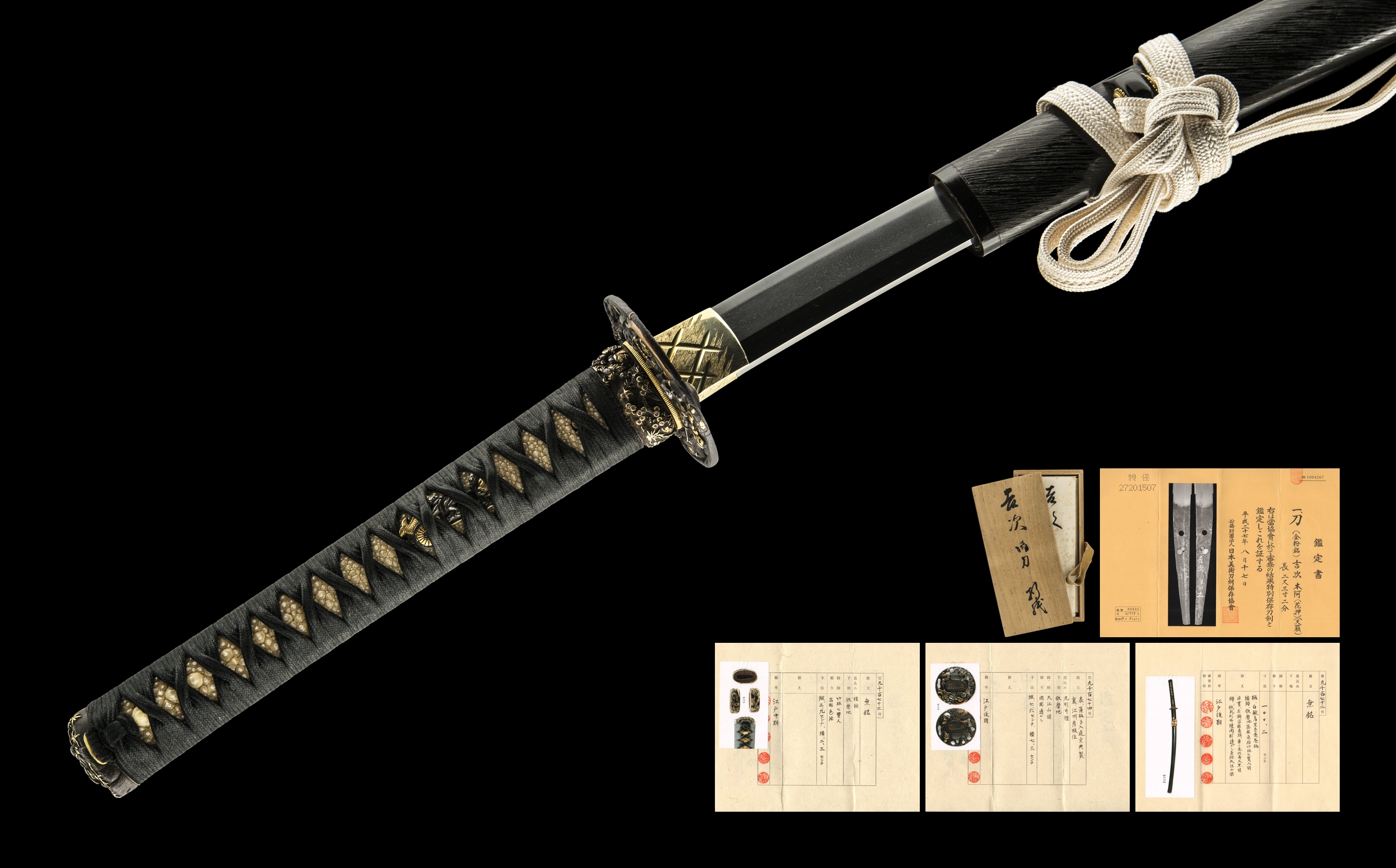
Yoshitsugu of the prestigious Aoe school ranks among the finest swordsmiths of the late Kamakura period, rated jojo-saku – highly superior – by Fujishiro. Said to be the son of Tôshichirô Yoshitsugu, he bore the honorary title of Uemon no Jô, later raised to Saemon no Jô during the Karyaku era. Dated signatures are recorded from the second year of the Genkô era (1322) through to the Kôei era (1342-1345), placing this blade squarely within his productive period. Certain works by Yoshitsugu have attained Tokubetsu Jûyô, Jûyô Bijutsuhin, and Jûyô Bunkazai status, making this attribution one of considerable significance.
The blade was first attributed to Yoshitsugu by Hon’ami Tenrai in 1935, who signed the ô-suriage nakago in gold inlay (kinpun-mei) and prepared both a washi-paper origami and a fine hakogaki – signed wooden box. Tanobe Michihiro later examined the blade and added a comprehensive sayagaki confirming the attribution. The steel displays all the hallmarks that collectors associate with the Aoe school: a ko-itame-hada interspersed with the distinctive namazu-hada (catfish skin) – dark clustering spots of nie in the body – and clear dan-utsuri, the layered linear reflection in the ji that is so characteristic of this tradition. The hamon is a bright suguha-chô worked in fine ko-nie, slanting in places to form saka-chôji, adding further elegance to the temper line.
The sword is presented in a superb late Edo period uchigatana-koshirae with a structured glossy black-lacquer saya sprinkled with mother-of-pearl accents. The kojiri is rendered in intricate plum blossom metalwork, the tsuba is signed Goshu Soheishi Nyudo Soten and depicts the legend of Shuten-doji, and the fuchi-kashira is attributed to Mogarashi Sôten in Edo (1700-1780) with the Seven Sages of the Bamboo Grove motif. The menuki show Ebisu-ten and Daikoku-ten on a cart. All koshirae fittings hold NTHK-NPO Kanteisho certificates of authenticity.
| Item Number | UJKA328 |
| Sword Type | Katana |
| Attribution | Attributed to Aoe Yoshitsugu (o-suriage mumei, attribution by Hon’ami Tenrai) |
| School | Aoe |
| Province | Bitchû |
| Period | Kotô – Late Kamakura (circa 1326-1329) |
| Nagasa | 70.3cm |
| Sori | 1.6cm |
| Moto-haba | 2.8cm |
| Weight | 710g |
| Nakago | Ô-suriage, gold inlay (kinpun-mei) attribution by Hon’ami Tenrai, 1 mekugi-ana |
| Jihada | Ko-itame-hada with namazu-hada (catfish skin), chikei and dan-utsuri |
| Hamon | Suguha-chô mixed with saka-chôji in ko-nie deki |
| Certificates | NBTHK Tokubetsu Hozon; NTHK-NPO Kanteisho (koshirae, tsuba & fuchi-kashira) |
| Fujishiro Rank | Jojo-saku |
| Sayagaki | Tanobe Michihiro — Bitchû no Kuni Aoe Yoshitsugu, dated Heisei 27, December (2015) |
| Koshirae | Late Edo uchigatana-koshirae (aogai-mijin kuro-ro-kawari-saya), circa 1780-1867; NTHK-NPO Kanteisho certified |
| Tsuba | Polished iron, signed Goshu Soheishi Nyudo Soten; Shuten-doji design with gold inlay; Late Edo period; NTHK-NPO Kanteisho certified |
| Fuchi-kashira | Attributed to Mogarashi Sôten, Edo (1700-1780); Seven Sages of the Bamboo Grove (Chikurin nana-kenjin) motif; NTHK-NPO Kanteisho certified |
| Menuki | Ebisu-ten and Daikoku-ten on a cart |
| Catalogue | Catalogue 31 |
| Status | Sold |
| Includes | Shirasaya, Edo koshirae, bags, stand, kit, DVD, booklet, printed description, origami and hakogaki by Hon’ami Tenrai |