
ITEM# UJKA327 – Catalogue 31 – Sold
A Jumyô Katana (常陸守藤原寿命)
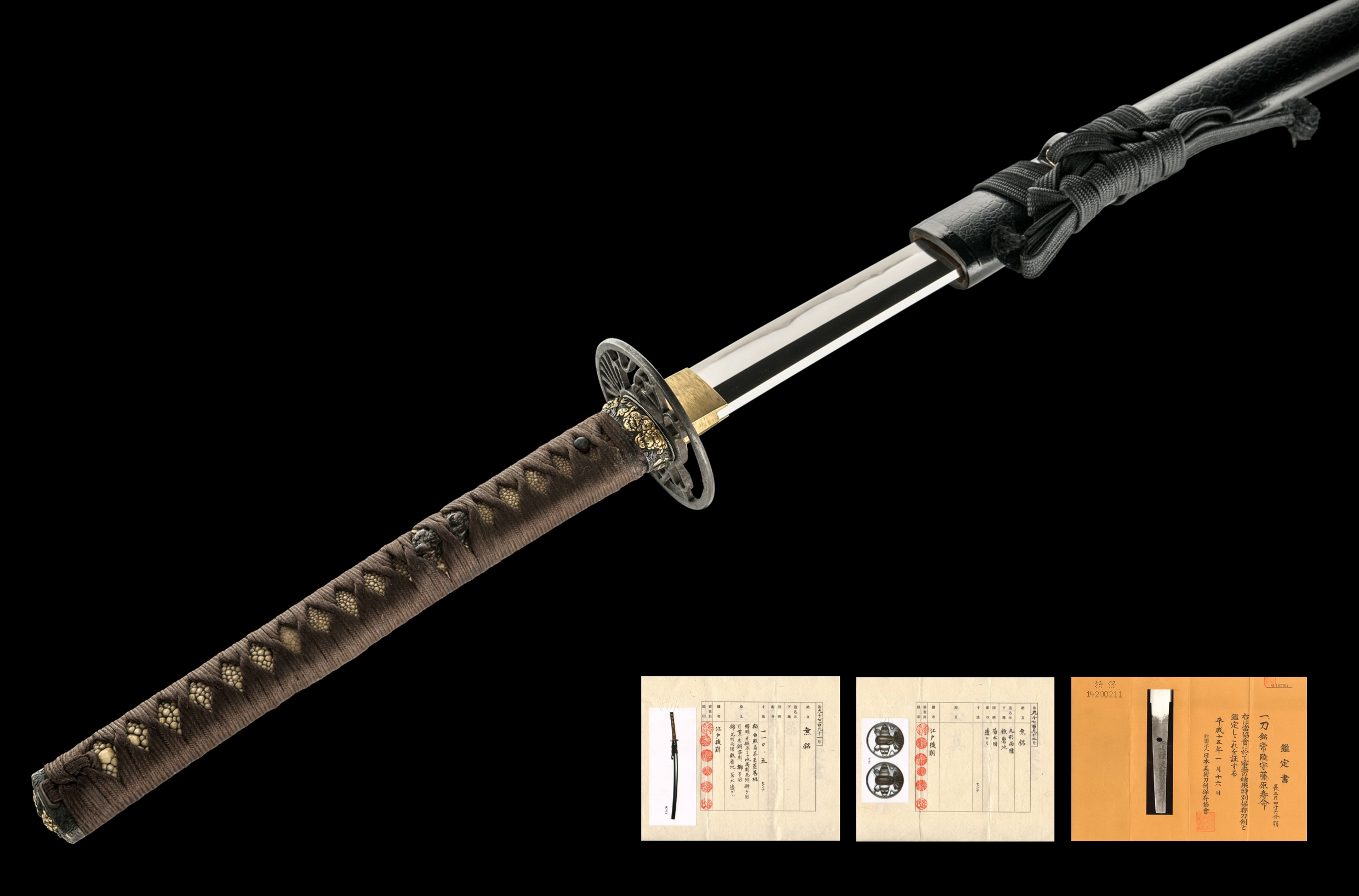
The Jumyô school traces its origins to Yamato province (modern Nara) before relocating to Mino during the Kamakura period, eventually settling in Shimizu in Mino province under the long patronage of the Owari Tokugawa clans. The name Jumyô – written with the characters for *kotobuki* (congratulations) and *inochi* (life) – translates as “happy [long] life,” and blades bearing this signature were prized as auspicious gifts to *daimyô* families. This long, well-proportioned katana dates to the Middle Edo period, circa the Kyôho era, and carries the full signed title of *Hitachi no Kami Fujiwara Jumyô* – Lord of Hitachi province, of the Fujiwara clan, Jumyô.
The blade’s character is thoroughly Mino in tradition: a bright *gunome-midare hamon* in rich *ko-nie deki* with rhythmic *togari* peaks, active *ashi*, *kinsuji* formations, and brushed *sunagashi* threading through the temper line. The *jihada* is a tight *itame-hada* with a quality that rewards careful examination under light. The *boshi* is a refined *hakikake* with a small turnback (*ko-maru*), requiring considerable skill from the smith. Despite a slight trim at the *nakago-jiri* – approximately 2cm removed to fit a desired *tsuka* at some point in the sword’s history – the full *mei* survives perfectly intact.
The provenance of this katana is exceptional. It carries a *sayagaki* written personally by Dr. Honma Junji (1904-1991), known as Kunzan, the former director of the NBTHK and the foremost sword scholar of the 20th century. Honma gifted this katana to his brother-in-law Mori Kazuo – an inscription on the shirasaya reads *”Mori Kazuo-kei no tame”* (for my brother-in-law Mori Kazuo), with the attribution title *Iehisa Yokei Jumyô* (Fortunate Family Heredity Jumyô). It was very likely a wedding present, given the auspicious nature of the Jumyô signature. The *koshirae* is an Edo-period *uchigatana* mounting lacquered in black with a distinctive leather-like textured *saya* (*kawa-omote-fû kuro-kawari-nuri*), and a cast iron *tsuba* in *sukashi* design depicting the *kikusui* crest – chrysanthemum and water – associated with the legendary samurai Kusunoki Masashige. Both the *tsuba* and the koshirae carry NTHK-NPO Kanteishô certificates of authenticity.
| Item Number | UJKA327 |
| Sword Type | Katana |
| Swordsmith | Hitachi no Kami Fujiwara Jumyô |
| Swordsmith (JP) | 常陸守藤原寿命 |
| Signature | Hitachi no Kami Fujiwara Jumyô |
| School | Jumyô |
| Province | Mino (Shimizu, present-day Gifu) |
| Period | Shintô – Middle Edo period (circa Kyôho era: 1716-1736) |
| Nagasa | 74.6cm |
| Sori | 1.5cm |
| Moto-haba | 3.17cm |
| Weight | 765g |
| Nakago | Ubu (trimmed approximately 2cm at nakago-jiri); kiri-yasurime (horizontal file marks); 1 mekugi-ana |
| Jihada | Itame-hada in ko-nie deki |
| Hamon | Gunome-midare with rhythmic togari, ashi, kinsuji and sunagashi |
| Boshi | Hakikake (brushed) with ko-maru turnback |
| Certificates | NBTHK Tokubetsu Hozon; NTHK-NPO Kanteishô (Edo period tsuba and koshirae) |
| Sayagaki | Honma Junji (Kunzan) — Iehisa Yokei Jumyô, gifted to Mori Kazuo; inscribed by Kunzan Honma Jun[ji] |
| Koshirae | Edo period uchigatana-koshirae; kawa-omote-fû kuro-kawari-nuri saya (black lacquer with leather-like textured finish); Late Edo period (circa 1780-1867); NTHK-NPO Kanteishô certified |
| Tsuba | Cast iron, sukashi (openwork) kikusui design (chrysanthemum and water) – kamon of Kusunoki Masashige; Late Edo period; NTHK-NPO Kanteishô certified |
| Catalogue | Catalogue 31 |
| Status | Sold |
| Includes | Shirasaya, Edo koshirae, bags, stand, kit, DVD, booklet, printed description |