
ITEM# UJKA293 – Catalogue 29 – Sold
A Sa Yukihide Katana (筑州住左行秀鍛之)
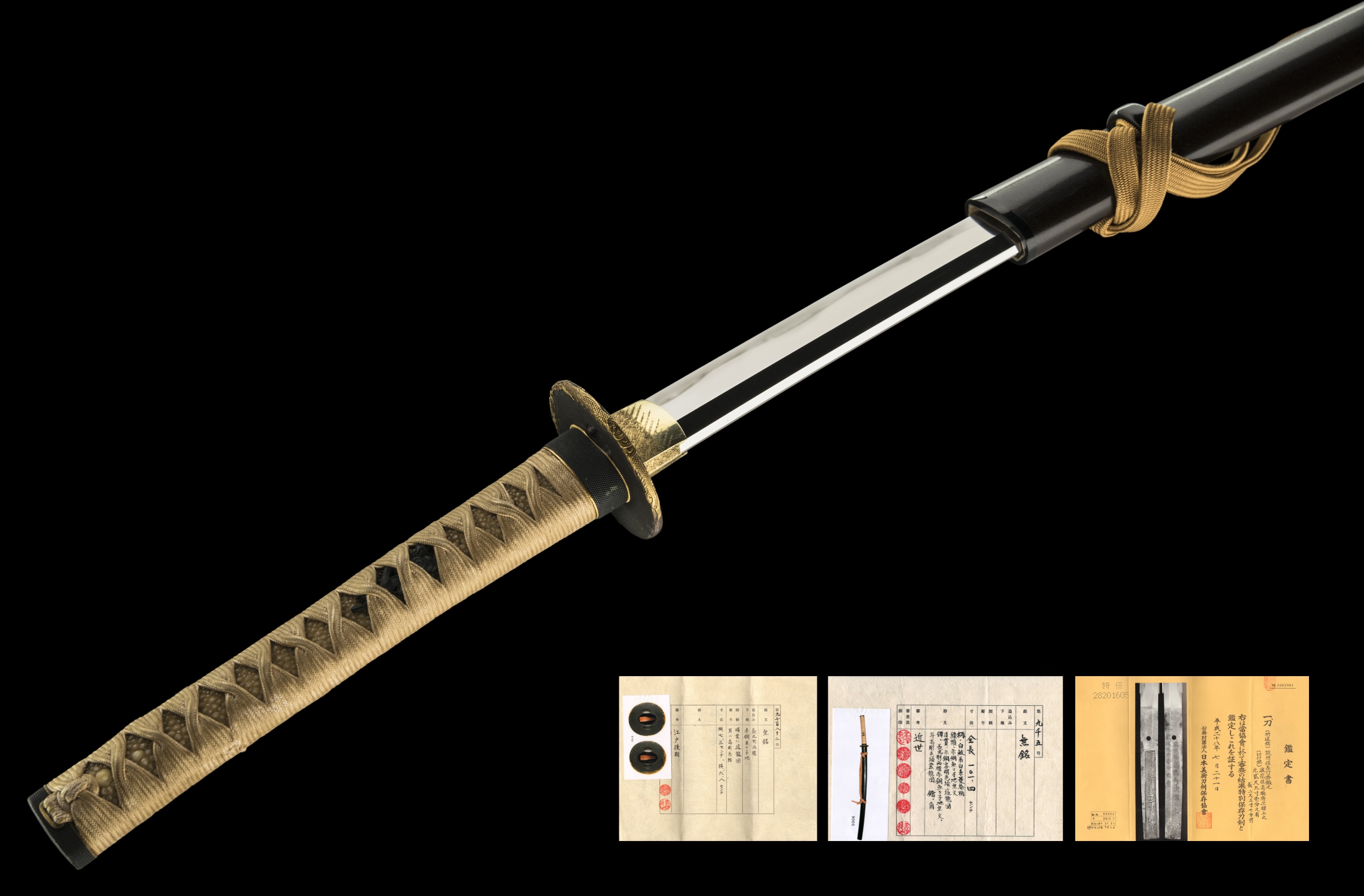
Born in 1813 in Chikuzen province, Kyushu, Sa Yukihide stands among the most celebrated swordsmiths of the shinshintô period. He regarded himself as the thirty-ninth generation successor of the great Sa (Samonji), who forged in Chikuzen in the early 1300s. After training under Shimizu Hisayoshi in Edo and later working as a retained smith for the Yamanouchi family of Tosa province, Yukihide developed a mature style drawing inspiration from the masterworks of Gô Yoshihiro, Inoue Shinkai, and Kotetsu – tempering a rolling notare with gunome-ashi in very bright and thick nie. An impressive 58 of his swords have attained NBTHK Jûyô Tôken status, a testament to the consistent brilliance of his work.
This katana carries a remarkable history. Originally forged as a kinno to – a royalist sword – with an extraordinary cutting edge of 88.2cm, it was carefully shortened in the mid-20th century by WWII swordsmith Takahashi Hidetsugu, a student of Gassan Sadatsugu (Japan’s first Ningen Kokuhô, appointed 1955). Hidetsugu reduced the blade to 71.8cm and preserved Yukihide’s original signature by way of orikaeshi-mei, folding the signed portion of the tang over onto the opposite side. The new nakago was inscribed with the original length and the name of the smith who performed the work. Almost certainly a cherished family sword carried by a high-ranking officer in WWII, this piece embodies the crossroads of history at which Japanese sword culture found itself in the final years of the samurai era.
The blade itself is classic Sa Yukihide: dense, uniform masame-hada (straight grain) with flowing nagare-hada, vivid chikei, and bright ji-nie blanketing the body. The wide notare hamon crackles with thick nie and nioi, threaded through with kinsuji and sunagashi, while gunome-ashi reach toward the edge like a painter’s strokes. The blade weighs nearly 1kg – some 25% heavier than most katana of comparable length – and features a relatively rare mitsu-mune (three-surface spine) construction associated with the Sôshû tradition. Accompanying it is an exquisite uchigatana-koshirae built around a powerful dragon theme: a round shakudo-nanako tsuba with a gold cloud dragon by the Yoshioka school, shakudo crawling-dragon menuki, and a gold habaki with rain pattern. Both the tsuba and koshirae carry NTHK-NPO Kanteishô authentication.
| Item Number | UJKA293 |
| Sword Type | Katana |
| Swordsmith | Sa Yukihide |
| Swordsmith (JP) | 筑州住左行秀 |
| Signature | Chikushu-ju Sa Yukihide kore o kitau (orikaeshi-mei, folded-over signature preserved by T. Hidetsugu) |
| School | Sa (Samonji lineage), Sôshû tradition |
| Province | Chikuzen (Kyushu) |
| Period | Shinshintô – Late Edo (Kaei era: 1848-1864) |
| Nagasa | 71.8cm (original nagasa: 88.2cm) |
| Sori | 1.4cm |
| Moto-haba | 3.2cm |
| Weight | 985g |
| Nakago | Shortened (orikaeshi-mei); nakago length 22.8cm; 1 mekugi-ana; inscribed by Takahashi Hidetsugu recording original length of 2-shaku 9-sun 1-bu (88.2cm) |
| Jihada | Masame-hada with nagare-hada, chikei, and bright ji-nie |
| Hamon | Wide notare with thick nie and nioi; kinsuji, sunagashi, and gunome-ashi appear |
| Mune | Mitsu-mune (three-surface spine) |
| Certificates | NBTHK Tokubetsu Hozon (issued Heisei 28 / 2016); NTHK-NPO Kanteishô (tsuba and koshirae) |
| Fujishiro Rank | Jojo-saku |
| Koshirae | Cha ishimeji-nuri saya uchigatana-koshirae (uchigatana mounts with brown stone surface-lacquer saya) |
| Tsuba | Round shakudo-nanako with gold cloud dragon along the mimi (rim); Yoshioka school, late Edo period; NTHK-NPO certified |
| Menuki | Shakudo crawling dragons |
| Habaki | Gold, rain pattern |
| Catalogue | Catalogue 29 |
| Status | Sold |
| Includes | Shirasaya, koshirae, fabric bag, stand, kit, DVD, booklet, description |