
ITEM# UJKA278 – Catalogue 28 – Sold
A Shodai Masahiro Katana (肥前国河内大掾藤原正広)
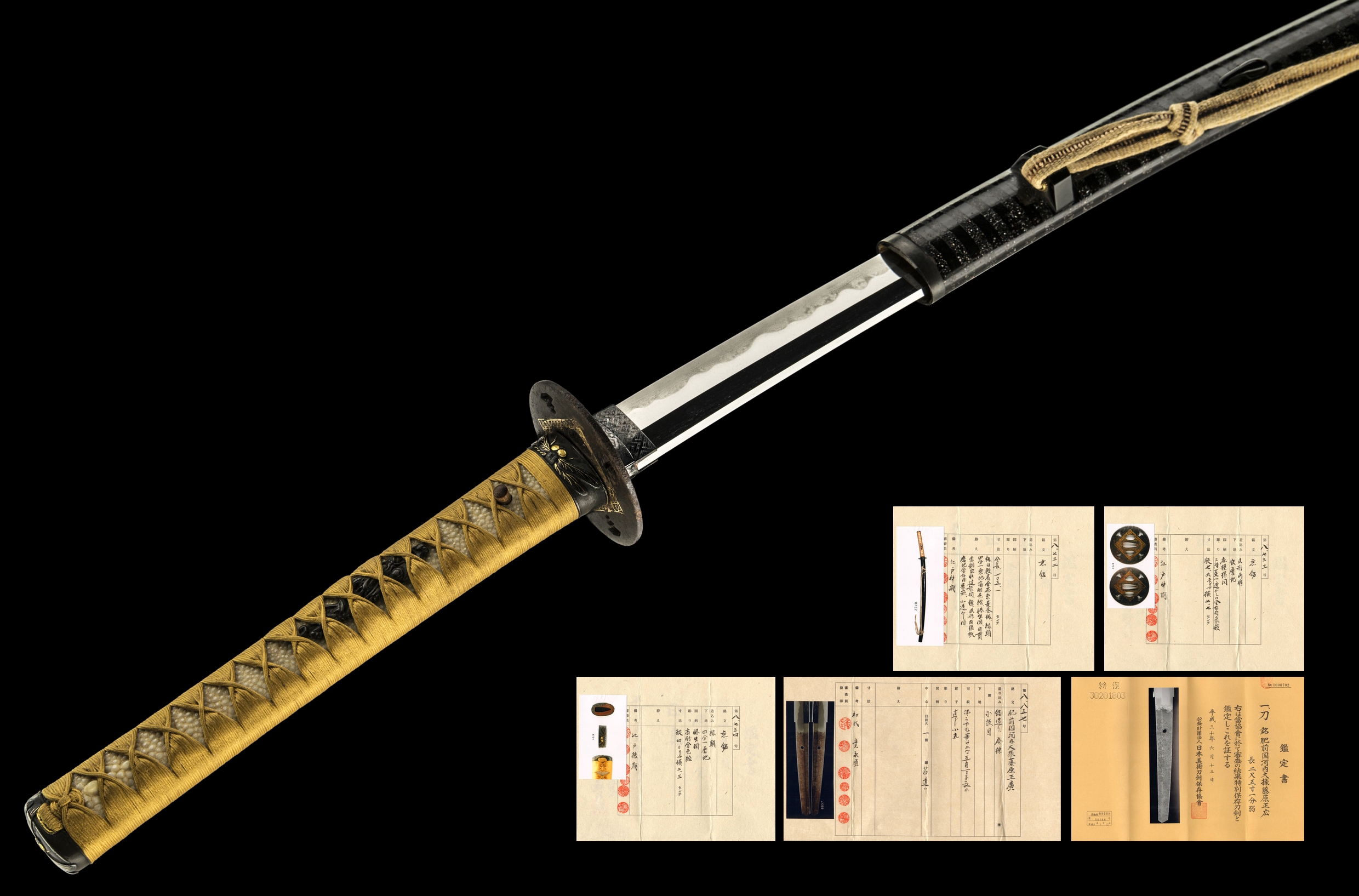
Kawachi Masahiro was born Sadenjiro in 1607 and died at only 59 in 1665. The son of Yoshinobu — who was himself the adopted son of the great first generation Shodai Tadayoshi — he began his career signing as Masanaga and even cut signatures on behalf of the ailing Shodai Tadayoshi (dai-mei). Recognising his exceptional talent, Lord Nabeshima Katsushige suggested the young smith take the name Masahiro, and so Shodai Masahiro was born. Ranked Jo-saku and rated Wazamono for cutting ability, he stands among the finest smiths the Hizen tradition ever produced.
This long and splendid katana is a tour de force. The steel is forged in the classic Hizen manner: a tight ko-mokume that refines into the school’s celebrated konuka-hada, so densely worked it resembles fine rice bran under magnification. Masahiro was renowned for his thick nie-deki, and this blade delivers in full — generous splashes of sparkling nie crystals animate the hamon from base to point, with lively kinsuji and generous sunagashi threading through the activity. The boshi is a spectacular kaen, the thick clusters of nie at the tip blazing like fire.
The sword comes complete with a superb Edo period uchigatana koshirae. The saya is finished in black raden fuemaki lacquer — symmetrical mother-of-pearl flute stripes — dated and certified to the middle Edo period, circa 1688-1780. The tsuba is a polished iron example with gold cloth inlay attributed to the prestigious Umetada school, bearing the sangaibishi triple-diamond kamon of the Ogasawara daimyo who ruled the Karatsu domain in Hizen from 1817 to 1871. The fuchi-kashira is decorated with large crawling dragonflies in shakudo — the dragonfly being the quintessential samurai symbol of forward-only determination — certified by the NTHK-NPO to the Iga school of the late Edo period. The tsuka is wrapped in a bold two-strand tsunegumi-kumiagemaki weave in gold silk over stingray skin, with large shakudo dragon menuki. An ibushigin flower niju-habaki in oxidised silver completes the mounting. Every component is a statement piece — together, they form one of the most complete and visually compelling Edo period mountings one could wish for.
| Item Number | UJKA278 |
| Sword Type | Katana |
| Swordsmith | Shodai Masahiro (first generation) |
| Swordsmith (JP) | 肥前国河内大掾藤原正広 |
| Signature | Hizen no Kuni Kawachi Daijo Fujiwara Masahiro |
| School | Hizen (Omi-Ishido lineage, Tadayoshi school) |
| Province | Hizen |
| Period | Shintô – Early Edo period (Kan’ei era: 1624-1644) |
| Nagasa | 76.0cm (ubu) |
| Sori | 1.5cm |
| Moto-haba | 3.3cm |
| Weight | 875g |
| Nakago | 19.8cm, 1 mekugi-ana, tachi-mei |
| Jihada | Ko-mokume leading to Hizen konuka-hada, thick nie-deki |
| Hamon | Gunome choji-midare with kinsuji and sunagashi |
| Boshi | Kaen (flame) |
| Certificates | NBTHK Tokubetsu Hozon (guaranteed; original certificate lost, new shinsa required — Unique Japan covers all associated costs); NTHK-NPO Kanteisho (tsuba, fuchi-kashira, koshirae) |
| Fujishiro Rank | Jo-saku |
| Sharpness Rating | Wazamono |
| Koshirae | Edo period uchigatana koshirae |
| Tsuba | Polished iron with gold cloth inlay, sangaibishi (triple-diamond) kamon of the Ogasawara clan; attributed to Umetada school, mid-Edo circa 1700s. NTHK-NPO Kanteisho certified. |
| Fuchi-kashira | Shakudo with dragonfly motif and gold inlay; Iga school, late Edo period (early 1800s). NTHK-NPO Kanteisho certified. |
| Menuki | Large shakudo crawling dragons, tsunegumi-kumiagemaki two-strand weave |
| Tsuka | Gold silk tsukamaki over white stingray skin (same), tsunegumi-kumiagemaki weave |
| Habaki | Ibushigin flower niju-habaki (oxidised silver, two-piece) |
| Catalogue | Catalogue 28 |
| Status | Sold |
| Includes | Shirasaya, Edo koshirae, fabric bag, stand, kit, DVD, booklet, description |