
ITEM# UJKA259 – Catalogue 29 – Sold
A Ko-Gassan Katana (古月山)
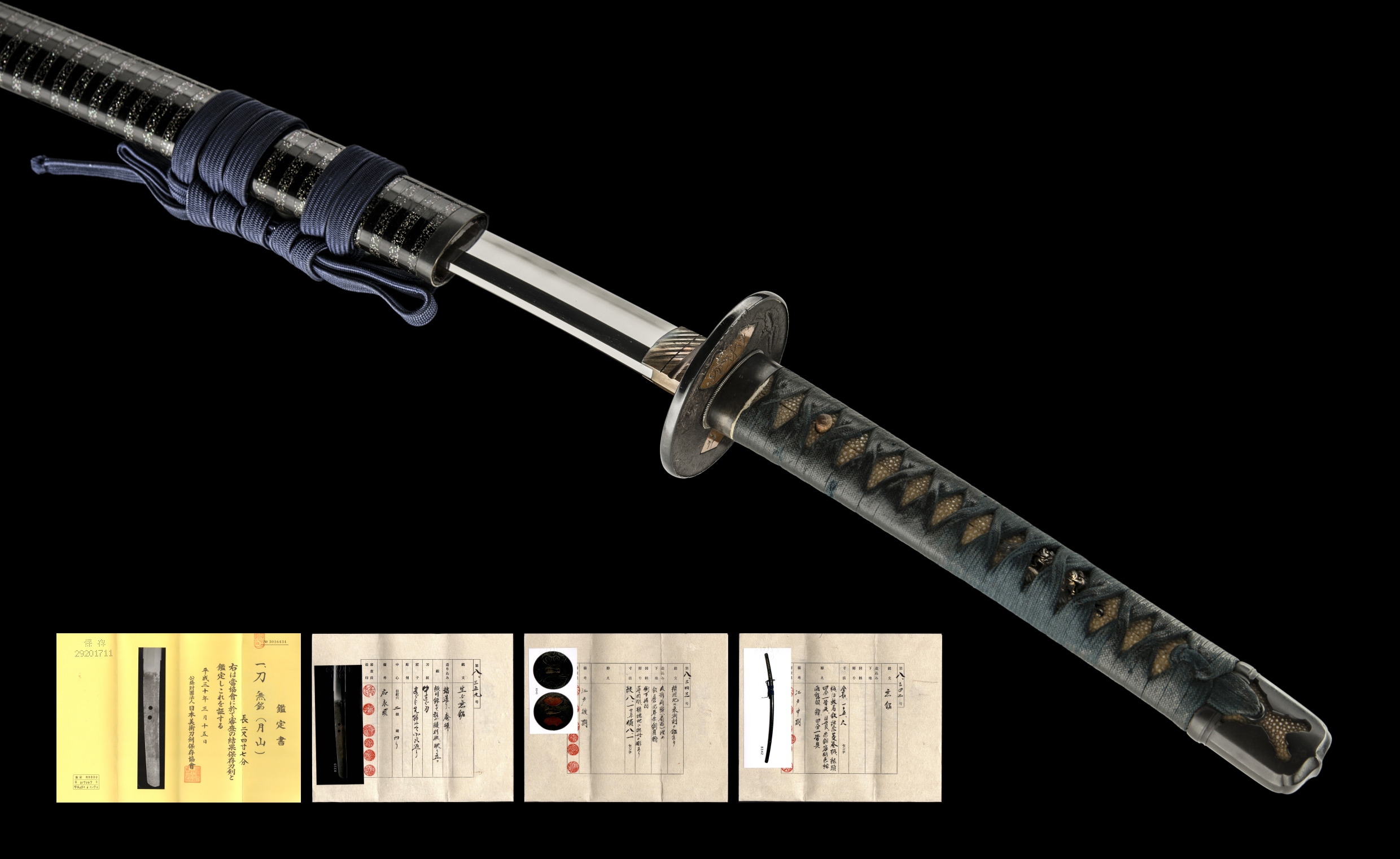
The Gassan school is one of the most celebrated lineages in Japanese sword-forging, with roots in Mt. Gassan in the ancient province of Dewa – present-day Yamagata prefecture. Mountain priests trained there from earliest times, and swordsmiths bearing the Gassan name are documented from the Heian period, though no signed work predates the close of the Nanbokuchô era in 1394. Blades made before the Edo period carry the prefix Ko (ancient), and this katana, dated to the first era of the Muromachi period circa 1400, is a textbook example of the school at its most refined. The line continues unbroken to this day under Living National Treasure Gassan Sadatoshi, and the reason for that longevity is visible in every inch of this blade.
The steel tells the story immediately. The ayasugi-hada – also written as Gassan-hada (月山肌) – rolls across the ji in perfectly controlled waves, each crest crisp and deliberate, the whole surface alive with movement. Named after the decorative carving pattern found on traditional Japanese koto and shamisen instruments, it has been the school’s trademark for centuries. A misty utsuri rises through the body of the blade as if conjured from within the steel itself. The hamon is a composed chu-suguha, its straight line picking up a gentle undulation as it rides the underlying grain – disciplined craftsmanship working in quiet harmony with the material. The boshi is a classic hakikake, the brushed tip finishing the edge with characteristic Gassan authority. The sugata is graceful and long, with an elegant torii-zori – the deepest point of curvature resting near the middle of the blade, as befits a sword of this period.
The nakago is ubu – original and unaltered in length – and carries a history worth noting. The blade was originally left unsigned by its maker. At some later point a Gassan signature was added as an ato-mei; as this was not by the original smith, it constituted a gimei (false inscription). That signature was carefully removed prior to submission to the NBTHK, which formally certified the blade to the Gassan school. The sword also retains its original torokusho registration card, issued on 12 March 1951 in Kanagawa – the 26th year of Shôwa – bearing the serial number 1568. That year was the very first in which swords were formally registered in Japan, and the low serial number strongly suggests this blade was submitted by a prominent, possibly former daimyô family. It comes with a magnificent late Edo-period handachi koshirae – the Kuro Aogai Nuri Wake Fue Maki Saya Shibuichi Kaigu – its black lacquer saya decorated with crushed mother-of-pearl in a striped fue (bamboo flute) pattern. All major fittings are matched shibuichi alloy. The iron tsuba, from the Kishu school, is the work of Zoko and depicts a wild boar resting under a tree, with peony engravings across the surface. The menuki take the form of rain dragons. The ensemble has remained essentially unchanged since its last samurai owner in the early 1800s – even the original samekawa is present, worn gracefully with age.
| Item Number | UJKA259 |
| Sword Type | Katana |
| Attribution | Ko-Gassan School (mumei) |
| School | Ko-Gassan |
| Province | Dewa |
| Period | Kotô – Early Muromachi (Oei era: 1394-1428) |
| Nagasa | 74.8cm |
| Sori | 2.1cm |
| Moto-haba | 2.7cm |
| Weight | 650g |
| Nakago | Ubu (original, unaltered length), mumei, 2 mekugi-ana |
| Jihada | Ayasugi-hada (Gassan-hada) with utsuri |
| Hamon | Chu-suguha with slight undulations following the ayasugi wave |
| Boshi | Hakikake (brushed tip) |
| Certificates | NBTHK Hozon; NTHK-NPO Kanteisho (sword, tsuba and koshirae designated as Authentic) |
| Fujishiro Rank | Chujo-saku |
| Koshirae | Edo-period handachi koshirae – Kuro Aogai Nuri Wake Fue Maki Saya Shibuichi Kaigu; black lacquer saya with crushed mother-of-pearl fue (bamboo flute) stripe pattern; shibuichi fittings throughout; original samekawa |
| Tsuba | Polished iron, Kishu school, signed Zoko; wild boar (inoshishi) resting under a tree with peony engraving; late Edo period (1780-1867); NTHK-NPO certified |
| Menuki | Rain dragons (shibuichi) |
| Habaki | Copper habaki |
| Catalogue | Catalogue 29 |
| Status | Sold |
| Includes | Shirasaya, Edo handachi koshirae, fabric bag, stand, kit, DVD, booklet, description, torokusho (original 1951 registration card) |