
ITEM# UJKA200 – Catalogue 24 – Sold
A Niô Katana (二王)
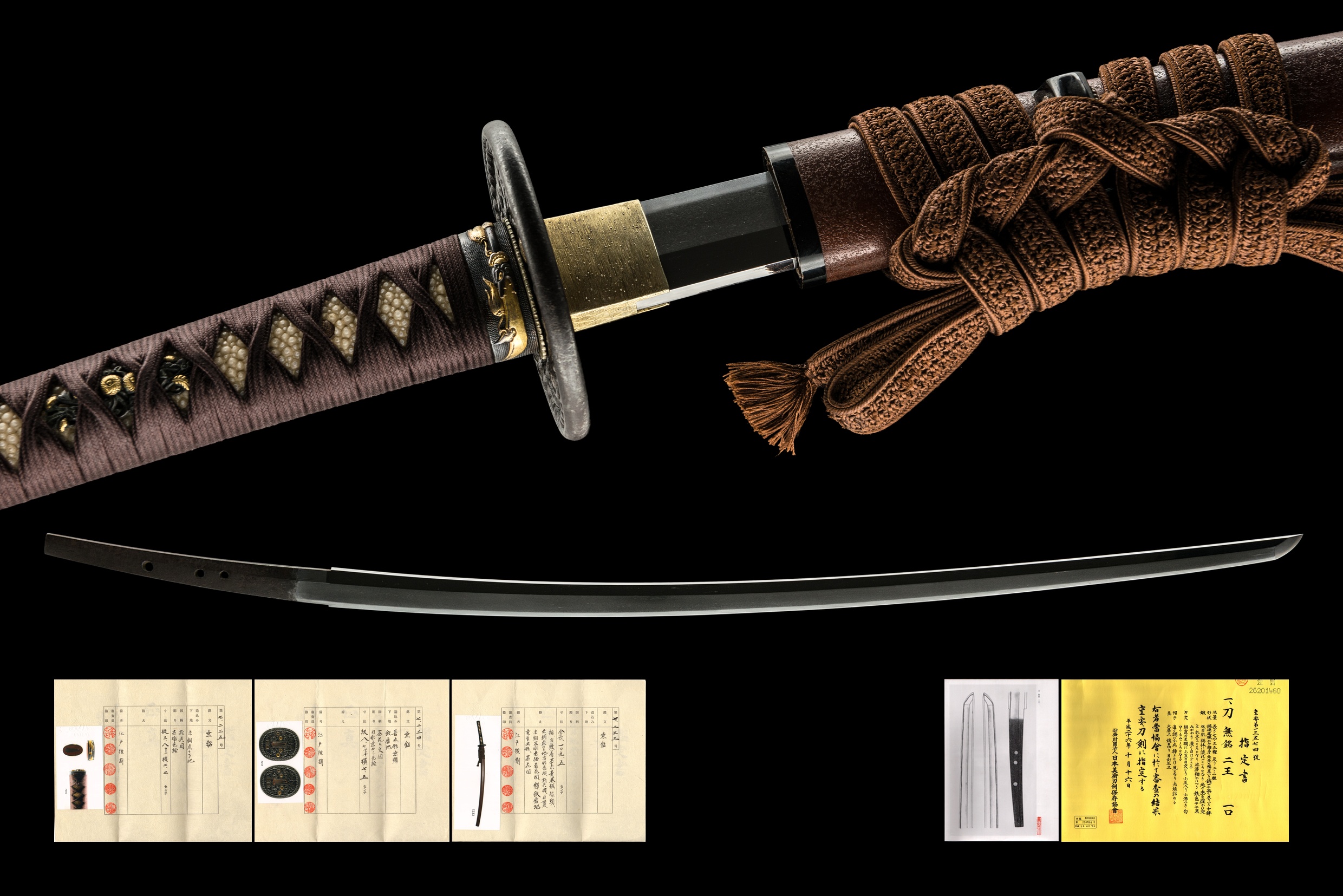
The Niō school (二王) of Suo province – present-day Yamaguchi prefecture – was one of the most spiritually charged lineages in the history of Japanese swordsmithing. Founded by Kiyozane circa 1249, with his grandson Kiyotsuna I generally regarded as the school’s definitive figure, the Niō tradition drew on Yamato influences to produce blades of serene authority and deeply characteristic steel. The school’s name is bound up with legend: it is said that a tachi by 1st-generation Kiyotsuna cut the chain locking the door of the Niō-dō temple, rescuing a sacred Niō statue from fire – though the NBTHK also notes the name derives from the school’s settled location, called Niho. This unsigned katana, attaining NBTHK Jūyō Tōken in October 2014 at the 60th session, was highlighted in the December 2014 edition of Tōken Bijutsu magazine as an exemplary specimen of the tradition.
The blade carries all the hallmarks the NBTHK examiners identified as definitive Niō: deep koshizori curvature centred at the waist, strong funbari taper from a wide moto-haba, ko-kissaki, and pronounced curvature at the tip – all pointing unmistakably to the late Kamakura period, circa 1329. The jihada is a gorgeous combination of wavy mokume and masame with jinie and shirake utsuri – the pale, misty reflection in the body of the blade that is a signature of Yamato-tradition heritage and a key marker that led the NBTHK to conclude Niō over Rai or Enju. Fine dark lines of chikei twist through the surface. The hamon is a refined hoso suguha with tightly woven ko-gunome and short ashi, and the nioi-guchi has the distinctive watery, hazy quality – urumu – that is the school’s calling card. The boshi runs to yakizume.
The sword is accompanied by a magnificent set of Edo-period koshirae. The large oval Namban tsuba is a striking piece of tetsu suriji polished iron in sukashi openwork, crafted in Nagasaki during the late Edo period with a chabana (Tea Ceremony flower) design, accompanied by an NTHK-NPO Kanteisho certificate. The fuchi depicts a dragon with a hoko spear drawn from its teeth; the kashira presents an elaborately detailed Samurai kabuto (helmet) – together forming the Bugu Zu (weaponry) theme, attributed by NTHK-NPO Kanteisho to the Den Kyō, Gotō School of the late Edo period. The menuki are botan (Japanese peony), the King of Flowers. A sword of rare spiritual energy and exceptional pedigree.
| Item Number | UJKA200 |
| Sword Type | Katana (o-suriage) |
| Attribution | Niô School (mumei) |
| School | Niô School |
| Province | Suo |
| Period | Kotō – Late Kamakura period (Gentoku era: 1329-1331) |
| Nagasa | 74.35cm |
| Sori | 2.2cm |
| Moto-haba | 2.9cm |
| Weight | 755g |
| Nakago | O-suriage, 21.6cm, 3 mekugi-ana |
| Jihada | Itame with mokume and masame, jinie and shirake utsuri; chikei |
| Hamon | Hoso suguha ko-gunome ko-ashi ko-nie tsuki, nioi-guchi urumu gokoro |
| Boshi | Yakizume |
| Certificates | NBTHK Jūyō Tōken (60th session, issued Heisei 26 / October 16th, 2014); NTHK-NPO Kanteisho (koshirae); NTHK-NPO Kanteisho (tsuba); NTHK-NPO Kanteisho (fuchi-kashira) |
| Fujishiro Rank | Jo-saku |
| Koshirae | Edo-period koshirae |
| Tsuba | Namban tsuba – polished iron (tetsu suriji), sukashi openwork, chabana (Tea Ceremony flower) design; crafted in Nagasaki, late Edo period; NTHK-NPO Kanteisho |
| Fuchi-kashira | Den Kyō, Gotō School – dragon with hoko (fuchi) and Samurai kabuto (kashira), Bugu Zu (weaponry) theme; late Edo period; NTHK-NPO Kanteisho |
| Menuki | Botan (Japanese peony) |
| Habaki | Yokoyasuri-filed, brass |
| Catalogue | Catalogue 24 |
| Status | Sold |
| Includes | Edo-period koshirae, shirasaya, carry bags, sword stand, maintenance kit, DVD, booklet, NBTHK magazine, printed description, export permit from Japan |