
ITEM# UJKA157 – Catalogue 21 – Sold
A Kurihara Nobuhide Katana (栗原信秀)
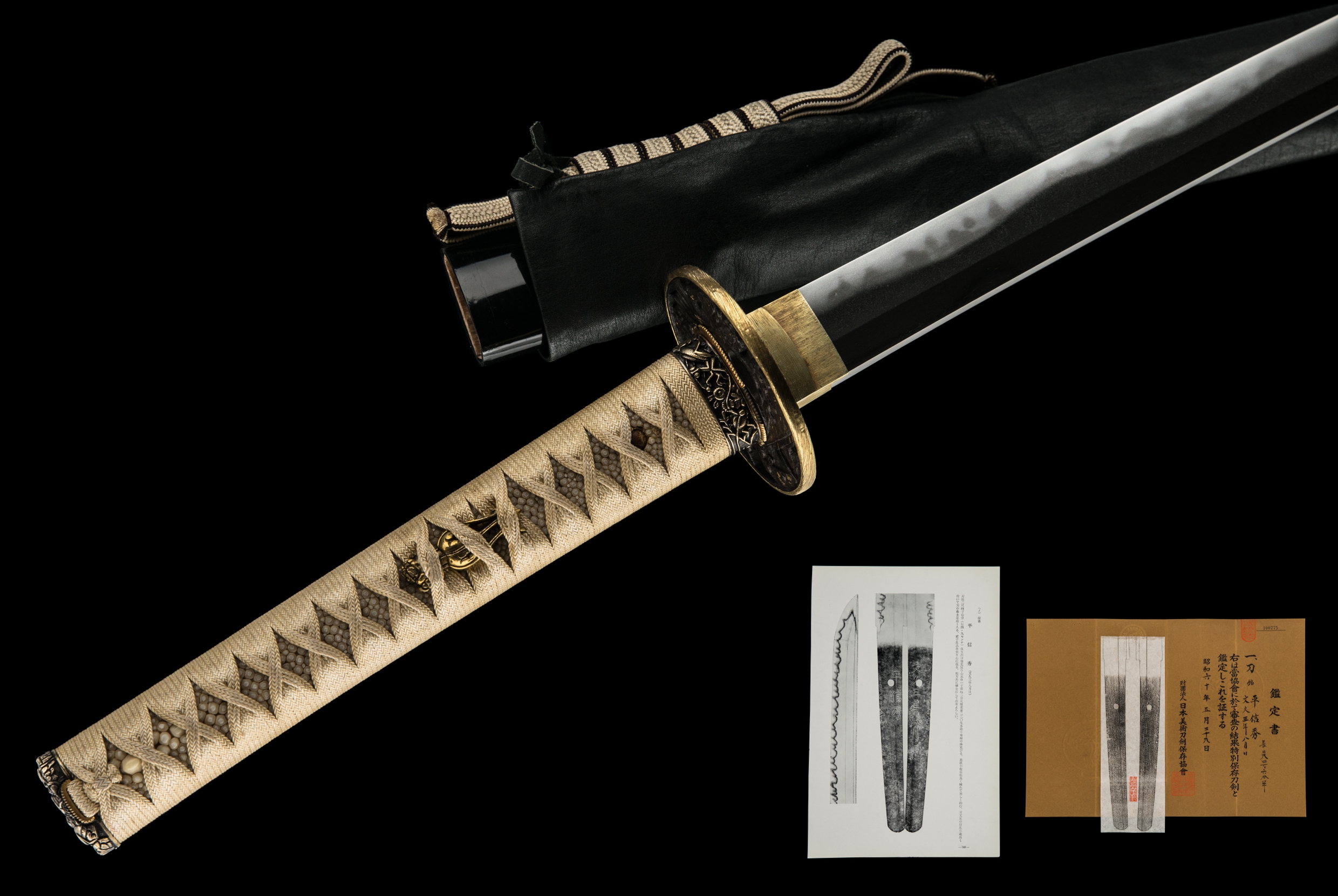
Kurihara (Taira) Nobuhide stands at the very summit of the Shinshintô period. Born in Echigo province and first apprenticed as a sickle smith, he later moved to Kyoto to practise as a kagami-shi (mirror-maker) before becoming a student of the legendary Kiyomaro in 1850 – at the age of 35. His training under Kiyomaro lasted only two years, a remarkably short tenure that reflects both the proficiency he had already acquired working metal and an innate talent that required little further instruction. He went on to become Kiyomaro’s most celebrated student; his hataraki within the hamon is broadly considered superior even to that of his master. A number of his blades have achieved Juyo Token status. He died in January 1880 at the age of 66, leaving behind a body of work that continues to command the highest respect among serious collectors.
This katana – signed with an elegant three-character mei reading Taira Nobuhide, dated to August 1863 – is among the finest examples Nobuhide produced. It is featured in the prestigious Shinshintô Taikan reference book by Iimura Yoshifume, an honour reserved for the most distinguished works of the period. The jigane is a densely packed ko-itame that speaks directly to Nobuhide’s background as a mirror-maker: immaculate, uniform, and possessed of a profound inner vitality. The blade carries the characteristic bluish tinge of the finest-quality steel, and the graceful nakago with its precise file marks is a work of craft in its own right.
The hamon is a commanding gunome-midare enriched with sunagashi, kinsuji, and ashi, with a pointed boshi that curls back like a burning candle. The full Edo-period koshirae is a superb complement to the blade, featuring a Hikone Bori Soten School tsuba (circa 1700s, NTHK-NPO Kanteisho certified) and a signed fuchi-kashira by Mino Mitsushige, elaborately carved with the kamakiri (praying mantis) motif – a symbol of the samurai’s moral duty to protect society during the Edo period. The koshirae fittings carry three further NTHK-NPO Kanteisho certificates. The shirasaya bears a sayagaki by Dr. Kanzan Sato, former director of the NBTHK. This is a complete, fully-documented samurai sword of exceptional character.
| Item Number | UJKA157 |
| Sword Type | Katana |
| Swordsmith | Kurihara Nobuhide |
| Swordsmith (JP) | 栗原信秀 |
| Signature | Taira Nobuhide (omote) / Bunkyu 3-nen 8-gatsu (ura) |
| Date | Bunkyu 3 (1863), 8th month |
| Province | Musashi (modern-day Tokyo) |
| Period | Shinshintô – Late Edo period (Bunkyu era: 1861-1864) |
| Nagasa | 74.9cm (ubu) |
| Sori | 1.7cm |
| Moto-haba | 3.1cm |
| Weight | 875g |
| Nakago | Ubu, signed omote and dated ura |
| Jihada | Ko-itame hada |
| Hamon | Gunome-midare with sunagashi, kinsuji, ashi |
| Boshi | Pointed, curling back |
| Certificates | NBTHK Tokubetsu Hozon / NTHK-NPO Kanteisho (tsuba, fuchi-kashira, full koshirae) |
| Fujishiro Rank | Jojo-saku |
| Sayagaki | Dr. Kanzan Sato — Taira Nobuhide, dated Bunkyu 3 (1863), 8th month |
| Koshirae | Edo period koshirae with black lacquer saya |
| Tsuba | Hikone Bori Soten School, circa Mid-Edo period (1700s), NTHK-NPO Kanteisho |
| Fuchi-kashira | Signed Mino Mitsushige – kamakiri (praying mantis) motif, NTHK-NPO Kanteisho |
| Published | Shinshintô Taikan by Iimura Yoshifume, page 348 |
| Catalogue | Catalogue 21 |
| Status | Sold |
| Includes | Edo period koshirae, shirasaya, sword fabric bag, sword stand |