
ITEM# UJKA116 – Catalogue 34 – Sold
A Chiyozuru Morihiro Katana (千代鶴守弘)
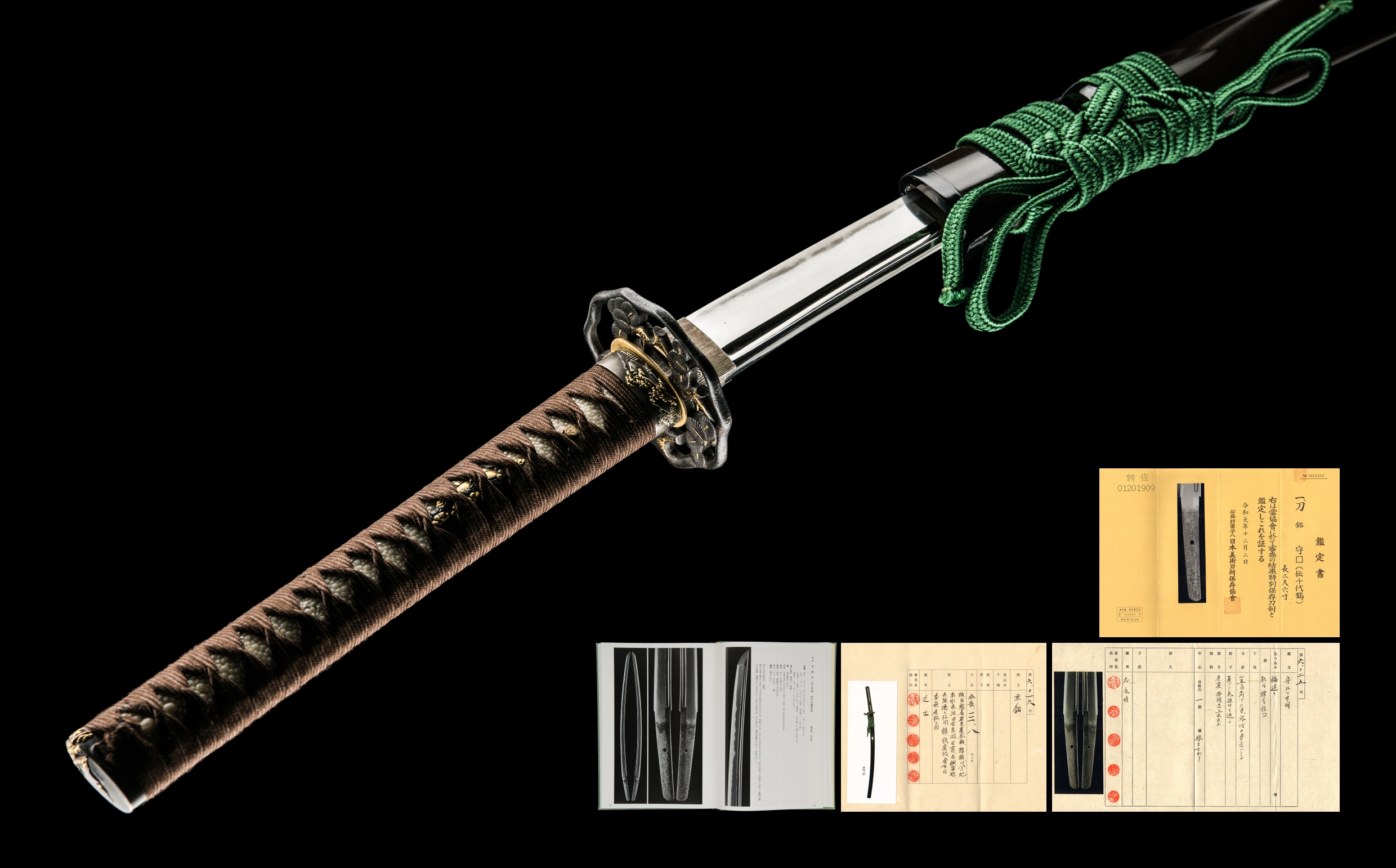
The Chiyozuru school traces its roots to Rai Kuniyasu in Yamashiro (Kyôto), from whose lineage the first generation Morihiro descended – either as a son or adopted son. When Chiyozuru Kuniyasu relocated to Echizen province around 1337, settling in Takefu in search of the right spring water for forging, he established the school that would bear the Chiyozuru name. These swordsmiths became known collectively as the Echizen Rai, carrying the refined Rai tradition northward to a province that would go on to produce blades of lasting distinction. The Morihiro name itself continued for approximately four generations into the early Muromachi period.
At 78.8cm with a deep 2.4cm curvature, this blade was almost certainly worn as a tachi on horseback earlier in its life. What makes it extraordinary is that it has never been shortened – after more than 600 years, the nakago remains completely ubu, untouched since the day it left the forge. The shirasaya carries a sayagaki by Dr. Kanzan Satô, former co-chairman of the NBTHK. The NBTHK awarded it Tokubetsu Hozon in 2019, and the NTHK-NPO previously designated it Yûshûsaku (Highly Excellent Masterwork) in 2014 – their highest honour, confirmed by five judges’ stamps. It was subsequently featured in the NTHK-NPO Book of Yûshûsaku Masterwork Swords.
The hamon is a lively ko-gunome-midare with togari peaks and valleys, said to echo the cedar forest tree lines of Echizen – a vivid and energetic temper line with threads of kinsuji and sunagashi running through it. The jihada is a rich mix of nagare-hada with itame and mokume, animated by dark swirls of chikei. A delicate shirake-utsuri reflects the hamon deep in the body of the blade, a characteristic of Echizen work along the Sea of Japan coast. Full-length bo-higrooves finished with kakudome (squared ends) run the length of the blade, forming an I-beam construction that lightens the sword without sacrificing strength. The accompanying longevity koshirae carries a unified matsu (pine) theme throughout its fittings – tsuba by the Nishigaki school from Higo, fuchi-kashira by the Sonobe school from Edo – a presentation worthy of a sword of this age and quality.
| Item Number | UJKA116 |
| Sword Type | Katana |
| Swordsmith | Morihiro (first generation) |
| Swordsmith (JP) | 守弘 |
| Signature | Morihiro (second character partially legible on nakago) |
| School | Chiyozuru (Echizen Rai) |
| Province | Echizen (Fukui) |
| Period | Kôtô – Early Muromachi period (Oei era: 1394-1427) |
| Nagasa | 78.8cm (ubu) |
| Sori | 2.40cm |
| Moto-haba | 3.06cm |
| Weight | 775g |
| Nakago | Ubu, 15.6cm |
| Jihada | Nagare-hada mixed with itame and mokume, with chikei |
| Hamon | Ko-gunome-midare with togari, kinsuji, sunagashi |
| Boshi | Hakikake |
| Horimono | Full-length bo-hi with kakudome (squared ends), both sides |
| Certificates | NBTHK Tokubetsu Hozon; NTHK-NPO Yûshûsaku (Masterwork); NTHK-NPO Kanteisho (koshirae and tsuba) |
| Fujishiro Rank | Jô-saku |
| Sayagaki | Satô Kanzan (Dr. Kanzan Satô, former co-chairman of the NBTHK) |
| Koshirae | Urumi-nuri saya uchigatana-koshirae (gloss black lacquer), matsu (pine) longevity theme, Modern period. NTHK-NPO Kanteisho certified. |
| Tsuba | Polished iron, twisted pine branch (matsu) design with gold highlights, Nishigaki school (Higo province), late Edo period (1780-1867). NTHK-NPO Kanteisho certified. |
| Fuchi-kashira | Pine landscape design, Sonobe school (Edo province), late Edo period (1780-1867). NTHK-NPO Kanteisho certified. |
| Menuki | Pine-themed menuki on dark brown ito over white same |
| Habaki | Silver with kikko (turtle shell) design |
| Catalogue | Catalogue 34 |
| Status | Sold |
| Includes | Shirasaya and bag; longevity koshirae; NBTHK Tokubetsu Hozon certificate; NTHK-NPO Yûshûsaku certificate; NTHK-NPO Kanteisho certificate; sword stand; cleaning kit; DVD; booklet; printed description |