
ITEM# UJKA079 – Catalogue 30 – Sold
A Fujishima Katana (藤島)
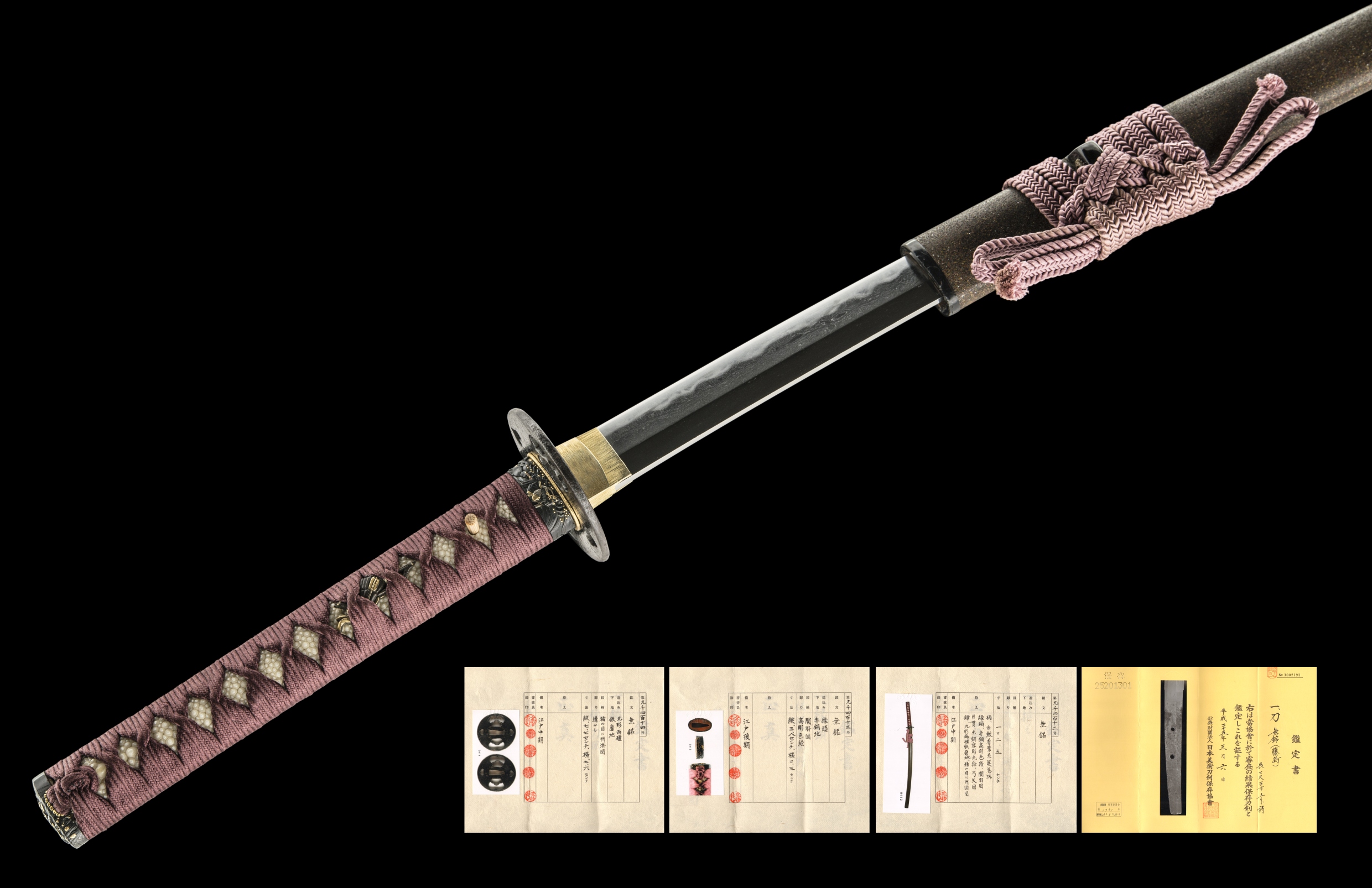
The Fujishima school traces its origins to the early 1400s, when the first-generation smith Tomoshige (circa 1394-1429) is believed to have worked in Fujishima, an area of Echizen province, before relocating to Kaga province along the Hokurikudo trade route facing the Sea of Japan. The harsh, extended winters of this northern territory demanded blades of exceptional resilience, and out of that necessity was born a unique jigane called hadamono – a swirling, living mix of itame, mokume, masame and o-hada that outperformed tightly forged grain patterns in flexibility, strength and cutting ability. This blade exemplifies that tradition. The jihada is absolutely spectacular, alive with activity and threaded throughout with gorgeous chikei – dark lines of nie crystals weaving through the body of the blade.
The shape speaks clearly to the early Muromachi period: curvature centred toward the middle to upper section of the blade, a form that predates the flatter profiles of later centuries. The hamon is a rhythmic $1 animated by splendid streams of sunagashi and pointed togari elements that betray a Mino tradition influence. The nakago is o-suriage (greatly shortened), the original signature lost in the process, though the darker patina visible in the lower quarter of the tang confirms this section is original to the sword. The original torokusho (registration card), serial number 1791, dates to May 30, 1951 – among the very first swords formally registered in Japan, suggesting the blade was once held by a prominent Daimyo family.
The mid-Edo period uchigatana-koshirae is a worthy companion. The saya carries an aogai-mijin-nuri finish – an ishimenuri stone finish layered with particles of mixed abalone shell – crafted circa 1700-1780. The fuchi-kashira is attributed to the Hamano school (NTHK-NPO certified), depicting Guan Yu, the revered general of the Eastern Han dynasty, in superb relief with gold highlight work. Menuki in the form of a yumi (bow) and ya (arrows) complete a fittings set with a unified warrior spirit. The Tosho-attributed iron tsuba is pierced with inome – the eye of the wild boar – a motif deeply associated with the samurai ideal of single-minded, unstoppable resolve.
| Item Number | UJKA079 |
| Sword Type | Katana |
| Attribution | Fujishima school (mumei) |
| School | Fujishima |
| Province | Kaga (Ishikawa prefecture) |
| Period | Kôtô – Early to Mid Muromachi period (circa 1400s) |
| Nagasa | 71.24cm (o-suriage) |
| Sori | 1.55cm |
| Moto-haba | 3.03cm |
| Weight | 695g |
| Nakago | O-suriage mumei, 18.9cm, 2 mekugi-ana |
| Jihada | Hadamono mix of itame, mokume, masame and o-hada with plentiful chikei |
| Hamon | Gunome-midare with kinsuji and sunagashi; togari elements showing Mino influence |
| Boshi | Midare-komi |
| Certificates | NBTHK Hozon (No. 3002193, issued Heisei 25 / 2013); NTHK-NPO Kanteisho (tsuba, fuchi-kashira, and koshirae) |
| Koshirae | Aogai-mijin-nuri uchigatana-koshirae, Middle Edo period (circa 1700-1780) |
| Tsuba | Polished iron, Tosho attribution, inome (wild boar eye) piercings, NTHK-NPO certified |
| Fuchi-kashira | Hamano school (NTHK-NPO certified), shakudo with gold, depicting Guan Yu |
| Menuki | Yumi (bow) and ya (arrows) motif |
| Habaki | Niju habaki, gold wrapped over copper base with kiri straight file pattern |
| Catalogue | Catalogue 30 |
| Status | Sold |
| Includes | Shirasaya, Edo koshirae, bags, stand, kit, DVD, printed description |