
ITEM# UJDI026 – Sold
A Shodai Yamato no Daijô Masanori Custom Daishô (大和大掾藤原正則)
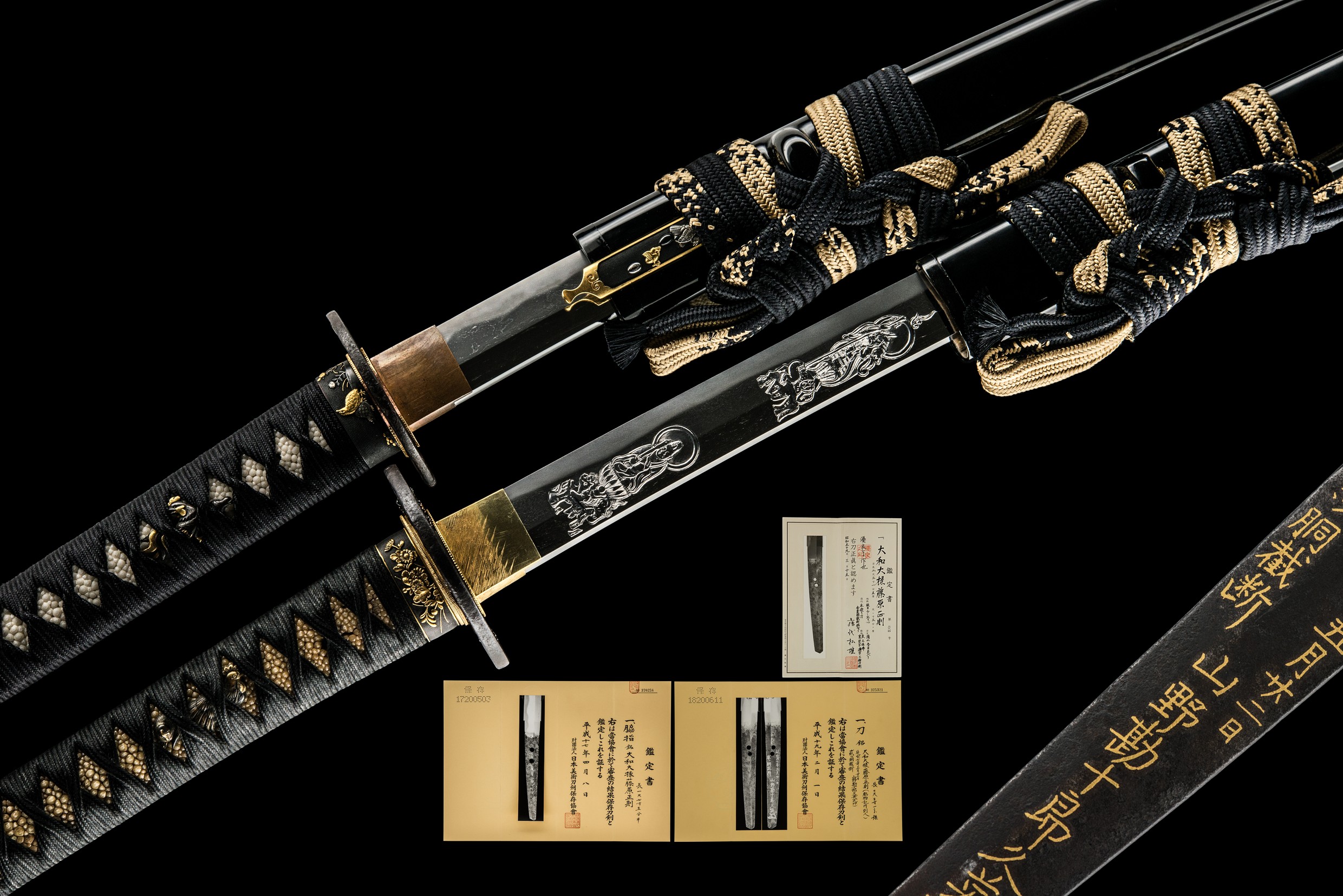
Shodai Yamato no Daijô Fujiwara Masanori worked at the cusp – the close of the Kôtô age and the opening of the Shintô. Trained first by his father Norimitsu and later refined in Kyoto, he was retained by the Matsudaira Tadanao clan in Echizen province, where he spent the remainder of his career producing swords celebrated for both their cutting quality and their beauty. Fujishiro ranks him Jô-saku (superior swordsmith), and he carries the Ryô-wazamono designation for sharpness. This Keichô-era pair represents that reputation fully realised.
The katana carries a kinzôgan tameshi-mei – a gold-inlaid cutting test inscription – on its nakago, certifying that on May 22, 1679, Shogun-appointed master sword-tester Yamano Kanjûrô Hisahide severed two human bodies with this blade in a single stroke. Futatsu-dô saidan. Above the cutting test, four Buddhist deities are engraved into the steel as horimono: Yakushi-Nyorai (the Medicine Buddha), Bishamonten (warrior-god and one of the Seven Lucky Gods), Kokuzô Bosatsu (the bodhisattva of boundless wisdom), and a sankôzuka suken capped with a renge lotus and a vajra thunderbolt. These are not decoration. They are talismans – spiritual protection cast into the sword itself. The wakizashi, signed by the same Masanori on an ubu nakago and recently polished to a high standard, carries a consistent nio-guchi in gunome midare, busy with sunagashi (streams of sand), kinsen (lines of gold) and ashi spraying toward the edge. The jihada is a beautiful ko-itame with swirling mokume and ji-nie.
The katana came to the client already wearing its mid-1800s late Edo koshirae. Once the wakizashi was secured, a matching wakizashi koshirae was commissioned in 2015 – a ‘past meets present’ daishô, in the same spirit as a samurai of the Edo period would have assembled fittings from what could be sourced. The larger tsuba carries a Mizu Aoi Zu water hyacinth design; the smaller, a Noshi congratulatory ribbon signed Itô Masatoyo of the Bushû School (Mid-Edo, circa 1692-1779). The fuchi-kashira, signed Ichinomiya Tsuneyuki (1769-1828), show quails amongst flowers and a Japanese crane on shakudô-nanako in fine high relief. A kogai of a hen with chicks (NBTHK Hozon, attributed to Kyô Kinkô) and a kozuka with a quails-and-village-scene complete the set. Past and present, brought together – and the result, magical.
| Item Number | UJDI026 |
| Sword Type | Daishô (katana and wakizashi) |
| Swordsmith | Shodai Yamato no Daijô Fujiwara Masanori |
| Swordsmith (JP) | 大和大掾藤原正則 |
| Signature | Yamato no Daijô Fujiwara Masanori (on both blades) |
| Province | Echizen |
| Period | Shintô – Keichô era (circa 1596-1615) |
| Nagasa (katana) | 70.2cm |
| Nagasa (wakizashi) | 53.4cm |
| Sori (katana) | 1.0cm |
| Sori (wakizashi) | 1.1cm |
| Moto-haba (katana) | 3.0cm |
| Moto-haba (wakizashi) | 2.8cm |
| Nakago (katana) | Ubu |
| Nakago (wakizashi) | Ubu |
| Jihada | Ko-itame with swirling mokume and ji-nie |
| Hamon | Gunome midare with sunagashi, kinsen and ashi |
| Horimono (katana) | Yakushi-Nyorai, Bishamonten, Kokuzô Bosatsu, and sankôzuka suken with vajra and renge |
| Tameshigiri | Futatsu-dô saidan (two-body cutting test) performed Enpô 7 (May 22, 1679) by Yamano Kanjûrô Hisahide – kinzôgan (gold inlay) |
| Tameshigiri (JP) | 延寳七年五月廿二日 貳ツ胴截断 山野勘十郎久英(花押) |
| Certificates | NBTHK Hozon Tôken (both blades); Fujishiro Yûshu Kanteishô (katana) |
| Fujishiro Rank | Jô-saku |
| Sharpness Rating | Ryô-wazamono |
| Koshirae | Custom ‘past meets present’ daishô – katana koshirae mid-1800s late Edo; matching wakizashi koshirae assembled 2015 |
| Tsuba (katana) | Mizu Aoi Zu (water hyacinth) design |
| Tsuba (wakizashi) | Noshi (congratulatory ribbon) design, signed Itô Masatoyo of the Bushû School (Mid-Edo, circa 1692-1779) |
| Fuchi-kashira | Quails amongst flowers and Japanese crane, high-relief engraving on shakudô-nanako, signed Ichinomiya Tsuneyuki (1769-1828) |
| Kogai | Hen with chicks design – NBTHK Hozon, attributed to Kyô Kinkô |
| Kozuka | Quails amongst a village scene |
| Status | Sold |
| Includes | Shirasaya for both blades, silk sword bag, original NBTHK and Fujishiro certificates |