
ITEM# UJDI012 – Catalogue 46 – Sold
A Kaneshige Tameshigiri Daishô (上総介藤原兼重)
Born Tsuji Suke’emon (辻助右衛門), Nidai Kazusa no Suke Kaneshige was active during the Kanbun era (1661-1673) and is believed to be the son of the first-generation Izumi no Kami Kaneshige (和泉守兼重). Both generations served the Tôdô (藤堂) family before relocating to Edo, where Kaneshige forged for samurai clientele, collaborating with major smiths including the third-generation Yasutsugu and Hôjôji Masateru. He ranks among the foremost swordsmiths of the early shintô period, rated jô-saku for quality and ryô-wazamonô for the cutting ability of his blades – a combination that made him the smith of choice for serious testing. His style closely resembles that of grandmaster Kotetsu, with whom he shares a lineage through the first-generation Kaneshige.
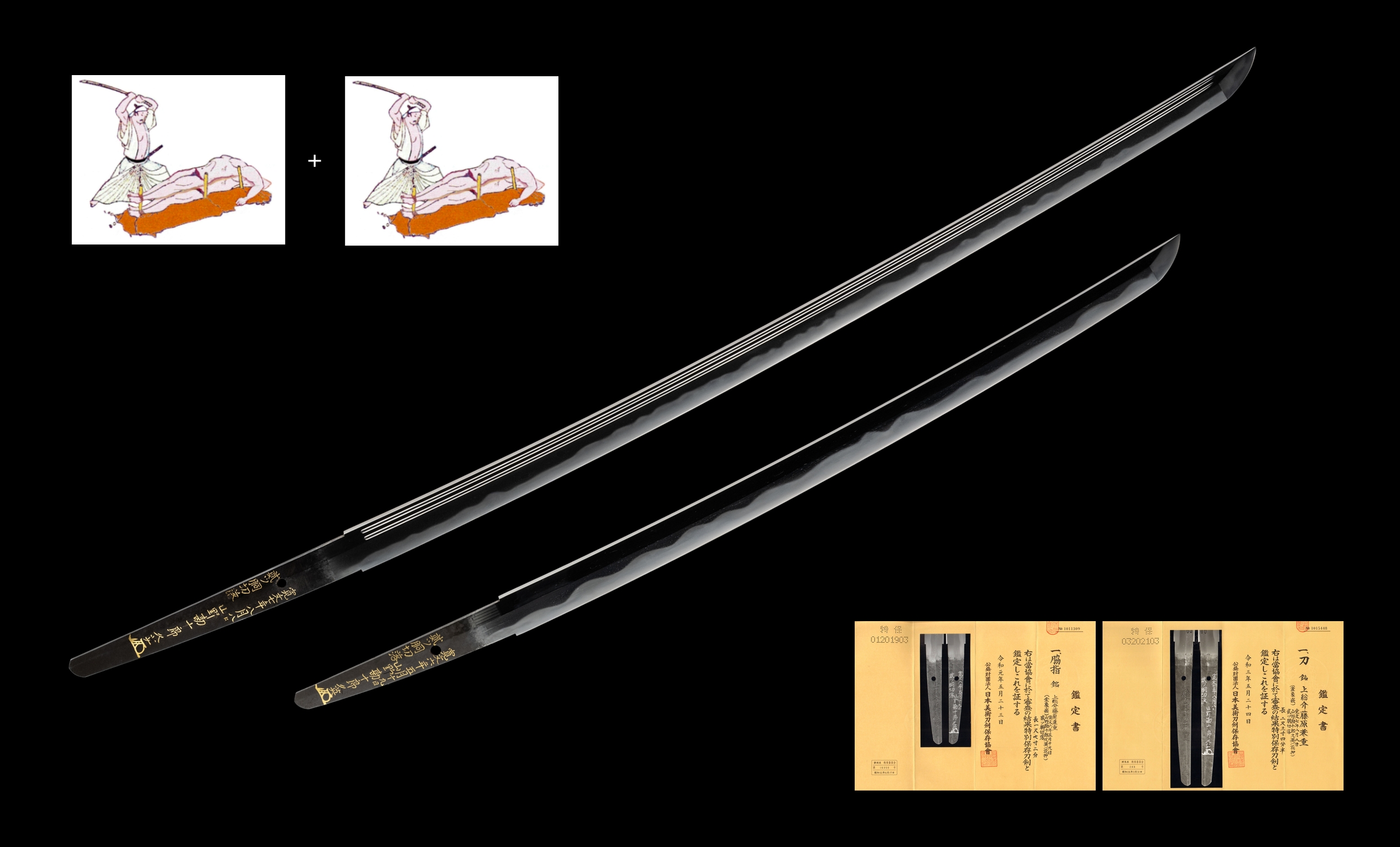
Both blades display Kaneshige’s signature approach at its most refined. The jigane is a dense, expertly worked mixture of mokume, itame, and flowing nagare-hada covered in shining ji-nie and plentiful chikei. The hamon is a beaming $1 in nie-deki with a deep, luminous nioiguchi – gleaming like freshly fallen snow – populated with long ashi, togari, kinsuji, sunagashi, and crackling inazuma. The katana carries a full-length pair of parallel grooves, futatsuji-bi, that lighten the blade and give it a commanding presence. The near-identical signatures on both nakago – in the same assured hand – are remarkable to behold side by side. What sets this daishô apart absolutely is the gold kinzôgan inlay on both nakago by Yamano Kanjurô Hisahide (山野勘十郎久英), one of the Edo period’s most celebrated sword testers. The wakizashi was tested on the 19th day of the 5th month of Kanbun 6 (May 1666), the katana on the 8th day of the 8th month of Kanbun 7 (August 1667) – each cleanly severing two bodies in a single stroke. That both tests were conducted by the same hand, just fifteen months apart, on a matched pair by the same smith, speaks to wealth, discernment, and deliberate intent.
The swords are accompanied by two sets of period koshirae, acquired separately and not matched to each other – a situation that Unique Japan can resolve through a bespoke custom daishô koshirae commission using museum-quality antique fittings. The katana koshirae features a round iron tsuba with chrysanthemum-inspired openwork, and a striking iron fuchi-kashira inlaid with silver clematis vines. Its menuki depict the ancient practice of ukai cormorant fishing. The wakizashi koshirae is fitted with an iron tsuba carved with wild horses and a stream, and a fuchi-kashira in wave and nanako dotwork. A kozuka utility knife accompanies the wakizashi, bearing the gold-inlaid inscription “Yamato Rikiô” alongside a chrysanthemum crest, signed Kurodayamashiro no Kami Nobutoshi. Both shirasaya carry the opportunity for sayagaki by Tanobe-sensei.
| Item Number | UJDI012 |
| Sword Type | Daishô (katana and wakizashi) |
| Swordsmith | Nidai Kazusa no Suke Kaneshige (second generation) |
| Swordsmith (JP) | 上総介藤原兼重 |
| Signature | Kazusa no Suke Fujiwara Kaneshige (both blades; near-identical mei) |
| Province | Musashi (Edo) |
| Period | Shintô – Early Edo period (Kanbun era: 1661-1673) |
| Nagasa (katana) | 71.0cm |
| Sori (katana) | 1.0cm |
| Moto-haba (katana) | 2.94cm |
| Saki-haba (katana) | 2.04cm |
| Kissaki (katana) | 3.52cm |
| Moto-kasane (katana) | 7.2mm |
| Saki-kasane (katana) | 4.6mm |
| Nakago (katana) | 21.1cm, ubu, keshô-tsuki sujikai-yasurime, 1 mekugi-ana |
| Weight (katana) | 760g |
| Nagasa (wakizashi) | 52.8cm |
| Sori (wakizashi) | 0.7cm |
| Moto-haba (wakizashi) | 2.83cm |
| Saki-haba (wakizashi) | 2.01cm |
| Kissaki (wakizashi) | 2.94cm |
| Moto-kasane (wakizashi) | 6.4mm |
| Saki-kasane (wakizashi) | 4.7mm |
| Nakago (wakizashi) | 15.4cm, ubu, 1 mekugi-ana |
| Weight (wakizashi) | 530g |
| Jihada | Mokume, itame and nagare-hada with shining ji-nie and plentiful chikei |
| Hamon | Gunome-midare in nie-deki with deep nioiguchi, long ashi, togari, kinsuji, sunagashi and inazuma |
| Certificates | 2 x NBTHK Tokubetsu Hozon (both swords Especially Worthy of Preservation) |
| Fujishiro Rank | Jô-saku |
| Sharpness Rating | Ryô-wazamonô |
| Tameshigiri (JP) | 寛文七年八月八日貳ツ胴切落山野勘十郎久英(花押) / 寛文六年五月十九日貳ツ胴切落山野勘十郎久英(花押) |
| Koshirae | Two period koshirae (acquired separately, mismatched); custom daishô koshirae commission available |
| Tsuba (katana) | Round iron, chrysanthemum-inspired openwork design |
| Fuchi-kashira (katana) | Iron with silver-inlaid clematis vine motif |
| Menuki (katana) | Ukai (cormorant fishing) theme |
| Tsuba (wakizashi) | Iron, carved motif of wild horses and stream |
| Fuchi-kashira (wakizashi) | Surging waves motif with dotted nanako ground |
| Menuki (wakizashi) | Nakago-form with gold-inlaid signature |
| Habaki | Nijû-habaki x 2 (one per blade: gold nijû-habaki for katana; gold and silver nijû-habaki for wakizashi) |
| Catalogue | Catalogue 46 |
| Status | Sold |
| Includes | Shirasaya x 2, koshirae x 2, fabric bags, stand, kit, printed description |