
ITEM# UJDI006 – Catalogue 28 – Sold
A Hizen Tadahiro Daisho (肥前国住近江大掾藤原忠広)
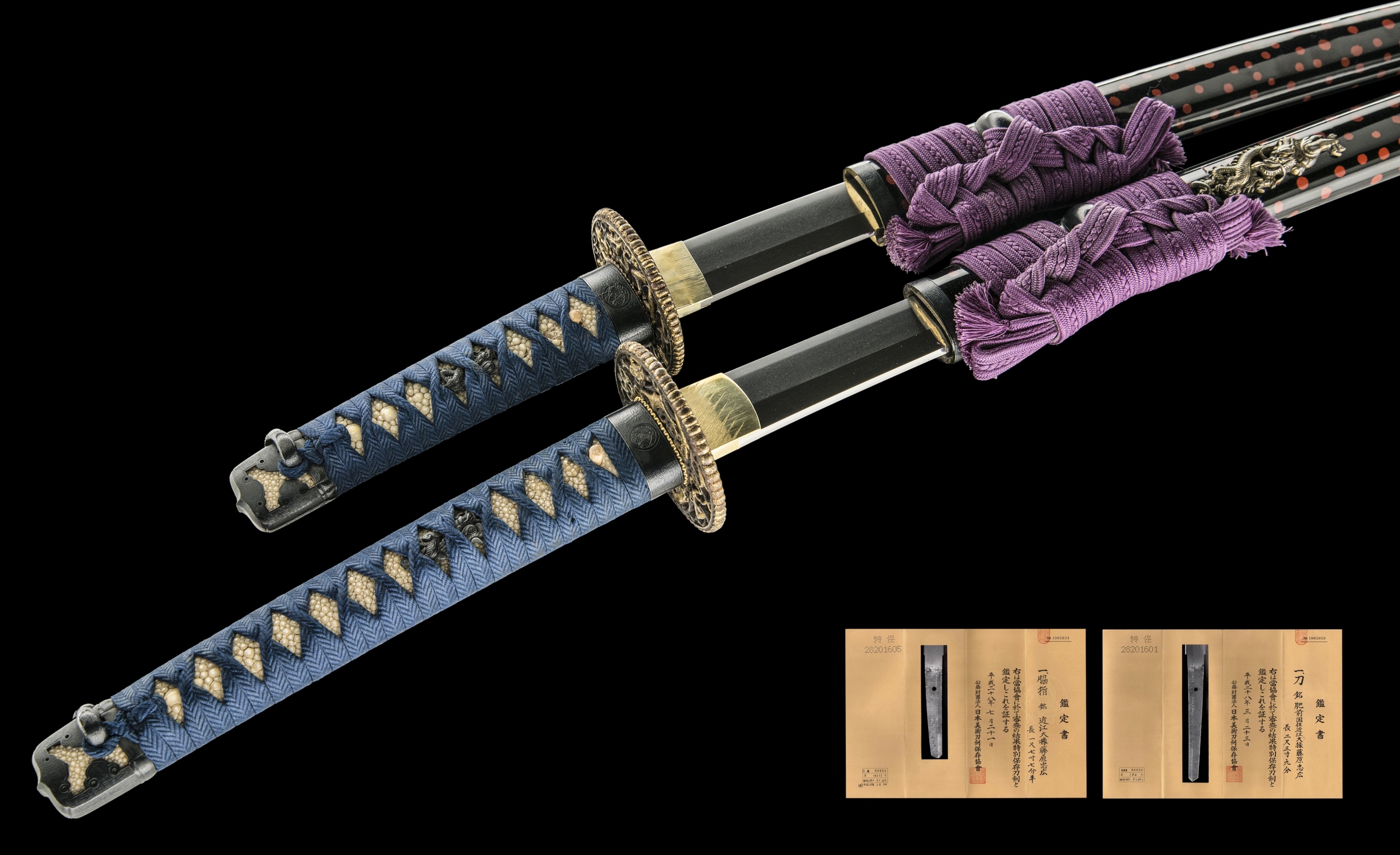
Born Hashimoto Heishiro in Saga, Hizen province in 1614, second generation (nidai) Tadahiro began training under his father, the legendary shodai (first generation) Tadayoshi, at the age of ten. Guided also by shodai Masahiro and Yoshinobu, he assumed leadership of the Tadayoshi School at just nineteen following his father’s death in 1632. In July of 1641, only nine years into his tenure, he was awarded the prestigious honorific title of Omi Daijo – assistant lord of Omi province. He was twenty-eight years old. Nidai Tadahiro worked for an extraordinary sixty years until his death in 1693 at the age of eighty-one, producing a body of work that places him among the most prized smiths in Japanese history. He is ranked Jojo-saku – a highly superior swordsmith.
Both swords in this daisho display Tadahiro’s signature characteristics: a masterful suguha hamon (straight temper line) running clean and bright over a finely worked jigane, packed so tightly that it produces the much-admired konuka-hada – the rice-bran grain that is the hallmark of great Hizen blades. The boshi on both swords is ko-maru, a small curl-back typical of Hizen-tô. Tiny ashi reach toward the cutting edge on the katana, and chikei (dark swirls of nie crystals) animate the steel on close inspection. Both blades remain in ubu (unshortened) condition with one mekugi-ana each, and both carry NBTHK Tokubetsu Hozon certification. The katana’s shirasaya sayagaki is by Dr. Sato Kanzan, dated Showa 51 (May 1976); the wakizashi’s sayagaki is also by Dr. Sato Kanzan, dated Showa Kenen (spring 1968).
The matching daisho koshirae is a spectacular period piece. Lacquered in black with red polka dots and vivid blue tsukas wrapped over stingray, the set projects both formality and exuberance – precisely the kind of festive daisho a wealthy Edo-period samurai would have worn on a night out. The fuchi on both hilts bear the famous cho-kamon (butterfly crest) of the Ikeda daimyo family, placing this set firmly in upper-echelon samurai hands during the mid-Edo period. The namban tsuba – chrysanthemum-form, polished iron with gold inlay, fire and twin-dragon design – carry NTHK-NPO Kanteisho certification for both the daisho koshirae and the tsuba. The wakizashi saya also houses a kozuka (small utility knife) decorated with ume (plum blossom) motifs in gold and coloured lacquer. Nearly all Edo-period daisho have long since been separated or survive in poor condition; this one comes together intact and magnificent.
| Item Number | UJDI006 |
| Sword Type | Daisho (katana and wakizashi) |
| Katana (Dai) | |
| Swordsmith | Nidai Tadahiro (second generation) |
| Swordsmith (JP) | 肥前国住近江大掾藤原忠広 |
| Signature | Hizen no Kuni ju Omi Daijo Fujiwara Tadahiro |
| School | Tadayoshi School, Hizen |
| Province | Hizen |
| Period | Shintô – Early Edo period (Kan’ei to Kanbun era: 1641-1673) |
| Nagasa | 72.3cm |
| Sori | 1.3cm |
| Moto-haba | 3.1cm |
| Weight | 675g |
| Nakago | Ubu, 19.5cm, 1 mekugi-ana, tachi-mei |
| Jihada | Tight mokume-hada with chikei; konuka-hada |
| Hamon | Suguha with plentiful hataraki and bright nioguchi; ashi |
| Boshi | Ko-maru |
| Sayagaki | Dr. Sato Kanzan — nidai Tadahiro, suguha, nagasa 72.3cm, dated Showa 51 (May 1976) |
| Wakizashi (Sho) | |
| Swordsmith | Nidai Tadahiro (second generation) |
| Swordsmith (JP) | 近江大掾藤原忠広 |
| Signature | Omi Daijo Fujiwara Tadahiro |
| School | Tadayoshi School, Hizen |
| Province | Hizen |
| Period | Shintô – Early Edo period (Kan’ei to Kanbun era: 1641-1673) |
| Nagasa | 53.8cm |
| Sori | 1.3cm |
| Moto-haba | 3.0cm |
| Weight | 570g |
| Nakago | Ubu, 17.5cm, 1 mekugi-ana |
| Jihada | Tight mokume-hada; konuka-hada |
| Hamon | Suguha with bright nioguchi |
| Boshi | Ko-maru |
| Sayagaki | Dr. Sato Kanzan — nidai Tadahiro, suguha deki, nagasa 53.8cm, dated spring 1968 |
| Certificates & Ratings | |
| Certificates | NBTHK Tokubetsu Hozon (both swords); NTHK-NPO Kanteisho (daisho koshirae and daisho tsuba) |
| Fujishiro Rank | Jojo-saku |
| Sharpness Rating | O’wazamono |
| Koshirae | |
| Koshirae | Matching daisho koshirae, mid-Edo period; black lacquer saya with red polka dots; purple sageo; handachi-style saya fittings |
| Tsuba | Matching daisho namban tsuba; chrysanthemum (kiku) form; polished iron with gold inlay; fire and twin-dragon design; NTHK-NPO Kanteisho certified |
| Fuchi-kashira | Matching set; fuchi with Ikeda daimyo cho-kamon (butterfly crest); kashira carved with clasped hands motif |
| Menuki | Crawling dragon design, shakudo |
| Tsuka | Blue silk tsuka-ito over white same (stingray skin); matching daisho |
| Catalogue | Catalogue 28 |
| Status | Sold |
| Includes | Two shirasayas, daisho koshirae, fabric bags, stands, kit, etc. |