
ITEM# UJDI002 – Catalogue 23 – Sold
A Matsuba Motoyuki Daisho (松葉本行)
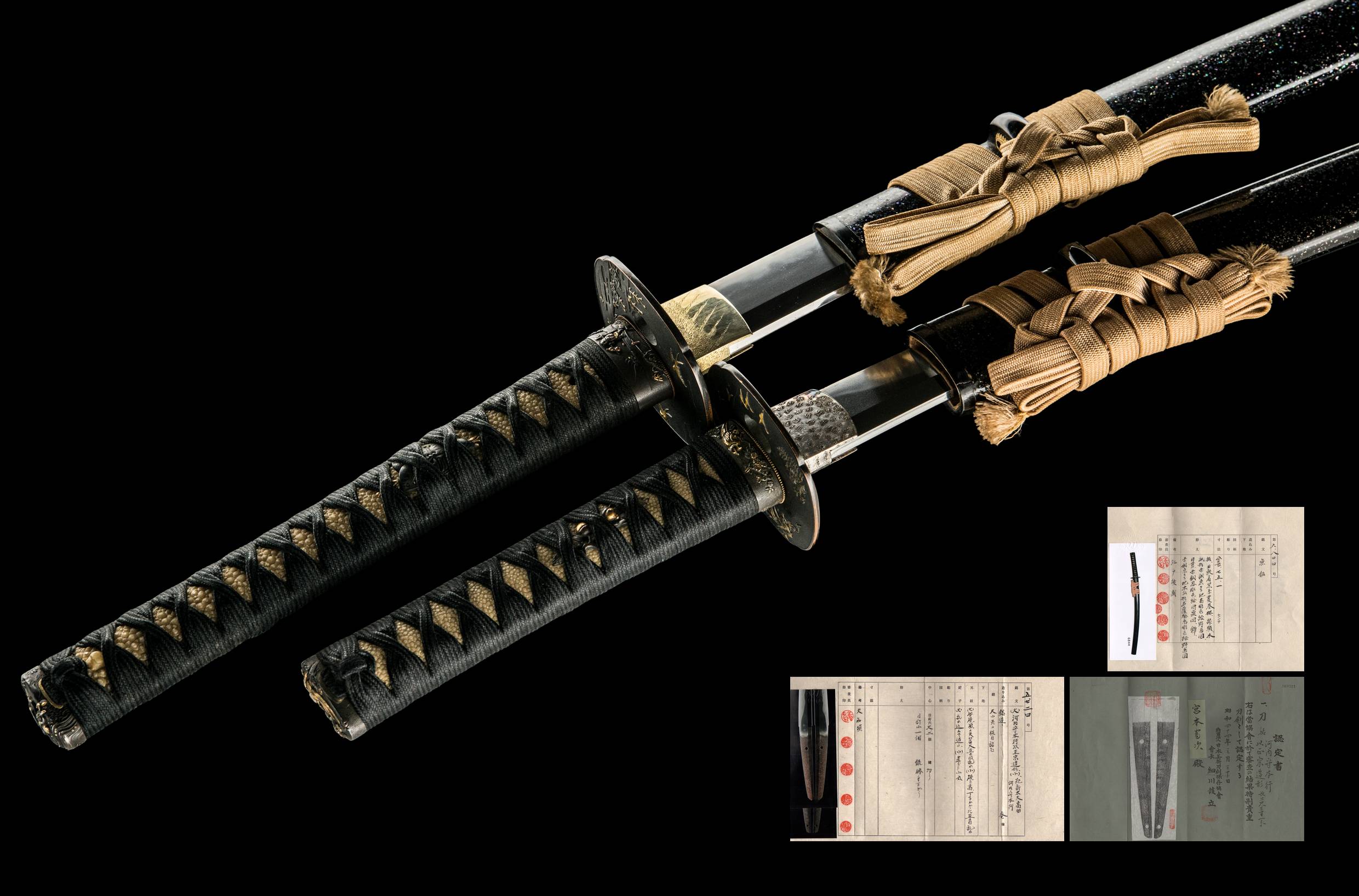
Kawachi no Kami Motoyuki (本行) is one of the most colourful figures in Shinto-period swordsmithing. Born in 1642 in Takada, Bungo province in Kyushu, he was the son of Shodai Naoyuki and claimed descent from the famous Koto-period Bungo smith Yukihira. His biography reads like a study in restless ambition: a move to Karatsu in 1677, a court title received the same year, formal study of Soshu techniques under Tsunahiro, and a journey to Kyoto in 1694 where the Hon’ami family bestowed upon him the character Hon (本) – read in Japanese as ‘Moto’ – whereupon he began signing Motoyuki. In his later years he formed the character for Moto to resemble pine needles (matsuba, 松葉), earning the affectionate nickname by which he is best known today. Both swords in this daisho are signed in precisely that distinctive pine-needle fashion.
The katana is a full-length ubu nakago blade of 69.8cm with a pronounced sori of 1.8cm, carrying a sublime hitatsura (full temper) hamon – a bubbling, crystal-rich landscape that showcases Motoyuki’s mastery of Soshu tradition at its most expressive. The wakizashi (52.1cm, ubu nakago) is signed and dated to the 11th month of Kyoho 6 (November 1721) with the full formal title: Ki Shindaibu Sue Takada Kawachi no Kami Motoyuki. Its hamon is an electric gunome choji midare with visible nie crystals. The katana carries a superb yujo-habaki in gold on copper; the wakizashi a richly textured botan-like habaki in silver on copper. Both swords were designated Especially Precious (Tokubetsu Kicho) by the NBTHK in the 44th and 46th year of Showa (1969 and 1971) – vintage certificates issued at a time when Juyo Token was the only rank above, making them highly prized. The daisho was further designated Yushusaku (Highly Excellent) by the NTHK-NPO in Heisei 26 (2014), published in an accompanying catalogue.
The koshirae tells its own story. Both sayas are decorated in aoi-gai – crushed limpet and mother-of-pearl lacquerwork that catches the light like a night sky – produced at different periods in the Edo era, hence their complementary rather than identical finish. The daisho tsubas depict herons and waterbirds among reeds and flowers, the fuchi of the katana carries the legend of Yoro Falls (the magical waterfall said to flow with sake), and the kashira depicts the Chinese hero Liu Bei in fine relief. Menuki on both handles feature finely worked decorative figures. The katana koshirae and wakizashi koshirae each hold an NTHK-NPO Kanteisho certificate. Together, this is a daisho of rare biographical depth – a monument to a swordsmith who never stopped learning.
| Item Number | UJDI002 |
| Set Type | Daisho (katana & wakizashi) |
| – Katana (Dai) – | |
| Sword Type | Katana |
| Swordsmith | Kawachi no Kami Motoyuki (Matsuba Motoyuki) |
| Swordsmith (JP) | 河内守本行 (松葉本行) |
| Signature | Kawachi no Kami Motoyuki (ubu nakago, matsuba style) |
| School | Sue-Takada (Bungo) |
| Province | Bungo (Oita prefecture) |
| Period | Shinto – Mid Edo (Kyoho era: 1716-1736, circa 1721) |
| Nagasa | 69.8cm (ubu nakago) |
| Sori | 1.8cm |
| Moto-haba | 3.3cm |
| Weight | 630g |
| Nakago | Ubu, 20.0cm, 2 mekugi-ana |
| Jihada | Itame, Soshu tradition |
| Hamon | Hitatsura (full temper) with rich nie |
| Habaki | Yujo-habaki (gold on copper base) |
| Certificates | NBTHK Tokubetsu Kicho (issued Showa 44, 1969) |
| – Wakizashi (Sho) – | |
| Sword Type | Wakizashi |
| Swordsmith | Kawachi no Kami Motoyuki |
| Swordsmith (JP) | 河内守本行 (松葉本行) |
| Signature | Ki Shindaibu Takada Kawachi no Kami Motoyuki (ubu nakago, matsuba style) |
| Date | Kyoho 6, 11th month (November 1721) |
| School | Sue-Takada (Bungo) |
| Province | Bungo (Oita prefecture) |
| Period | Shinto – Mid Edo (Kyoho era: 1716-1736) |
| Nagasa | 52.1cm (ubu nakago) |
| Sori | 1.6cm |
| Moto-haba | 2.86cm |
| Weight | 790g |
| Nakago | Ubu, 15.3cm, 1 mekugi-ana |
| Jihada | Itame, Soshu tradition |
| Hamon | Gunome choji midare with visible nie crystals |
| Habaki | Botan-like habaki (silver on copper base) |
| Certificates | NBTHK Tokubetsu Kicho (issued Showa 46, 1971) |
| – Koshirae & Fittings – | |
| Koshirae | Daisho koshirae; both saya decorated in aoi-gai (crushed mother-of-pearl lacquer). NTHK-NPO Kanteisho for each koshirae |
| Tsuba | Daisho tsubas with herons, waterbirds and botanical motifs in gold on shakudo |
| Fuchi-kashira | Katana: fuchi depicting Yoro Falls legend; kashira depicting Liu Bei. Wakizashi: complementary set |
| Certificates | NBTHK Tokubetsu Kicho x2 (swords), NTHK-NPO Yushusaku (daisho), NTHK-NPO Kanteisho x2 (koshirae) |
| Catalogue | Catalogue 23 |
| Status | Sold |
| Includes | 5 certificates total (NBTHK Tokubetsu Kicho x2, NTHK-NPO Yushusaku x1, NTHK-NPO Kanteisho x2), NTHK-NPO Yushusaku publication book |