A reference guide to the key terms used in Japanese sword collecting and samurai culture. Whether you are reading a sword description for the first time or brushing up on terminology you half-remember, this glossary is here to help. Terms are listed alphabetically. For illustrated diagrams of blade and koshirae components, see our Parts of a Japanese Sword page.
| Ha |
The cutting edge of the sword. |
| Habaki |
The collar around the blade above the tang that fits the blade securely into the scabbard. See Parts of a Japanese Sword. |
| Ha-buchi |
The border line between the ji and the yakiba. |
| Hada |
The surface grain of the blade. There are many types and more than one can appear on the same blade. See Parts of a Japanese Sword. |
| Hagane |
Steel used to make a Japanese sword – may also be referred to as tamahagane, the raw jewel steel. |
| Hagiri |
A flaw where the blade edge is cracked entirely through at a right angle to the edge. |
| Hakikake |
A feature of the tempered edge in which nie appear in a swept or brush-stroke pattern. |
| Hako-ba |
A box-shaped hamon. |
| Hamachi |
The edge notch where the blade joins the tang. See Parts of a Japanese Sword. |
| Hamon |
The temper line – the visible boundary between the hardened cutting edge and the softer body of the sword. One of the most studied elements of a Japanese blade. See Parts of a Japanese Sword and How Does a Japanese Sword Get So Hard and Sharp? |
| Handachi |
A katana with partly tachi mountings. |
| Hi |
Grooves cut into the blade. See Parts of a Japanese Sword. |
| Hira |
The flat surface of the blade. |
| Hira-zukuri |
A blade shape that is flat without shinogi ridges. |
| Hitatsura |
A hamon of full temper where the blade tends to resemble a tiger. |
| Hitsu-ana |
One or two holes in the sword guard (tsuba) through which the kozuka and/or kôgai are inserted into pockets in the scabbard. |
| Horimono |
A general term for carvings on the blade surface, including grooves (hi) and pictorial engravings. See 7 Points, Point 5. |
| Kaen |
A flame-shaped bôshi pattern. |
| Kaeri |
The shape of the turn-back of the bôshi pattern. |
| Kai-guntô |
Modern Japanese Naval swords. |
| Kaji |
A swordsmith. |
| Kaku-mune |
A square shape to the back of the mune. |
| Kami |
In Shinto belief, invisible spiritual beings and powers. Kami can be elements of the landscape, forces of nature, or exist within human-made objects such as a sword. |
| Kanji |
Chinese writing characters used in Japan. Seen on sword tangs in signatures, dates and inscriptions. |
| Kantei |
The study and appraisal of Japanese swords. |
| Kasane |
General term for the thickness of the blade. |
| Katana |
A long sword of 60.6cm or greater, worn cutting edge up through the belt. The most familiar form of Japanese sword. See 7 Points, Point 2. |
| Katana-kaji |
A swordsmith. |
| Katana-mei |
The signature on the side of the tang facing away from the body when the blade is worn cutting edge up. |
| Katana-togishi |
A sword polisher. |
| Katana-kake |
A horizontal sword display stand. |
| Katakiriba |
A sword shape with a ridgeline on one side only, the other side flat. |
| Ken |
A straight, double-edged sword. |
| Kengyo |
A tang end with a symmetrical V-shape. |
| Kinsuji |
Whitish-golden lines along or within the yakiba. |
| Kissaki |
The point of the blade. Comes in several shapes – ko-kissaki (small), chû-kissaki (medium) and ô-kissaki (large). See Parts of a Japanese Sword. |
| Kitae |
The style of forging. |
| Kizu |
Various flaws or defects in a blade. Literally “cut or scratch.” |
| Kodachi |
Short tachi blades, usually 60.6cm or less, from the Kamakura period. |
| Kôdôgu |
The collective term for all sword fittings except the tsuba. |
| Kôgai |
A hair-arranger which fits into a pocket in the scabbard, withdrawn through the hitsu-ana in the tsuba. |
| Kôjiri |
The fitting on the bottom end of the scabbard. See Parts of a Japanese Sword. |
| Ko-kissaki |
A blade point of short length in proportion to the width near the tang. Associated with refined, older aesthetics. |
| Komaru |
A small round bôshi. |
| Ko-mokume |
Small wood-burl grain hada. |
| Ko-nie |
Tiny martensite crystals along the hamon. |
| Koshirae |
The full mounting of a Japanese sword, including scabbard, fittings and handle. See Parts of a Japanese Sword and our Koshirae page. |
| Koshi-zori |
A blade curve with the maximum curve point nearer to the tang than the middle. Characteristic of older tachi. |
| Kôtô |
Old swords – generally swords made before 1600. The most sought-after period for serious collectors. See 7 Points, Point 3. |
| Ko-wakizashi |
A short wakizashi. |
| Kozuka |
A small utility knife that fits into a pocket in the scabbard. |
| Kuri-jiri |
A rounded asymmetrical tang end resembling a chestnut shape. |
| Kurikata |
The knob on the side of the scabbard for the belt cord. |
| Machi |
Notches in the blade to stop the habaki. The edge side is the hamachi; the back side is the munemachi. |
| Machi-okuri |
When the notches have been moved up the blade. |
| Maki-ito |
The braid for wrapping handles. |
| Masame-hada |
Straight grain. One of the most distinctive and admired jihada types – characteristic of the Yamato tradition. |
| Mei |
Signature. See Parts of a Japanese Sword. |
| Mekugi |
The peg holding the handle onto the tang. See Parts of a Japanese Sword. |
| Mekugi-ana |
The hole for the mekugi. |
| Menuki |
Ornaments under the handle wrapping to improve grip. See Parts of a Japanese Sword. |
| Midareba |
Irregular hamon patterns. |
| Midare-chôji |
Irregular clove shapes in the hamon. |
| Mihaba |
The general width of the blade from the back edge to the cutting edge. |
| Mitsu-mune |
A three-surface back edge of the blade. |
| Mizukagi |
The white diagonal stripe at the base of a re-tempered blade. |
| Mokume-hada |
A burl wood grain hada. |
| Mono-uchi |
The striking area of the blade – generally 12-16cm below the point. See Parts of a Japanese Sword. |
| Moroha |
A double-edged sword. |
| Motohaba |
The width of the blade measured at the habaki(collar). |
| Mumei |
A blade without a signature. An unsigned sword is not a lesser sword – in certain traditions, a signed blade is actually the exception. See 7 Points, Point 5. |
| Mune |
The back edge of the blade. See Parts of a Japanese Sword. |
| Munemachi |
The notch in the back of the blade to stop the habaki. |
| Muneyaki |
A temper pattern along the back edge of the blade. |
| Musori |
A blade without curvature (sori). |
| Nagamaki |
A type of koshirae for a naginata in which the hilt was wrapped with cord or leather. |
| Nagasa |
The length of the blade. See Parts of a Japanese Sword. |
| Naginata |
A long hafted sword used in large sweeping strokes. Many naginata were later shortened to katana or wakizashi length – known as naginata-naoshi. See 7 Points, Point 2. |
| Nakago |
The tang of the blade – the part that fits into the handle. Never polished, it is one of the most reliable guides to a sword’s age. See 7 Points, Point 5. |
| Nakago-jiri |
The butt end of the tang. |
| Nakago-mune |
The back edge of the tang. |
| Namban-tetsu |
A general term for foreign steel. |
| Nambokuchô |
The period of the Northern and Southern dynasties, approximately 1333 to 1392. A period of intense warfare characterised by long, powerful blades with large ô-kissaki. |
| Naoshi |
Corrected or repaired. |
| Nie |
Martensite crystals formed during the heating and quenching process – large enough to be viewed as individual particles. See How Does a Japanese Sword Get So Hard and Sharp? |
| Nioi |
The same phenomenon as nie but at a finer scale – particles too small to be individually discernible, appearing like a mist or fog. |
| Notare |
A hamon outline that is wave-like. |
| Ô-chôji |
A hamon of large clove patterns. |
| Omote |
The side of the sword facing away from the body when worn. The opposite side is the ura. |
| Origami |
A certificate of appraisal. Refers to NBTHK and NTHK-NPO authentication certificates. See NBTHK Certification Rankings. |
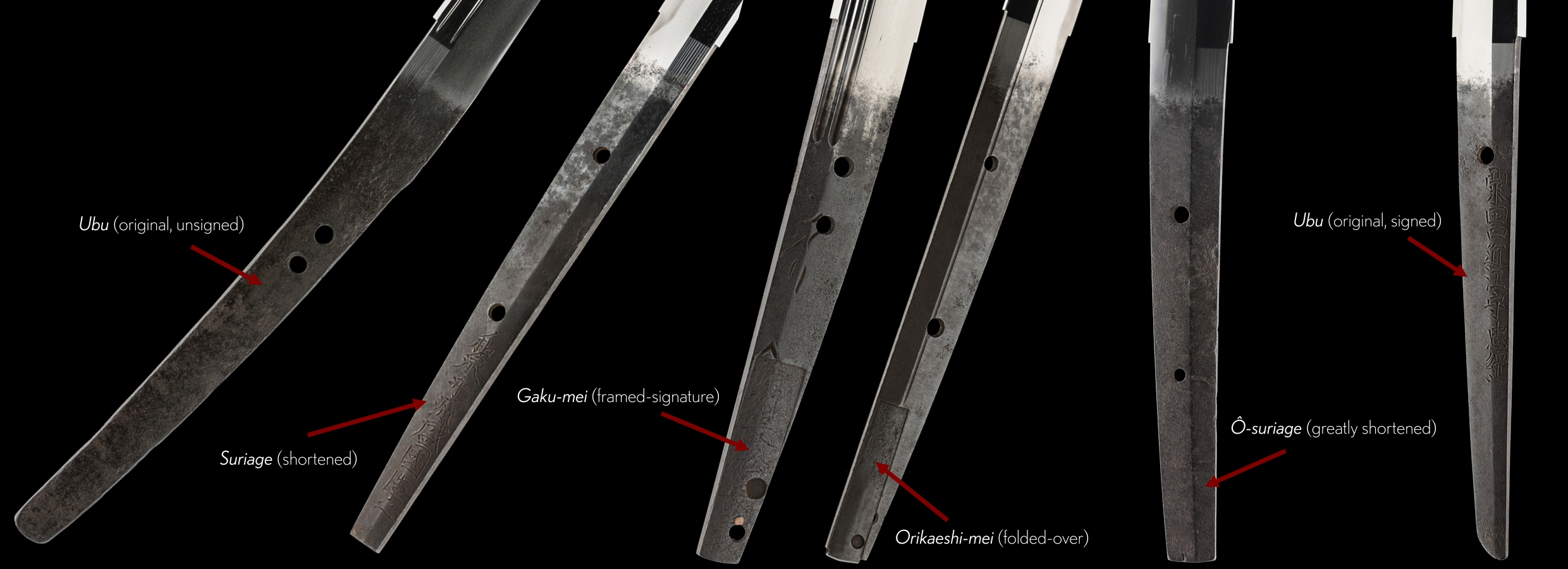
| Orikaeshi-mei |
A blade signature folded onto the opposite side of the tang when the blade is shortened. |
| Oshigata |
A rubbing of the inscription on the tang, used in documentation and on NBTHK Jûyô certificates. |
| Ô-suriage |
A blade that has been greatly shortened, losing all or most of the original tang. |
| Ô-wakizashi |
A longer wakizashi, almost two shaku (60.6cm) in length. |
| Sageo |
The cord or braid attached to the kurikata on the scabbard. |
| Saiha |
A re-tempered edge. |
| Saka-chôji |
Clove shapes slanting down toward the base of the blade. |
| Saki-haba |
The width of the blade at the kissaki (point). |
| Saki-zori |
Curvature with the more pronounced curve toward the point. Tends to suggest a later sword. |
| Same |
Ray fish skin used on sword handles and sometimes scabbards. |
| Samurai |
The elite warrior class of Japanese feudal society (1185-1868), guided by the code of Bushidô. The term derives from the Japanese verb saburau – “one who serves.” Not merely fighters, the samurai were also men of culture. See 7 Points, Point 1. |
| Sanbonsugi |
A “three-tree” hamon pattern. The Mino swordsmith Kanemoto was famous for this distinctive style. |
| Saya |
The scabbard or sheath. See Parts of a Japanese Sword. |
| Sayagaki |
An inscription written on the shirasaya by a scholar, recording the sword’s attribution, period and other details. A sayagaki by Tanobe-sensei or Kanzan-sensei adds significant historical and scholarly value. |
| Seppa |
Washers used to fill the space between the tsuba and the sword. |
| Seppuku |
Ritual suicide by disembowelment. A practice of the samurai class, performed to avoid capture or to restore honour. |
| Shaku |
The Japanese unit of measurement equalling 30.3cm (11.93 inches). A tanto measures less than 1 shaku, a wakizashi between 1 and 2 shaku, and a katana is 2 shaku or more. |
| Shinae |
Small cross-wise cracks in a blade. A flaw. |
| Shinogi |
Ridges on each side of the blade. See Parts of a Japanese Sword. |
| Shinogi-zukuri |
Swords made with a ridgeline – the most prevalent type. |
| Shintô |
“New swords” – swords produced between approximately 1600 and 1780. See 7 Points, Point 3. |
| Shintoism |
The Japanese spiritual tradition devoted to invisible beings and powers called kami. Shinto has no known founder or single sacred scripture, and emphasises man’s essential goodness. |
| Shinshintô |
“New-new swords” – swords made between approximately 1781 and 1876, when smiths consciously attempted to revive the traditions of the kôtô masters. See 7 Points, Point 3. |
| Shirasaya |
A plain magnolia wood scabbard used for long-term storage. We refer to the shirasaya as the “humidor” for a Japanese sword – it absorbs moisture and preserves the steel. See 7 Points, Point 6. |
| Shôwa-tô |
Handmade blades produced after 1926. |
| Sori |
The curvature of the sword. See Parts of a Japanese Sword. |
| Suguba |
A straight hamon paralleling the edge curve. A perfectly executed suguba is a masterpiece of restraint. |
| Sunagashi |
Sweeping lines along the hamon like floating sand ridges. |
| Sun-nobi |
Longer than average wakizashi or tanto. |
| Suriage |
A shortened blade, generally cut from the base. See Parts of a Japanese Sword. |
| Tachi |
Long swords slung blade-down, carried mainly on horseback. Primarily produced during the Heian (794-1185) and Kamakura (1185-1333) periods. The pinnacle of Japanese sword collecting. See 7 Points, Point 2. |
| Tachi-kake |
A sword rack or stand for a tachi, displaying the blade facing downward. |
| Tachi-mei |
A signature on the side of the tang facing away from the body when the blade is worn slung with the cutting edge down. |
| Tamahagane |
Literally “jewel steel” – the raw steel used to make a Japanese sword, produced in a tatara clay furnace from iron sand and charcoal. See How Does a Japanese Sword Get So Hard and Sharp? |
| Tameshigiri |
A cutting test performed on a sword, sometimes recorded in gold or silver inlay on the nakago. A tameshigiri inscription is a highly collectible feature. See our available swords for examples. |
| Tantô |
Short daggers less than one shaku in length (30.3cm). See 7 Points, Point 2. |
| Togi |
Polish on a sword. |
| Torii-zori |
A blade curve with the deepest point in the centre of the blade. |
| Tsuba |
The sword guard. See Parts of a Japanese Sword. |
| Tsuka |
The sword handle (hilt). See Parts of a Japanese Sword. |
| Tsuka-ito |
The braid for wrapping the handle, normally made of silk. |
| Tsuka-maki |
The sword handle wrapping. |
| Tsunagi |
A wooden “mirror” sword used to keep the koshirae intact when the blade is housed in a shirasaya. |