
Resource Article – Written by Pablo Kuntz, Founder of Unique Japan
How Does a Japanese Sword Get So Hard and Sharp?
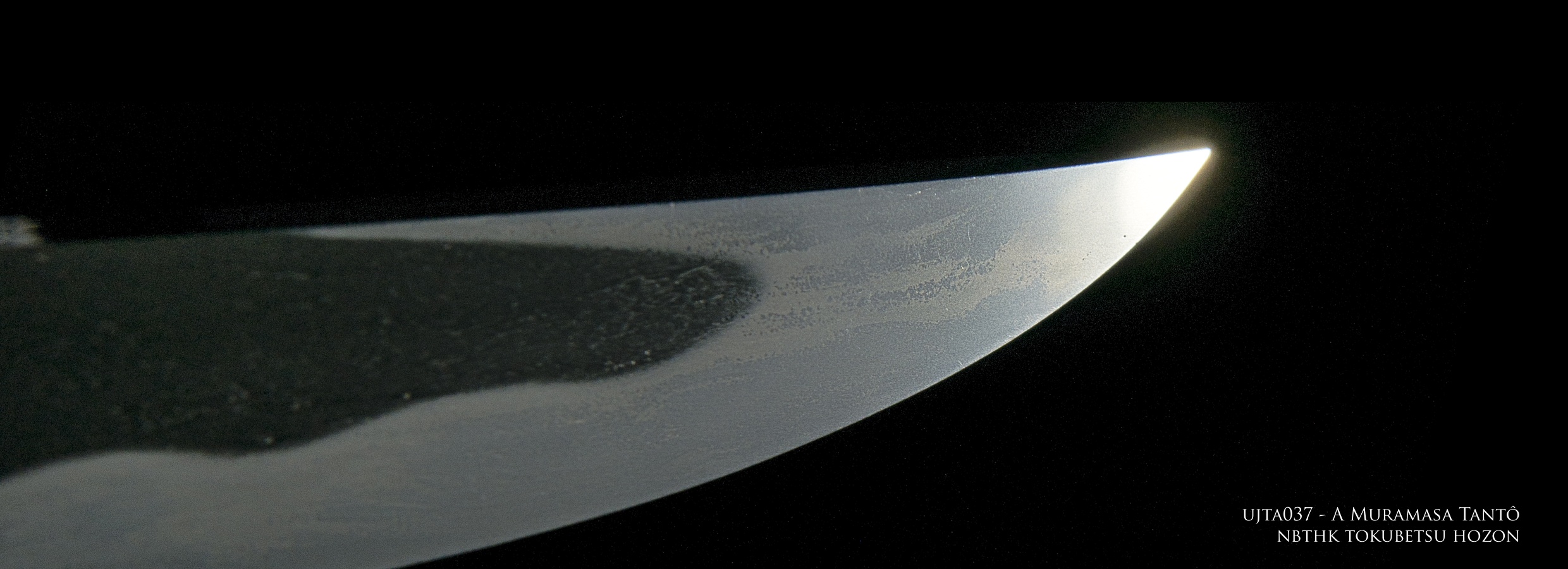
This is one of the questions I genuinely enjoy answering, because the science behind it is as fascinating as the object itself. A Japanese sword achieves its legendary sharpness and durability through a process that is simultaneously straightforward in principle and extraordinarily difficult in execution. Understanding it changes how you look at every blade.
The short answer: the hardness comes from trapping carbon inside iron crystals at the moment of quenching. The longer answer – which explains why the hamon looks the way it does, and why a great sword polisher can make you feel like you are looking into the surface of another world – is below.
| Quick Navigation | |
| Tamahagane | The raw material – steel made from iron sand |
| Folding and Forging | How the steel is refined and shaped |
| The Clay Coating | The secret to differential hardening |
| Yaki-ire | The quenching process – the most critical moment |
| The Hamon | What the temper line actually is – and why it is beautiful |
| Polishing | How the sword’s beauty is revealed |
Tamahagane – Jewel Steel
It begins with the raw material. Japanese swords are traditionally made from tamahagane – literally “jewel steel” – which is produced in a clay furnace called a tatara using iron sand (satetsu) and charcoal. This is a process virtually unchanged for over a thousand years, and it produces a steel with a carbon content that varies throughout the bloom. That variability, far from being a flaw, is essential to what follows.
The tatara smelt takes roughly three days. The resulting bloom of raw steel – the kera – is broken apart by the swordsmith to identify the pieces with the right carbon content for different parts of the blade. High carbon steel for the cutting edge and outer skin, low carbon steel for the core. The distinction matters enormously, as we will see.
Folding and Forging
The raw steel is heated, hammered, folded and hammered again – repeatedly. Each fold doubles the number of layers. After fifteen folds you have over 30,000 layers. This process does several things simultaneously: it drives out impurities, distributes the carbon more evenly through the steel, and creates the distinctive grain pattern – the jihada – that is one of the most immediately beautiful things about a Japanese sword under good light.
This is where the different steel types are married together. The hard high-carbon steel (hagane) wraps around a softer low-carbon core (shingane), typically in one of several traditional construction methods. The result is a blade with a hard outer skin capable of holding a razor edge, and a tough flexible core that absorbs shock without breaking. The combination is what makes the Japanese sword so extraordinarily effective as a cutting tool – and so resistant to the kind of catastrophic failure that plagued European swords of comparable sharpness.
The Clay Coating – Tsuchioki
Before the sword is hardened, the swordsmith applies a mixture of clay, charcoal powder and stone powder to the surface of the blade. This is called tsuchioki and it is where the real artistry begins.
The clay is applied thickly along the back of the blade and spine, and thinly – or not at all – along the cutting edge. The boundary between thick and thin clay is not a straight line. The swordsmith manipulates the edge of the clay with tools and fingers to create the pattern he intends for the hamon. Straight, wavy, irregular, spiked – this is decided now, before the blade enters the fire for the last time.
Why does the clay matter? Because clay is an insulator. When the blade is quenched, areas covered in thick clay will cool slowly. Areas with thin or no clay will cool rapidly. That difference in cooling rate is everything.
Yaki-ire – The Quenching Process
Here is the science, and it is remarkable.
Before heating, the steel contains tiny crystals of nearly pure iron. The carbon in the steel lives outside those crystals. At red heat – around 800°C / 1,742°F – the carbon dissolves into the iron crystals and the steel becomes homogeneous. At this moment, the entire blade is one unified material.
Then the swordsmith plunges it into water. This is yaki-ire.
In the areas covered by thick clay – the spine and body of the blade – cooling is gradual. The carbon has time to migrate back out of the iron crystals into its original position. The steel remains relatively soft and tough: ideal for the body of the sword that must flex and absorb shock.
But along the cutting edge, where the clay was thin or absent, cooling is almost instantaneous. The carbon atoms scramble frantically to escape the iron crystals but they do not have time. They are trapped. The resulting carbon-stuffed iron crystals are a form of steel called martensite – extraordinarily hard, capable of holding an edge that nothing else can match, and the heart of every great Japanese cutting sword ever made.
The entire transformation happens in seconds. The swordsmith has one chance. If the temperature is wrong, if the quench is mistimed, if the blade warps beyond correction or – worst of all – if it cracks, the work of weeks is lost. Every serious collector who understands what yaki-ire involves looks at a well-hardened blade with a different kind of respect.
The Hamon – What You Are Actually Looking At
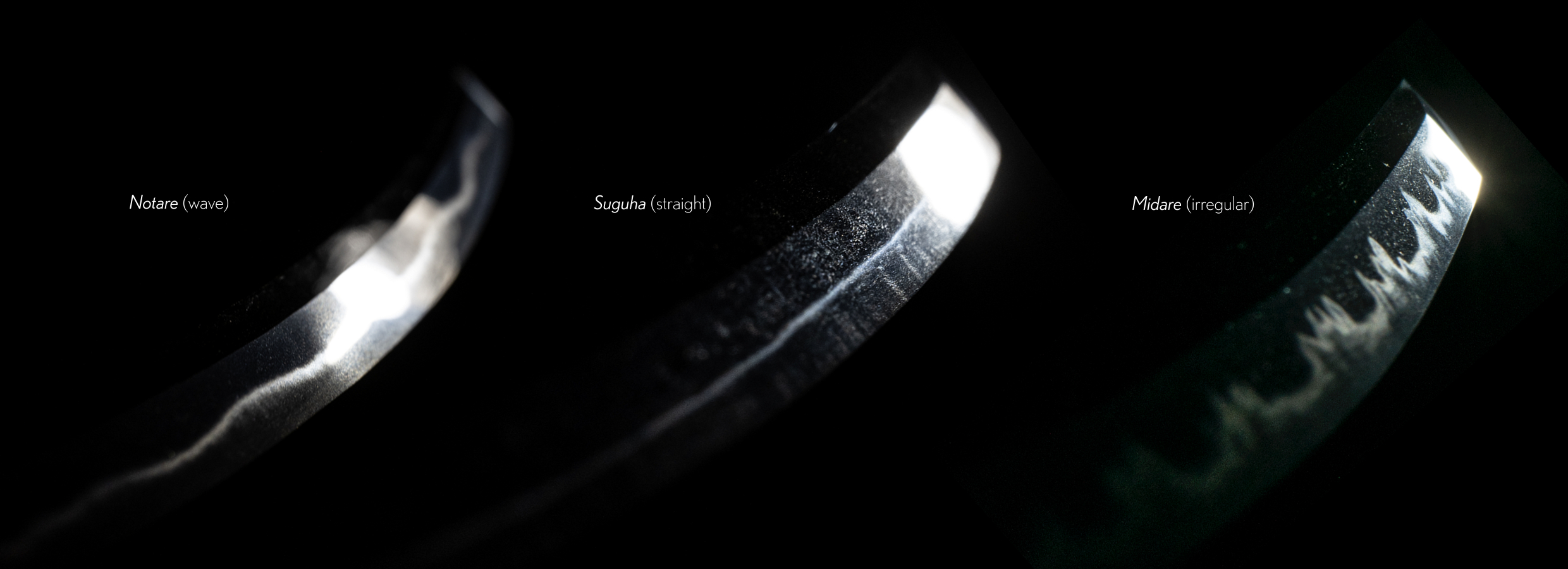
The hamon – the temper line – is the visible boundary between the hard martensitic cutting edge and the softer body of the sword. It is not decorative in origin. It is the direct physical record of where the clay was placed, and therefore where the steel hardened and where it did not.
But within and around the hamon is a world of fine activity that rewards close study under a good light source. Nie are bright crystalline particles visible as individual points of light – the result of martensite crystals large enough to be seen by the naked eye. Nioi is a misty, smoky quality – the same phenomenon at a finer scale. Kinsuji are bright lines running through the hamon like golden thread. Sunagashi looks like brushed sand. These effects are not planned – they emerge from the interaction of the steel’s grain structure, the clay boundary, and the precise conditions of the quench.
Two swords from the same smith, made the same week, with the same clay pattern, will produce different hamon. That is part of what makes this art form inexhaustible. No two swords are identical.
Polishing – How the Beauty is Revealed
After yaki-ire the blade exists but cannot yet be seen. It takes a master polisher – a togishi – working through a progression of increasingly fine stones over many weeks to reveal what the swordsmith has made. The polishing is not merely cosmetic. It is the final stage of making the sword, and a great polisher can reveal qualities in a blade that a poor polisher would bury forever.
The finest polishers have an intimate understanding of the steel. They work the surface in ways that make the jihada visible, that bring out the nie and nioi in the hamon, that give the blade its characteristic wet and reflective quality. The relationship between swordsmith and polisher has historically been one of mutual respect – Sasaki Takushi, one of the greatest polishers of recent decades, was known to say that a great polisher serves the sword, not the other way round.
When you hold a well-polished Japanese sword under a single light source and move it slowly, you are watching hundreds of thousands of crystal structures catch and release the light. The depth you perceive in the steel is real – it is the jihada, the grain produced by all that folding and forging. The activity in the hamon is real. The sword is showing you its entire history in light.
That is why people who understand these objects find them so difficult to put down.
Pablo Kuntz
Founder, Unique Japan
| Further Reading | |
| 7 Points to Consider When Choosing Your Japanese Sword | Point 5 covers sugata, hamon, jihada, nakago and horimono in detail |
| Parts of a Japanese Sword and Mountings | Illustrated diagrams with English labels for all blade components |
| Essential Books on Japanese Swords and Culture | Recommended reading including The Craft of the Japanese Sword by Leon Kapp and Yoshindo Yoshihara |
| Available Swords | Current inventory with full PDF descriptions and hamon photography |