
ITEM# UJWA244 – Sold
A Gassan Sadakazu Wakizashi (帝室技藝員月山貞一)
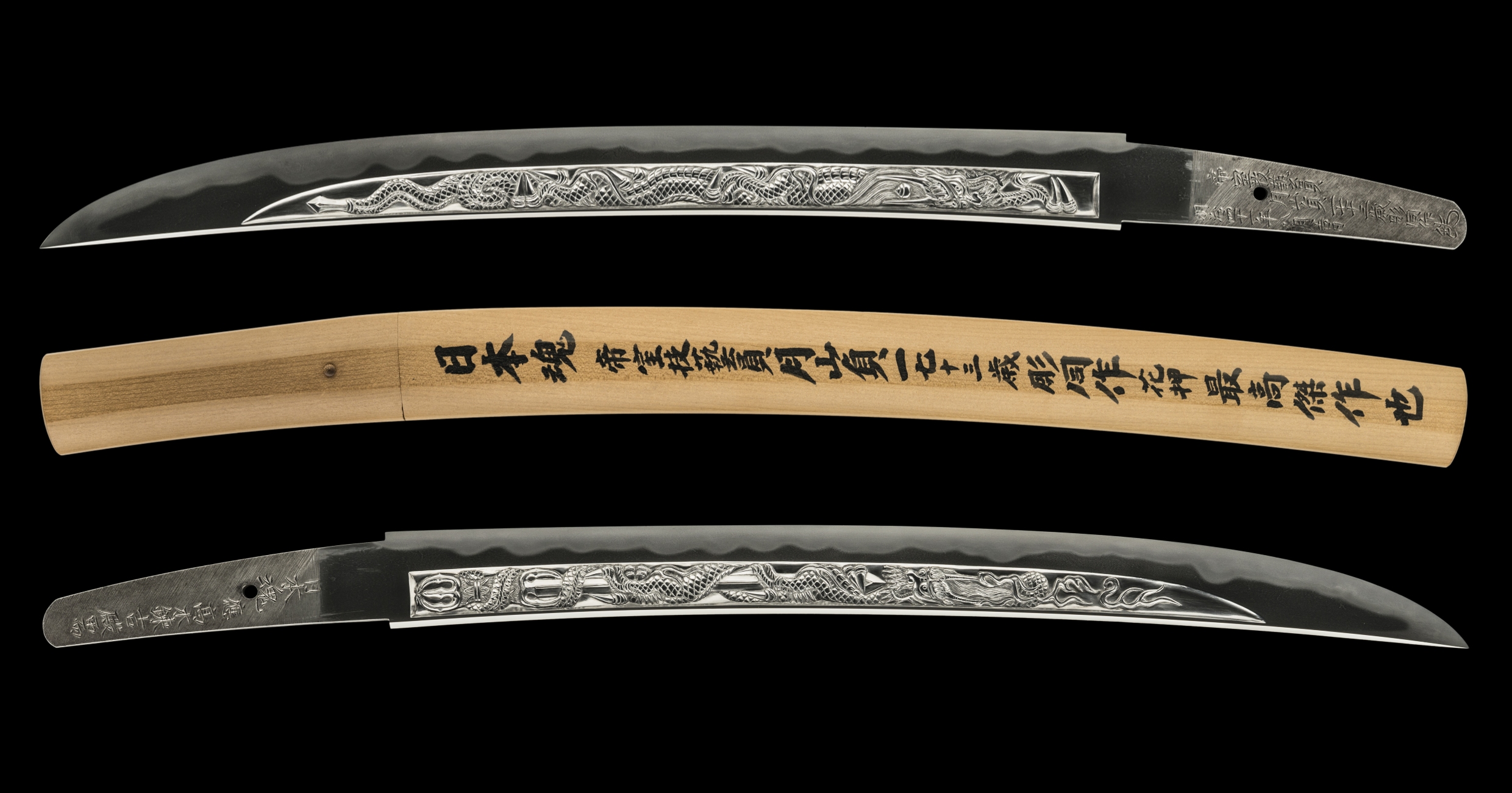
Gassan Sadakazu (1837-1918) was the foremost swordsmith of the Meiji era. Adopted into the Gassan family as heir to Sadayoshi, his career saw him master every major tradition – Bizen, Sôshû, Yamashiro and Yamato – a range matched by no other smith of his generation. In 1906 he was appointed Imperial Court Artisan (Teishitsu-gigei’in), the highest honour available to a craftsman in Japan.
This wakizashi was crafted in 1908 when Sadakazu was 73. It was commissioned by Colonel Takagi Renkichi – a graduate of the Imperial Military Academy, a celebrated sword master, and a relative of Princess Yuriko of the imperial family. Takagi gave Sadakazu a specific brief: to create an utsushi (recreation) of a celebrated 17th-century wakizashi by the grandmaster Nanki Shigekuni, complete with its elaborate horimono. The blade is forged in the Sôshû tradition – the hataraki illuminates the steel like electricity, with kinsuji, sunagashi and clusters of yô falling toward the cutting edge. The boshi is midare-komi with a long kaeri, kinsuji streaming through to the very tip.
But it is the horimono that lifts this piece into another order entirely – arguably the most exhilarating engraving work Sadakazu ever produced. Kurikara kenmaki-ryû, a dragon coiled around a sword, on one side; sankozuka (vajra) on the other – both hand-chiselled by Sadakazu himself. The detail is staggering: scales individually rendered, three-clawed feet, an aliveness in the eyes that follows you from any angle. Sadakazu eclipsed the original Gonsuke Ikeda engraving on the Shigekuni reference piece, and he knew it. He inscribed the blade with three significant characters – Nihon Damashî 日本魂, “The Soul of Japan” – giving the sword a Go Mei, an esteemed sword name reserved for works of the highest order. His great-grandson Sadatoshi, current head of the Gassan family, later examined the wakizashi and declared it in sayagaki as saikô kessaku nari – his ancestor’s greatest masterpiece.
| Item Number | UJWA244 |
| Sword Type | Wakizashi (ubu) |
| Swordsmith | Gassan Sadakazu |
| Swordsmith (JP) | 月山貞一 |
| Signature | Teishitsu-gigei’in Gassan Sadakazu nanajûsan-sai hori-dôsaku (kaô) |
| Date | Meiji 41 (August 1908) |
| School | Gassan |
| Province | Osaka |
| Period | Gendaitô – Meiji era (1908) |
| Nagasa | 42.7cm |
| Sori | 0.9cm |
| Moto-haba | 3.68cm |
| Moto-kasane | 6.6mm |
| Weight | 410g |
| Nakago | 13.8cm (ubu, one mekugi-ana) |
| Jihada | Ko-itame with ji-nie, abundant chikei |
| Hamon | Exuberant gunome-midare with plentiful kinsuji, ashi, sunagashi in nie-deki |
| Horimono | Kurikara kenmaki-ryû (omote), sankozuka / vajra (ura) – all hand-chiselled by Sadakazu |
| Boshi | Midare-komi with long kaeri, kinsuji |
| Fujishiro Rank | Jôjô-saku (a highly superior smith) |
| Sayagaki | Gassan Sadatoshi (great grandson) — declared saikô kessaku nari (his greatest masterpiece), inscribed Heisei 14 (February 2002) |
| Habaki | Gold habaki with a unique rock pattern |
| Status | Sold |
| Includes | Shirasaya inscribed with sayagaki, gold habaki |