
ITEM# UJTA049 – Catalogue 34 – Sold
A Teruyoshi Tantô (於東武英義作之)
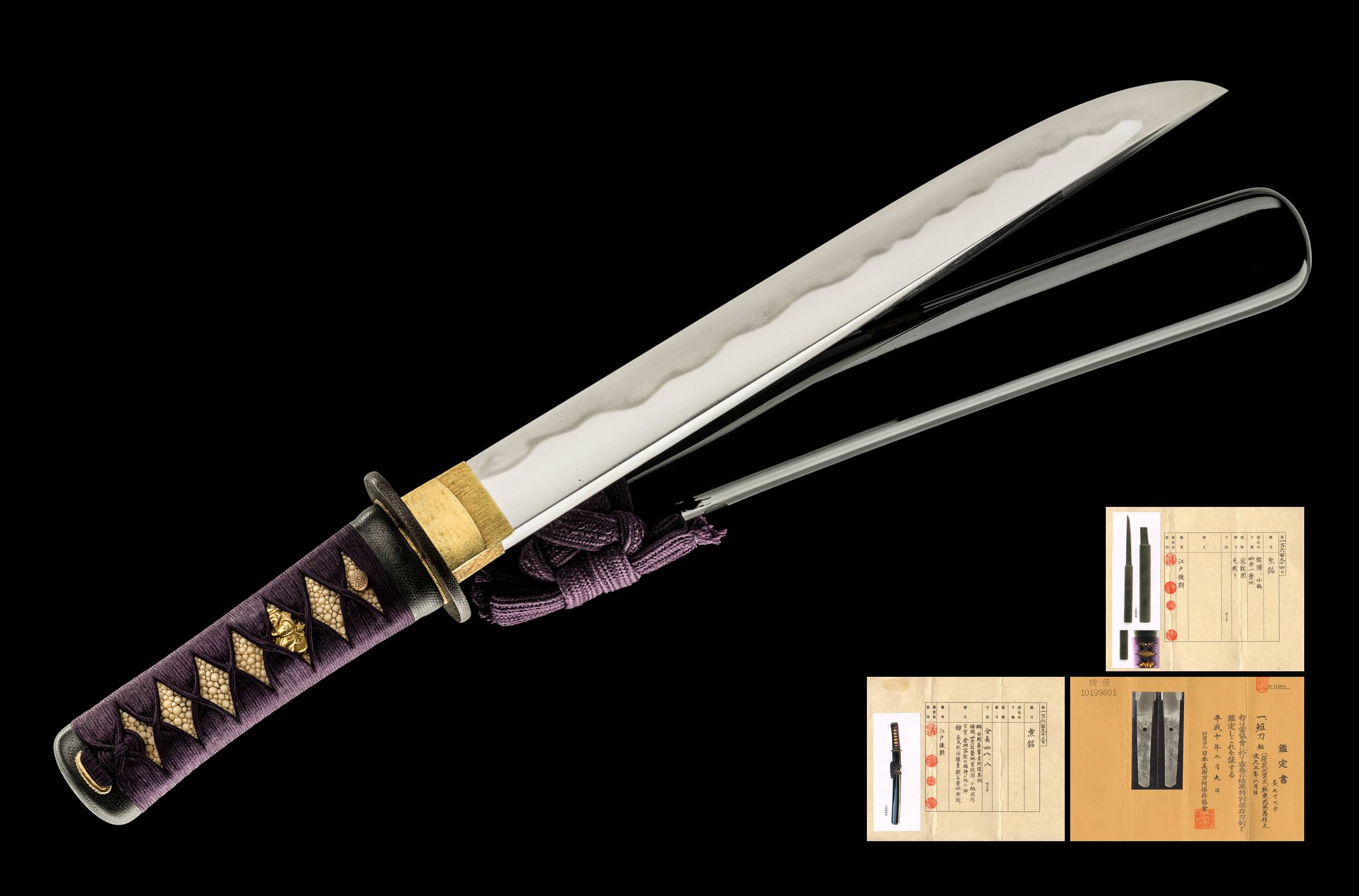
This is a beautifully refined Shinshintô tanto by the first generation Teruyoshi, a swordsmith working in Musashi province – the great hub of late Edo swordsmanship centred on Edo itself. Signed with a cherry blossom device (ôka futaba mon) and the full location and name inscription, and dated to a day in the eighth month of Bunkyû 3 (August 1863), this is a precisely documented piece made in the final turbulent years before the Meiji Restoration. The blade is hira-zukuri in form – flat-ground with no ridge, the classical tanto configuration – with zero sori, giving it a composed, purposeful profile at 29.4 cm.
The hamon is a gorgeous gunome-chôji-midare that runs the full length of the blade with an energy and clarity that belies the modest dimensions. The boshi is a saki-Jizo form – midare komi rolling into a rounded tip that resembles the profile of Jizo Bosatsu. An eye-catching island of nie crystals is embedded within the hamon, one of those small miracles of the polishing stage that rewards careful examination. The NBTHK awarded Tokubetsu Hozon in 1998, a strong endorsement of the blade’s quality.
The shirasaya carries a sayagaki by the late Satô Kanzan, one of the great sword scholars of the 20th century, inscribed in summer of 1974. The late Edo tanto-koshirae – glossy black lacquered saya with purple silk cord and braid – is an elegant complement, fitted with a kozuka, iron tsuba, gold menuki depicting Yebisu (god of fishermen and luck), and a kashira bearing a matching family crest. Gold habaki, gold menuki, purple everywhere: this is a koshirae of considerable refinement.
| Item Number | UJTA049 |
| Sword Type | Tantô |
| Swordsmith | Teruyoshi (first generation) |
| Swordsmith (JP) | 英義 |
| Signature | (Ôka futaba mon) Tôbu ni oite Teruyoshi kore o tsukuru |
| Date | Bunkyû 3 (1863), 8th month |
| Province | Musashi |
| Period | Shinshintô – Late Edo period (Bunkyû era: 1861-1864) |
| Nagasa | 29.4 cm |
| Sori | 0.0 cm |
| Moto-haba | 2.91 cm |
| Weight | 445 g |
| Nakago | Ubu-nakago; o-sujikai-yasurime (diagonal file marks); 1 mekugi-ana; ôka futaba (cherry blossom) device |
| Hamon | Gunome-chôji-midare with nie; saki-Jizo boshi; island of nie embedded in hamon |
| Boshi | Midare-komi with saki-Jizo (rounded, tobiyaki spot present) |
| Certificates | NBTHK Tokubetsu Hozon (issued Heisei 10 / 1998, February 9th) |
| Sayagaki | Kanzan (Satô Kanzan) — Teruyoshi, dated Shôwa kinoe-tora doshi natsu (summer 1974) |
| Koshirae | Kuro-roiro-nuri saya tanto-koshirae (黒呂色塗鞘打刀拵え); Late Edo period (1780-1867) |
| Tsuba | Iron tsuba, oval form with nanako ground and kamon (family crest) |
| Fuchi-kashira | Iron with nanako ground; kashira bearing kamon (family crest) with gold accents |
| Menuki | Gold; depicting Yebisu (god of fishermen and luck) |
| Tsuka | Purple silk braid over same |
| Habaki | Gold habaki with straight file marks |
| Catalogue | Catalogue 34 |
| Status | Sold |
| Includes | Shirasaya with sayagaki by Satô Kanzan, tanto-koshirae with koshirae bag, NBTHK Tokubetsu Hozon certificate |