
ITEM# UJKA369 – Catalogue 34 – Sold
A Shodai Nagamichi Tameshigiri Katana (三善長道)
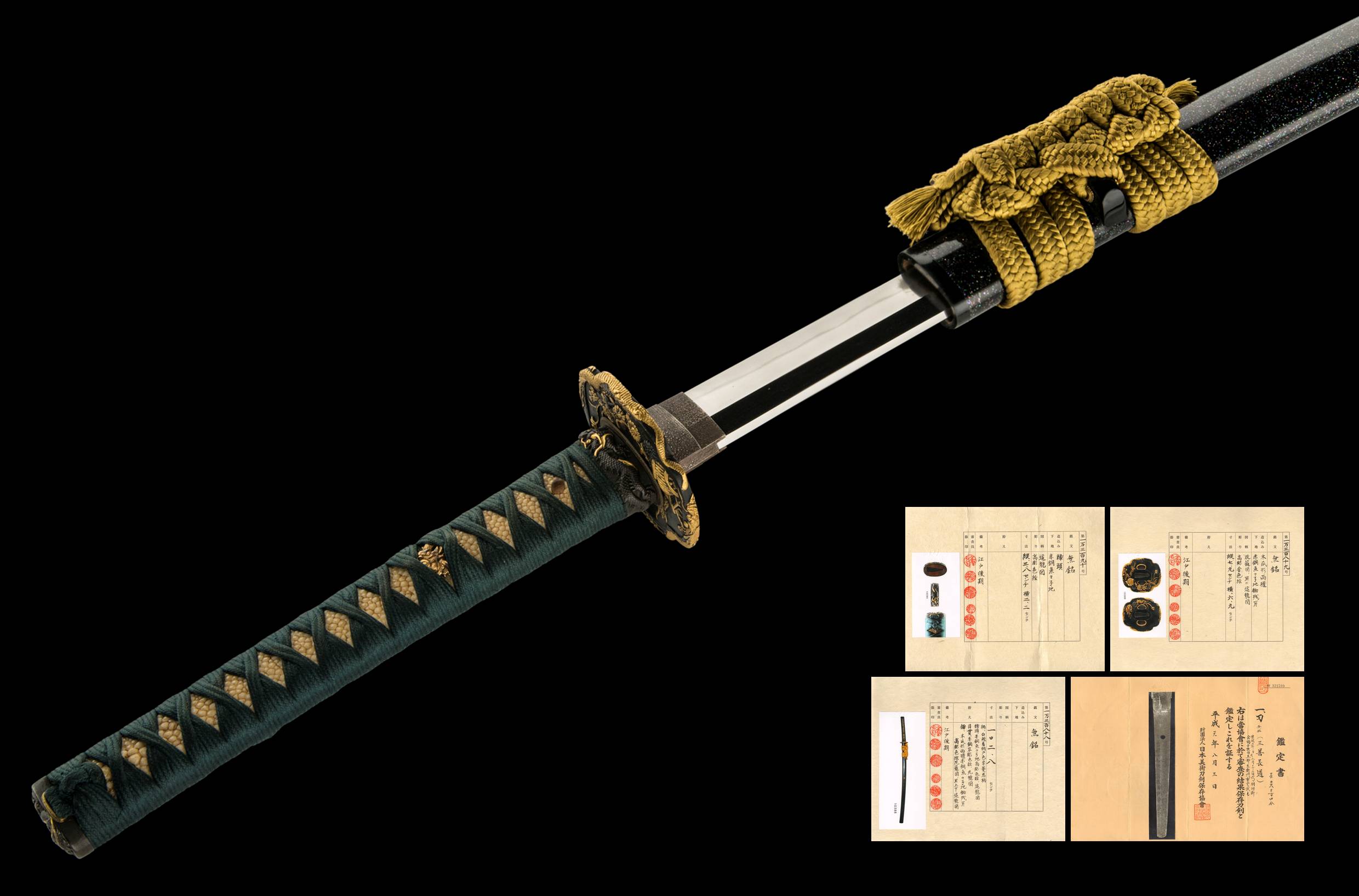
Miyoshi Nagamichi – born Miyoshi Toshiro in Iwashiro province, modern-day Fukushima – is one of the true greats of the 17th century. His father Masanaga served as a retainer to Daimyo Lord Kato Yoshiaki, and Nagamichi himself originally signed as Michinaga, adopting the name Nagamichi in 1659 when he received the title of Mutsu Daijo. He is ranked saijo-owazamono, the highest grade of sharpness, a grandmaster in producing swords of extreme cutting ability. This blade – unsigned on the nakago, yet firmly attributed to the Shodai by the NBTHK – is everything you would expect: powerful in hand, clean in construction, and possessed of a classic gunome-midare hamon with excellent brightness and fine ko-nie throughout.
The nakago carries a remarkable tameshigiri cutting test inscription recording a 2-body severing performed on 22nd February 1742 by Aizu retainer Makita Gorôza’emon Shigezane. Cutting tests of this kind – particularly futatsu-dô setsudan, through two bodies in a single stroke – represent the highest level of blade performance, and this inscription transforms an already distinguished katana into a piece of verifiable, documented history.
The late Edo uchigatana-koshirae is exceptional in its own right. The saya is lacquered in aogai-mijin-nuri, a technique using finely dusted mother-of-pearl that produces a night-sky effect of shimmering iridescence. A shisa guardian lion is mounted to the saya for spiritual protection. The multi-lobed shakudo nanako tsuba, depicting a flower basket with a dragon encircling the rim, is the work of the Mino school and holds its own NBTHK Tokubetsu Hozon certificate. The fuchi-kashira by Yoshitsugu, depicting coral collectors of the South Seas, is equally distinguished with a further NBTHK Tokubetsu Hozon certificate. A sword and koshirae of this combined quality is genuinely rare.
| Item Number | UJKA369 |
| Sword Type | Katana |
| Attribution | Attributed to Miyoshi Nagamichi, Shodai (mumei) |
| School | Miyoshi |
| Province | Mutsu (Aizu) |
| Period | Shintô – Kanbun era (1661-1673) |
| Nagasa | 71.0 cm |
| Sori | 0.9 cm |
| Moto-haba | 3.00 cm |
| Weight | 795 g |
| Nakago | Ubu-nakago; kiri-yasurime (straight file marks); 1 mekugi-ana |
| Jihada | Ko-nie deki |
| Hamon | Gunome-midare in ko-nie deki; kanitsume (crab claw) elements; kinsuji present; excellent brightness and consistency |
| Boshi | Midare-komi |
| Certificates | NBTHK Hozon (issued Heisei 1 / 1989, August 3rd) |
| Sharpness Rating | Saijo-owazamono |
| Tameshigiri (JP) | 寛保二年壬戊二月廿二日 弐ッ胴切断 会陽士牧田五郎左衛門重実試之 |
| Koshirae | Aogai-mijin-nuri saya uchigatana-koshirae (青貝微塵塗鞘打刀拵え); Late Edo period (1780-1867); NTHK-NPO Kanteisho certificate |
| Tsuba | Multi-lobed shakudo nanako tsuba depicting flower basket with dragon; Mino school; Late Edo period (1780-1867); NBTHK Tokubetsu Hozon |
| Fuchi-kashira | Shakudo; depicting coral collectors (South Sea Islanders); signed Yoshitsugu + kaô; NBTHK Tokubetsu Hozon (Reiwa 2 / 2020) |
| Menuki | Attributed to Kyô-Sasayama Tokuyuki; moon and wave theme; Late Edo period (1780-1867); NTHK-NPO Kanteisho certificate |
| Tsuka | Green silk braid over same; dragon menuki |
| Habaki | Silver habaki with straight file marks |
| Catalogue | Catalogue 34 |
| Status | Sold |
| Includes | Shirasaya, koshirae with koshirae bag, NBTHK Hozon certificate, NBTHK Tokubetsu Hozon certificate (tsuba), NBTHK Tokubetsu Hozon certificate (fuchi-kashira), NTHK-NPO Kanteisho certificates (koshirae, menuki) |