
ITEM# UJDI009 – Catalogue 34 – Sold
A Sandai Yasutsugu Daisho (康継於越前作之 / 康継以南蛮鉄)
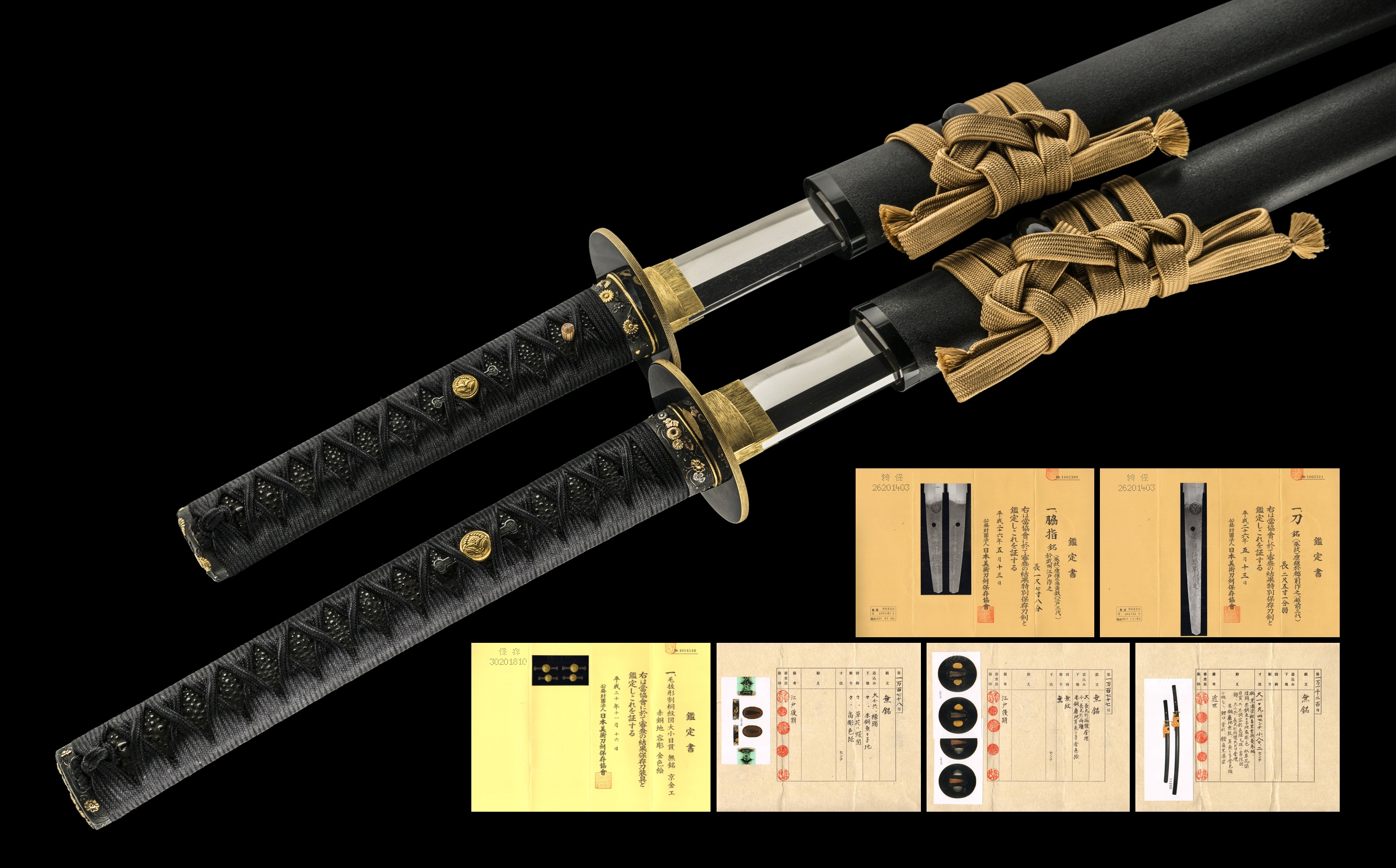
The Yasutsugu lineage stands apart in the history of Japanese swordmaking. Granted the right to carve the hollyhock crest of the Tokugawa clan and to borrow the character Yasu from Ieyasu’s own name, the Yasutsugu smiths served as the official sword-makers to the shogunate for eleven generations across both Edo and Echizen branches. This daisho captures the precise moment that dynasty divided. The katana was made by the Echizen Sandai, forged in Echizen province with the six-character signature that reads “Yasutsugu, crafted in Echizen.” The wakizashi bears the signature of the Edo Sandai, noting the use of imported namban-tetsu steel and giving Edo in Bushu province as the place of crafting.
Both blades share the hallmarks that define the school at its finest: a bright, energetic ko-gunome hamon that zig-zags with confidence along the katana, and a notare temper line rich with nie crystals on the wakizashi – features Tanobe Michihiro noted as the mark of a superior smith in his sayagaki on the katana’s shirasaya. The jihada on both blades is a well-forged ko-itame, dense and controlled. The katana measures a commanding 75.9 cm; the wakizashi, 54.0 cm. Both nakago remain ubu – original, unaltered.
The daisho is presented in a matching set of kuro-ishime-ji-nuri uchigatana koshirae lacquered in a black stone-like texture, crafted during the modern period and certified by the NTHK-NPO. The tsuba set is attributed to the Yoshioka school from Edo, executed in shakudo with nanako dotted gold rims – precisely the kind of formal fitting a samurai would wear to a daimyo’s castle. Menuki in a tweezers form with paulownia crests hold NBTHK Hozon certification. The fuchi-kashira, attributed to the Mino school, depicts a rich floral design in gold against dark metal. The complete set is housed in matched daishô koshirae bags.
| Item Number | UJDI009 |
| Sword Type | Daisho (katana and wakizashi) |
| Swordsmith (Katana) | Yasutsugu (Echizen, 3rd generation) |
| Swordsmith (JP) (Katana) | 康継 (越前三代) |
| Signature (Katana) | (Aoi-mon) Yasutsugu Echizen ni oite kore o tsukuru |
| Swordsmith (Wakizashi) | Yasutsugu (Edo, 3rd generation) |
| Swordsmith (JP) (Wakizashi) | 康継 (江戸三代) |
| Signature (Wakizashi) | (Aoi-mon) Yasutsugu Namban-tetsu o motte / Bushu Edo ni oite kore o tsukuru |
| School | Yasutsugu |
| Province (Katana) | Echizen |
| Province (Wakizashi) | Musashi (Edo) |
| Period | Shinto – Early Edo period (Kanbun era: 1661-1673) |
| Nagasa (Katana) | 75.9 cm |
| Sori (Katana) | 1.50 cm |
| Moto-haba (Katana) | 3.11 cm |
| Weight (Katana) | 820 g |
| Nagasa (Wakizashi) | 54.0 cm |
| Sori (Wakizashi) | 0.60 cm |
| Moto-haba (Wakizashi) | 2.91 cm |
| Weight (Wakizashi) | 540 g |
| Nakago | Ubu (both blades) |
| Jihada | Ko-itame hada |
| Hamon (Katana) | Ko-gunome |
| Hamon (Wakizashi) | Notare with nie |
| Certificates | NBTHK Tokubetsu Hozon x 2 (katana and wakizashi); NBTHK Hozon x 2 (menuki); NTHK-NPO Kanteisho x 3 (tsubas, fuchi-kashira, koshirae) |
| Fujishiro Rank | Jo-saku (katana) & Chujo-saku (wakizashi) |
| Sayagaki | Tanobe Michihiro – Sandai Yasutsugu, Echizen branch, dated Showa 52 (1977) |
| Koshirae | Kuro-ishime-ji-nuri daishô uchigatana-koshirae (black stone-texture lacquer), Modern period; NTHK-NPO Kanteisho |
| Tsuba | Daisho set, attributed to Yoshioka school, Edo; shakudo with nanako gold rims; NTHK-NPO Kanteisho |
| Fuchi-kashira | Floral design, attributed to Mino school, Late Edo (early 1800s); NTHK-NPO Kanteisho |
| Menuki | Tweezers form with paulownia crests, attributed to Kyo-Kinko, Late Edo; NBTHK Hozon |
| Habaki | Gold-wrapped with straight file marks (both blades) |
| Catalogue | Catalogue 34 |
| Status | Sold |
| Includes | Shirasaya x 2 (with sayagaki on katana), matching koshirae, daishô koshirae bags |