
⇩ Download Catalogue 27 (60MB)
Free to download. All swords in this catalogue are sold.
Index of Swords
Opening Remarks
Hello everyone,
I trust this message finds you in great spirits. Thank you for downloading Catalogue 27.
I’m very proud of the swords contained within this catalogue. Each sword is special and collectible. Every sword has attained prestigious NBTHK Tokubetsu Hozon certification apart from the Kuniie tachi, because the master smith is still alive. Most of the swords I acquired on my trip to Japan in January 2017.
Tokubetsu Hozon translates as a sword “especially worthy of preservation.” Each sword is made to a standard that deserves to be cherished by someone who reflects such excellence. It is my hope that the new caretakers gain a burst of emotional fuel to live each and every day as if it’s their last. Let’s make the memory of our lives also especially worthy of preservation by creating a lasting contribution to this world.
We begin the catalogue with a powerful katana dated to “A Good Day in February 1854.” The swordsmith is Suishinshi Masatsugu, grandson to the shinshintô grandmaster Suishinshi Masahide. This sword’s unique shape was inspired by the famous Kogarasu Maru tachi from the 8th century. The top 13cm of the blade is double-edged. I must admit, when holding this sword, I feel a sense of absolute invincibility.
The next piece is a katana by Jôjô-saku swordsmith Dewa Daijô Kunimichi. This splendid sword is in a wonderful polish and with me here in the UK on consignment. The blade measures to a jô-sun length (2-shaku 3-sun 5-bu or 71.5cm), modified to this benchmark size for a samurai katana in the Edo period.
The third sword is one I remember fondly from my trip to Japan. It is a katana by second-generation Takahira from the celebrated Kanewaka school. Everything about this sword speaks to samurai status — from the quality of the blade to the antique battle-ready koshirae that I believe to be original to the sword. If you wish to be transported to Kanazawa city 300-plus years ago, strongly consider this sword.
Our fourth piece is a muscular katana by famed swordsmith Musashi Daijô Korekazu. Korekazu is one of the leading figures of the shintô period, having established the Edo Ishido school in the early 1600s. His influence was so great that several generations of Korekazu followed in his footsteps. It’s easy to see why.
If you love dragons and want a sharp sword with character and flair, then the fifth piece by Kôzuke no Kami Kunitsune is for you. Look for the hidden dragon in the scabbard! Next, the Awa no Kami Yasutsuna katana from the Kii Ishido school is a delightful sword crafted near Osaka castle in the mid-1660s. This sword has good energy — I can tell that it has been cherished by previous owners.
The seventh sword is a stellar tachi by modern-day maestro Yoshihara Kuniie (Shoji). This sword knocked my socks off in Japan. At nearly 80cm in cutting length with a grand Kamakura koshi-zori curvature and over a kilogram in weight, this gunome chôji-midare Bizen masterpiece is an absolute tour de force.
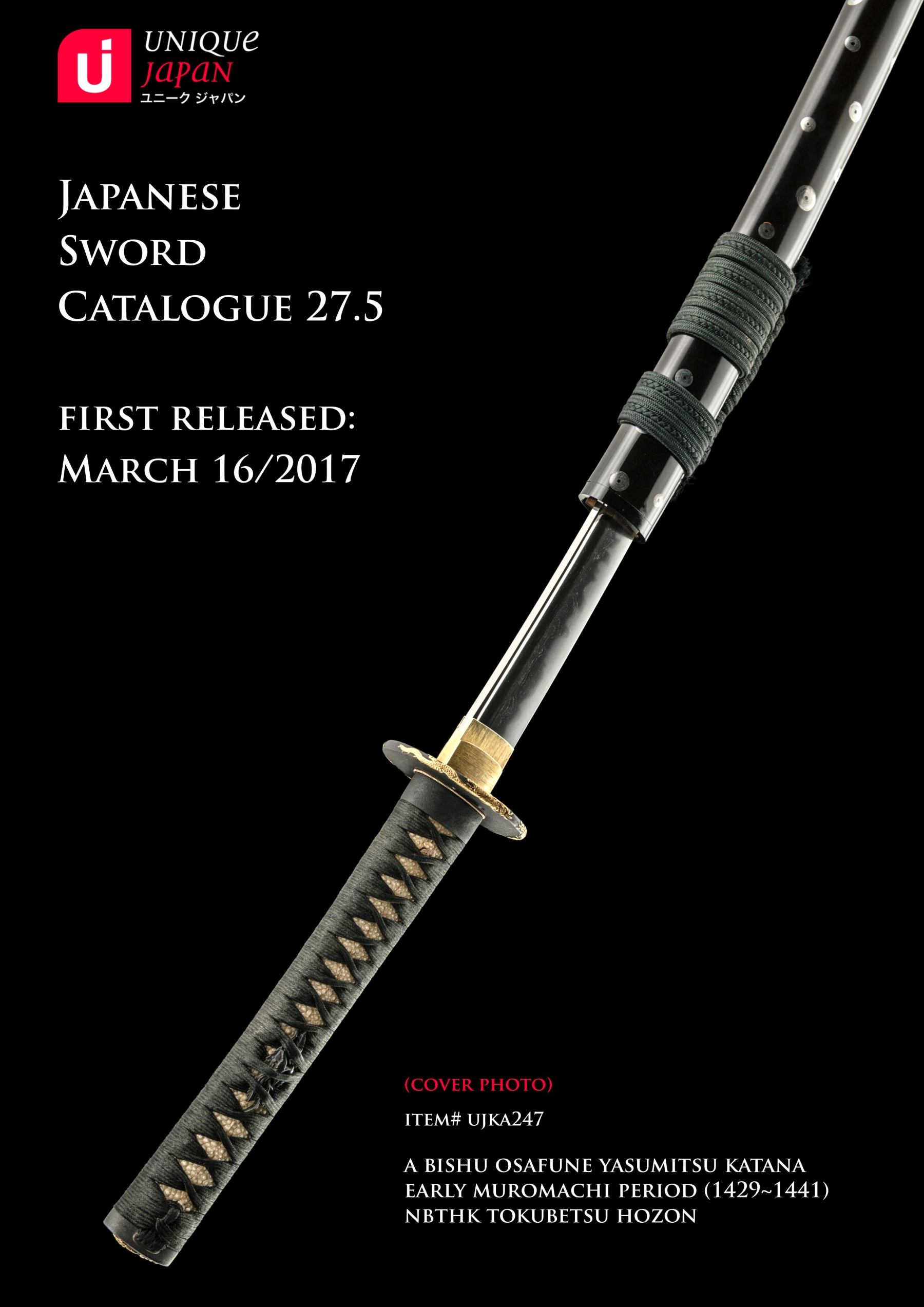
Our cover sword is our eighth piece — a beautiful katana made nearly 600 years ago by notable smith Bishu Osafune Yasumitsu. Elegance surrounds this rare treasure in every way. I recommend it highly. Our final piece is a superb wakizashi by Hidetoki that will make for an enjoyable custom koshirae project.
Thank you to all who have joined our VIP email list and to the many who claimed swords in Tokyo via a private meeting. As always, we look forward to serving you.
Warm regards,
Pablo Kuntz
March 2017