
ITEM# UJKA155 – Catalogue 22 – Sold
A Hizen Yoshihiro Katana (肥前国住伊勢大掾藤原吉広)
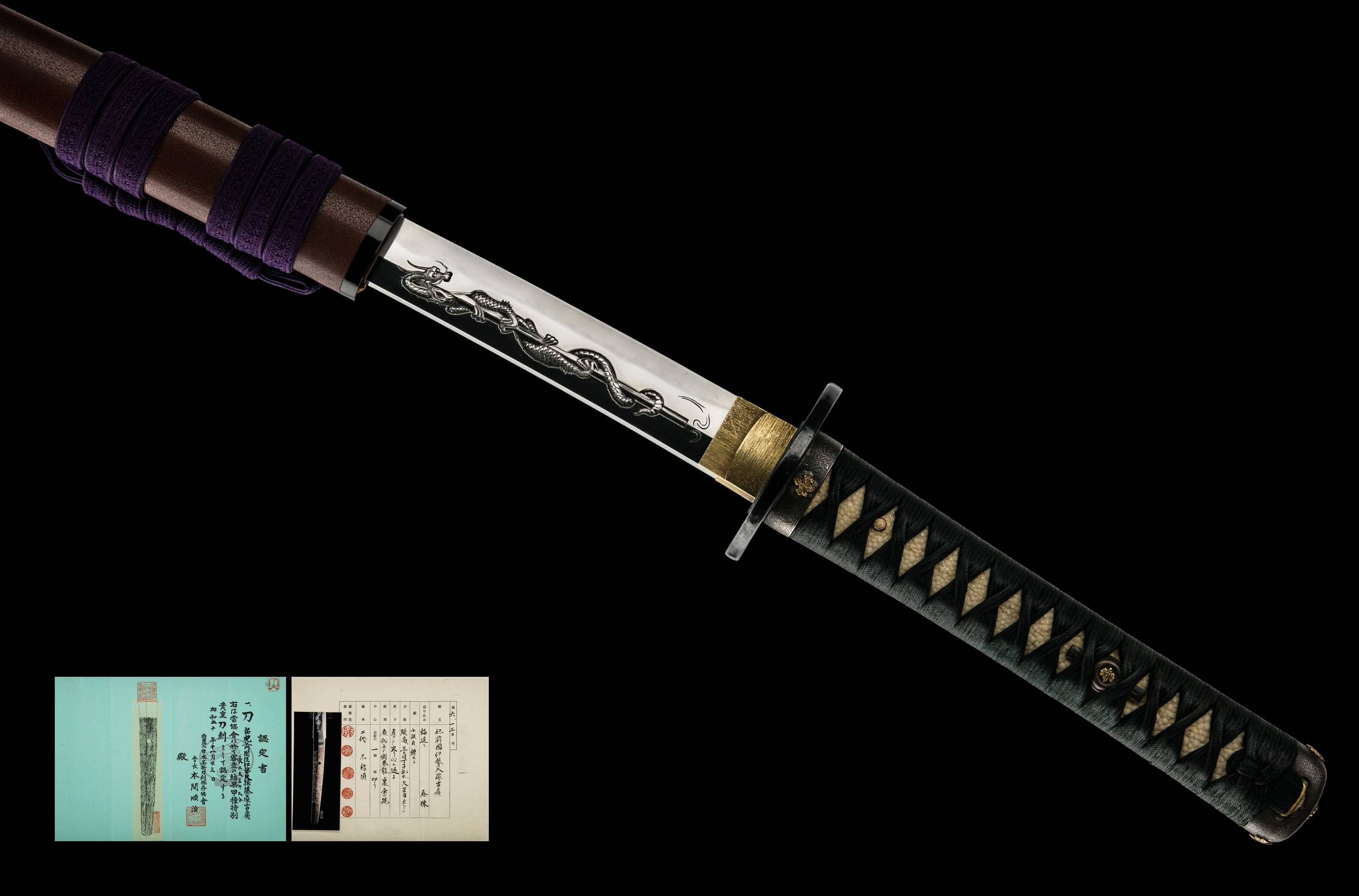
Grandmaster Hizen Tadayoshi trained many of the finest Shintô swordsmiths of the early Edo period, and among them was a smith named Yoshihiro. Yoshihiro established his own school around the Joo era (circa 1652), and when his second son succeeded him – changing his name from Yoshisada to Yoshihiro – the tradition entered its second generation. It is this 2nd generation smith who made the present katana: a classic josun (standard length) blade of 70.2cm that combines supreme sword-making with engraving of the very highest order. Fujishiro Shûkichi ranks 2nd generation Yoshihiro as Chû-Jôsaku, an above-average rating that this blade’s quality validates at every glance.
The hamon is a complex symphony of gunome-choji midare and a rare dovetail pattern called yahazuba (arrow notch), rich with activity. The swirling ko-itame hada carries chikei, kinsuji, and yubashiri throughout – every inspection rewards with something new. On one side of the blade is a Kenmaki-ryu engraving: the dragon Kurikara wound around the sword, representing the guardian deity Fudo-Myou in his most dramatic form. This is Shin no Kurikara – realistic carving of breathtaking detail, each individual scale and claw rendered with the precision of the finest metalwork tradition, attributed to the Umetada Myoju School whose similar work appears on swords by Hizen Shodai Tadayoshi. On the opposite side runs the Kensaku rope of Fudo-Myou – a motif symbolising the repelling of enemies and the drawing in of new believers, perfectly paired with its companion engraving.
The sword carries the rare blue NBTHK Koshu Tokubetsu Kicho certificate issued in 1975, designating it Extraordinarily Precious – one of the most senior pre-modern designations the NBTHK issued. The magnificent koshirae features a crimson ishime-lacquered saya, an iron tsuba by Echizen Ju Kinai with openwork depicting a wagasa (bamboo umbrella) surrounded by snowflakes, and fuchi-kashira and menuki carrying the kiri-mon – the paulownia badge of the Toyotomi family – all certified individually by the NTHK-NPO.
| Item Number | UJKA155 |
| Sword Type | Katana |
| Swordsmith | Yoshihiro (2nd generation) |
| Swordsmith (JP) | 吉広 (二代) |
| Signature | Hizen no Kuni Ju Ise Daijo Fujiwara Yoshihiro |
| School | Hizen Yoshihiro |
| Province | Hizen (Saga prefecture) |
| Period | Shintô – Early Edo period (Genroku era: 1688-1704) |
| Nagasa | 70.2cm (ubu) |
| Sori | 1.4cm |
| Moto-haba | 3.2cm |
| Weight | 705g |
| Nakago | Ubu, 20.7cm, mekugi-ana: 1 |
| Jihada | Ko-itame with chikei and yubashiri |
| Hamon | Konie, gunome-choji midare with yahazuba (arrow notch), kinsuji |
| Certificates | NBTHK Koshu Tokubetsu Kicho (sword); NTHK-NPO Kanteisho (sword); NTHK-NPO Kanteisho (tsuba); NTHK-NPO Kanteisho (koshirae) |
| Fujishiro Rank | Chu-Josaku |
| Koshirae | Antique koshirae with crimson ishime-lacquered saya; shirasaya |
| Tsuba | Iron, signed Echizen Ju Kinai; sukashi wagasa (bamboo umbrella) with snowflake pattern; NTHK-NPO Kanteisho |
| Fuchi-kashira | Kiri-mon (paulownia) design, Toyotomi family emblem |
| Menuki | Kiri-mon (paulownia) design, matching fuchi-kashira |
| Habaki | Niju-habaki (gold on copper base) |
| Catalogue | Catalogue 22 |
| Status | Sold |
| Includes | Shirasaya, koshirae, sword fabric bags, sword stand, maintenance kit, DVD, printed care guide, registration and export paperwork |