
ITEM# UJKA223 – Catalogue 26 – Sold
A Sakai Ikkansai Shigemasa Katana (酒井一貫斎繁正)
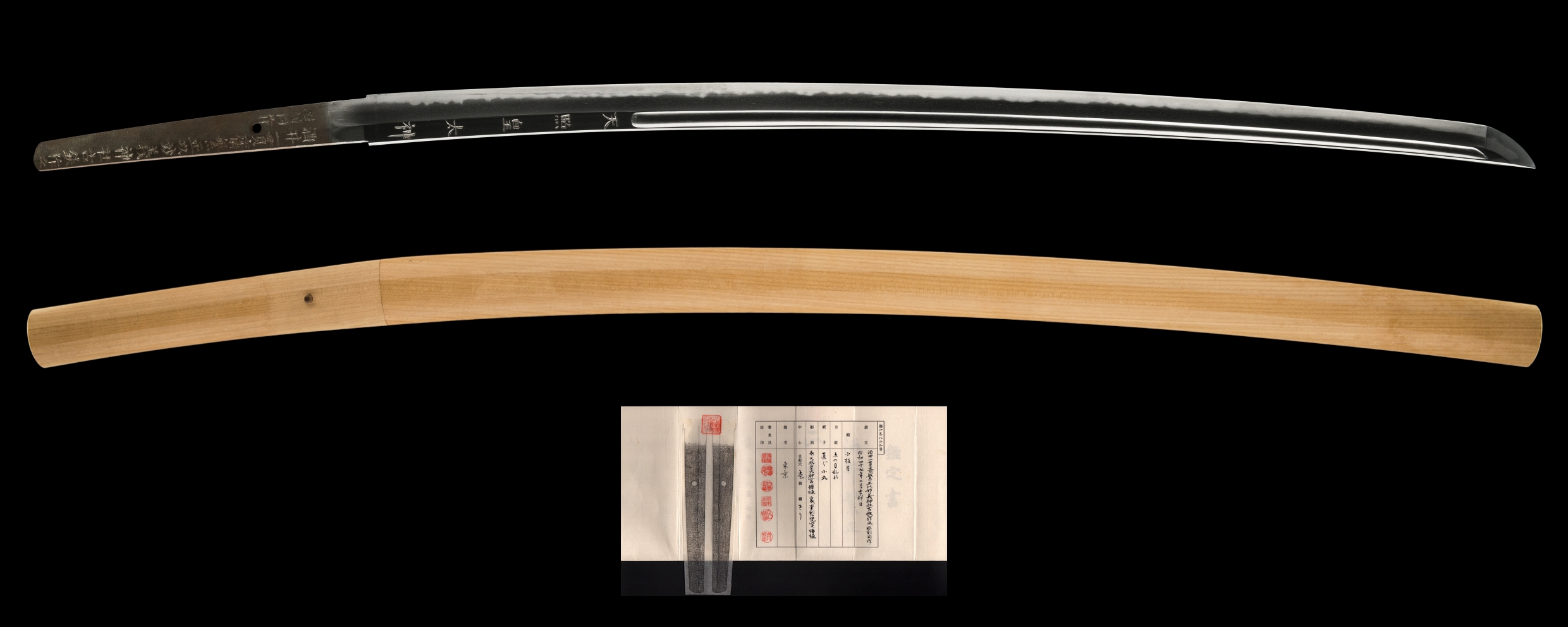
Sakai Ikkansai Shigemasa (1904-1991) stands among the most important swordsmiths of 20th-century Japan. Born in Meiji 37, he entered the studio of the celebrated Shigetsugu Kasama in Taisho 15 (1926) and eventually became heir to the Kasama Shigetsugu no Mon school – a lineage regarded by contemporaries as producing the finest craft of the pre-war and wartime era. In 1942, Admiral Yamamoto himself commissioned Shigemasa to forge ten prestigious presentation tantos, a commission that speaks directly to the esteem in which he was held. He would go on to achieve mukansa status – the highest rank awarded to a living swordsmith – in 1981.
This katana carries an exceptional provenance beyond the smith’s reputation alone. The blade was forged from furutetsu (ancient iron) sourced from Myogi Shrine in Gunma prefecture – a sacred site established, according to legend, in 537 A.D. during the reign of Emperor Senka. The shrine, dedicated to spirits including Prince Yamato Takeru, gained national significance during the Edo period and is today recognised as a Prefectural Important Cultural Property. That centuries-old sacred iron now lives within this blade is a fact Shigemasa recorded directly on the nakago: the full inscription reads Sakai Ikkansai Shigemasa Motte Myogi Jinja Furutetsu Saku Kore, Chokoku Dousaku – both the forging and the engraving by his own hand. The reverse is dated Showa 47 nen 2 gatsu Kichijou nichi (an auspicious day in February 1972).
Shigemasa was a master engraver, and this blade is as much a sculptural object as it is a weapon. The shinogi-ji carries the characters of Amaterasu Omikami – the great sun deity whose name means “the August kami who shines in heaven” – rendered with extraordinary chisel control visible in the close photography. Alongside these, a bonji character representing Aizen Myoo (one of the five wisdom kings) and a suken (straight old-style sword) complete the spiritual programme of the engraving. The hamon is a lively gunome midare that opens at the yakidashi into a striking nijuba – a double temper line far more separated than the conventional parallel form – before settling into bright, consistent waves enriched with kinsuji on both sides and sunagashi throughout. The blade rests in a well-fitted shirasaya with a silver Koshi Sukenori Yasuri-habaki, leaving the opportunity for a custom koshirae entirely open to the new caretaker.
| Item Number | UJKA223 |
| Sword Type | Katana |
| Swordsmith | Sakai Ikkansai Shigemasa |
| Swordsmith (JP) | 酒井一貫斎繁正 |
| Signature | Sakai Ikkansai Shigemasa Motte Myogi Jinja Furutetsu Saku Kore, Chokoku Dousaku (omote); Showa 47 nen 2 gatsu Kichijou nichi (ura) |
| Date | Showa 47 (February 1972) |
| Period | Showa era (1926-1989) |
| Nagasa | 72.5cm (2-shaku 3-sun 9-bu) |
| Sori | 1.7cm |
| Moto-haba | 3.2cm |
| Weight | 675g |
| Nakago | 21.3cm, 1 mekugi-ana |
| Jihada | Itame hada |
| Hamon | Gunome midare with nijuba, kinsuji and sunagashi |
| Certificates | NTHK-NPO Kanteisho (issued Heisei 9, September 7, 1997) |
| Habaki | Silver, Koshi Sukenori Yasuri style |
| Koshirae | Shirasaya |
| Catalogue | Catalogue 26 |
| Status | Sold |
| Includes | Shirasaya, sword bag, stand, kit, DVD, printed care guide, exportation |