
ITEM# UJWA234 – Catalogue 30 – Sold
A Munetsugu & Sukenaga Tameshigiri Wakizashi (宗次鍛小杉輔長慰淬刃之)
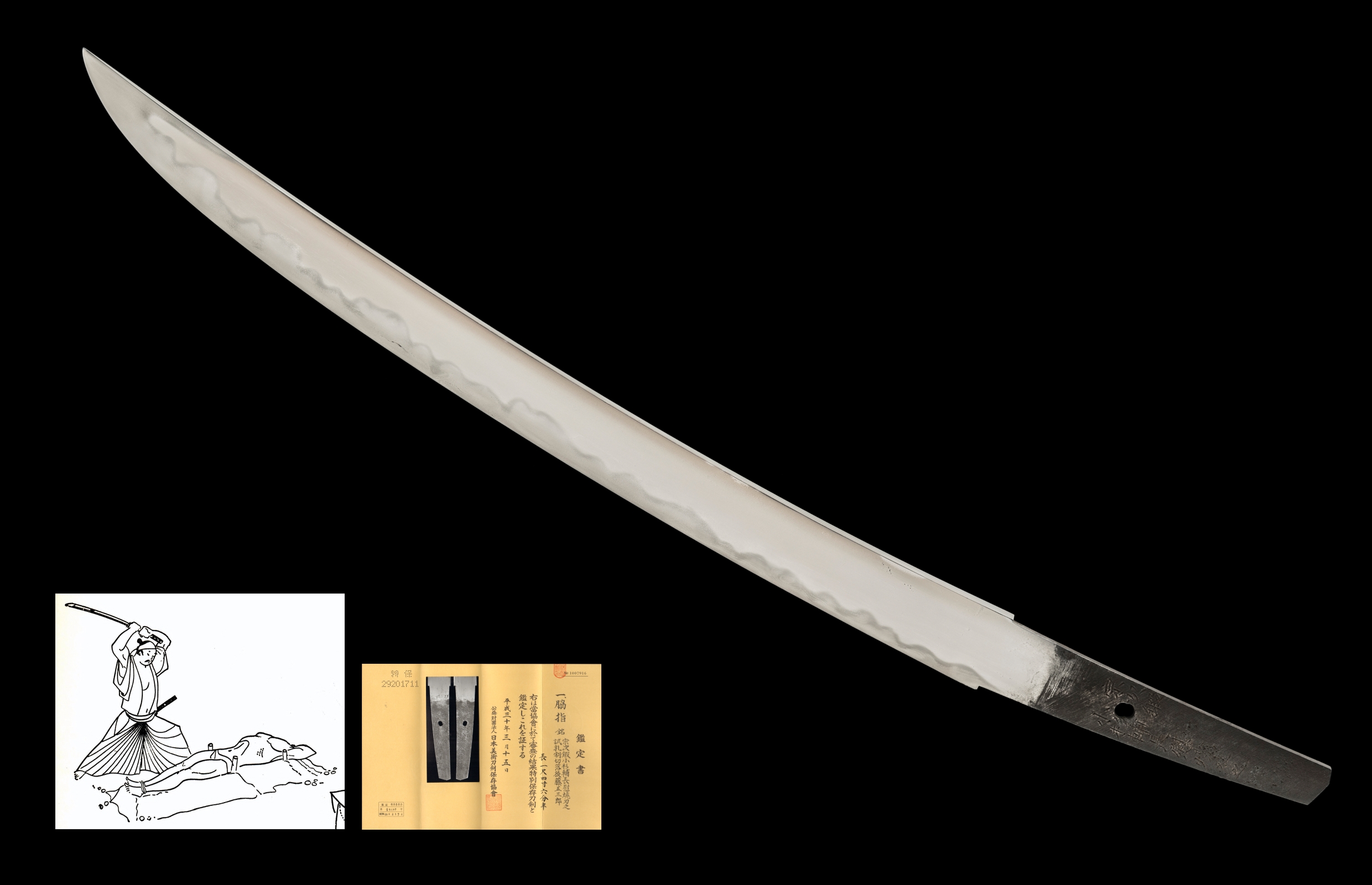
Few Shinshintô blades carry a story as vivid as this one. This compact hirazukuri wakizashi was forged by Koyama Munetsugu – one of the most celebrated swordsmiths of the late Edo period, ranked jôjô-saku by Fujishiro for the supreme quality of his work – and then handed to Kosugi Sukenaga, head karô (chief samurai advisor) of the Koga domain, who hardened the blade as a personal pastime. Sukenaga inscribed his own name on the nakago alongside Munetsugu’s, a remarkable document of the collaboration between master craftsman and high-ranking patron. An oshigata rubbing of this nakago was subsequently published in Mitsuo Shibata’s 1968 book Wakizashi no Miryoku (Charm of the Wakizashi), in the section introducing Koyama Munetsugu.
The blade is constructed in hirazukuri form – flat on both surfaces, without shinogi or yokote, a construction style reaching back to tachi of the Heian period. Munetsugu forged a beautifully bright, clear jigane of tightly folded kagami-hada, the folding so fine the surface grain becomes mirror-like. The hamon is a sparkling $1 in nioi-deki with kinsuji and sunagashi running through a clean, consistent nioguchi. At the tip, the boshi transitions from midare komi into the rounded saki-Jizô form – a demanding combination that required precise control of the quench. The ubu-nakago retains its original length and keshô-yasuri file marks, and is accompanied by a silver yûjô-habaki with slanted file marks.
The sword was subsequently tested by Gotô Gosaburô – birth name Yamada Yoshitoshi (1813-1884), adopted son of the seventh-generation sword-testing master Yamada Asae’mon – who severed the body of a deceased convicted criminal centrally across the chest in a single stroke. This chiwari (breast-splitter) cut, the Yamada school’s term for what the Yamano school called ichi no dô, was chiselled onto the nakago alongside the smiths’ inscriptions. The NBTHK awarded this blade Tokubetsu Hozon certification in Heisei 30 (2018).
| Item Number | UJWA234 |
| Sword Type | Wakizashi (hirazukuri) |
| Swordsmith | Koyama Munetsugu (forged) & Kosugi Sukenaga (hardened) |
| Swordsmith (JP) | 固山宗次・小杉輔長 |
| Signature | Omote: Munetsugu kitaeru (Forged by Munetsugu) / Ura: Kosugi Sukenaga nagusami ni kore wo saijin (Hardened as a pastime by Kosugi Sukenaga) |
| Period | Shinshintô – Late Edo (circa Tenpô era: 1830-1844) |
| Nagasa | 44.4cm |
| Sori | 1.06cm |
| Moto-haba | 3.48cm |
| Weight | 548g |
| Nakago | Ubu, keshô-yasuri, 14.4cm |
| Jihada | Tightly folded kagami-hada (mirror-like finish) |
| Hamon | Sparkling $1 in nioi-deki with kinsuji and sunagashi |
| Boshi | Midare komi transitioning to saki-Jizô |
| Tameshigiri (JP) | 試乳割切落後藤五三郎 |
| Certificates | NBTHK Tokubetsu Hozon |
| Fujishiro Rank | Jôjô-saku |
| Habaki | Silver yûjô-habaki with slanted file marks |
| Catalogue | Catalogue 30 |
| Status | Sold |
| Includes | Shirasaya, sword bag, stand, kit, DVD, printed description |