
ITEM# UJWA237 – Catalogue 31 – Sold
A Norishige Kodachi (則重)
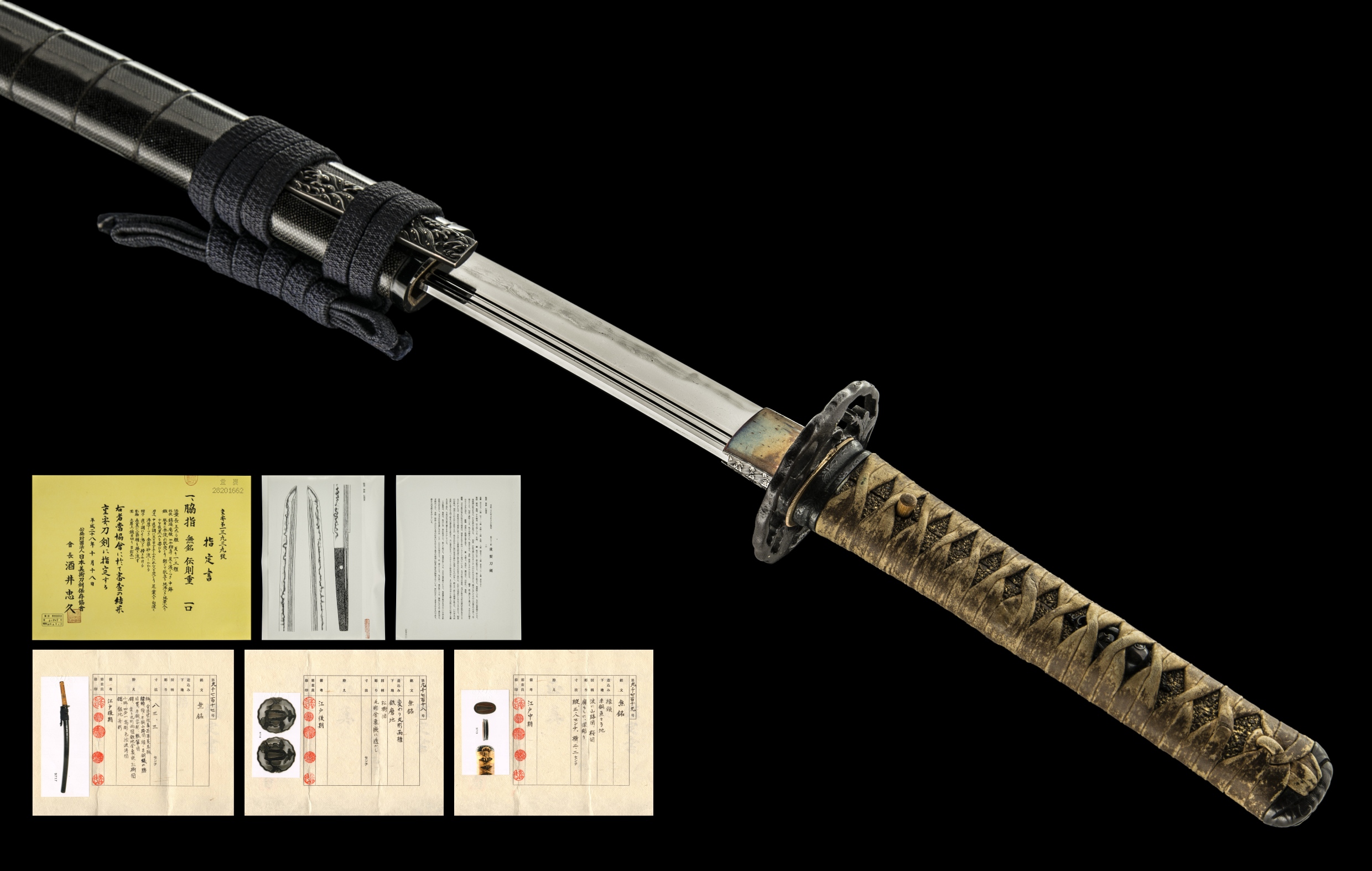
Among the great masters of the early Sôshû school, Norishige occupies a singular position. A fellow student of Masamune under Shintôgo Kunimitsu, Norishige worked in northern Etchu province on the Sea of Japan, and the cold, mineral-rich environment of his forge left its mark on everything he made. According to the NBTHK Token Bijutsu, Norishige surpasses even Masamune in hataraki – the spectacular internal activity of the blade – and his steel carries the unmistakable spiralled grain known as matsukawa-hada, a pattern that evokes the rough, furrowed bark of old pine trees. Fujishiro ranks him at the very highest level: Sai-josaku, a grandmaster swordsmith.
This splendid kodachi – registered as a wakizashi but carrying the graceful form of a small tachi – is a supreme example of his craft. The jihada is a stand-out itame with mokume and nagare resolving into classic matsukawa-hada formations, the darkish steel alive with clusters of ji-nie and thick weaving chikei. The hamon is wide and rich, mixing gunome, choji, and ko-notare with abundant ashi, yo, hotsure, yubashiri, and the dazzling gold-thread lines of kinsuji and sunagashi that run throughout. The boshi turns in a nie-laden ko-maru with sweeping hakikake. Two parallel grooves – futatsuji-hi – run the full length of the blade, adding elegance to its already graceful tachi-like curvature. The nakago is a clean o-suriage, mumei.
The koshirae is a late Edo period Higo uchigatana-koshirae of exceptional quality. The tsuba, certified by the NTHK-NPO to a late generation of the Nishigaki school of Higo province (circa 1780-1867), bears a pierced pine tree design – a pointed tribute to the Norishige matsukawa-hada itself, with all the Shintô symbolism of pine. The kashira features deeply carved waves and is certified to the Jingo school of Higo province. An antique brown-leather wrapped tsuka, preserved with gold lacquer on the samekawa, and a kozuka with a signed Omori wave design complete this museum-worthy ensemble. The blade was designated at the 62nd NBTHK Juyo Token session in Heisei 28 (2016).
| Item Number | UJWA237 |
| Sword Type | Kodachi (registered as wakizashi) |
| Attribution | Norishige (o-suriage, mumei) |
| School | Sôshû |
| Province | Etchu |
| Period | Kotô – Late Kamakura period (circa Enkyô era: 1308-1311) |
| Nagasa | 59.1cm |
| Sori | 1.3cm |
| Moto-haba | 2.68cm |
| Weight | 470g |
| Nakago | O-suriage, mumei (unsigned, greatly shortened); 16.6cm; 1 mekugi-ana |
| Jihada | Stand-out itame with mokume and nagare forming matsukawa-hada, darkish steel with ji-nie and chikei |
| Hamon | Wide nioguchi mixed with gunome, choji, ko-notare, ashi, yo, hotsure, yubashiri, kinsuji and sunagashi |
| Boshi | Nie-laden ko-maru kaeri with plenty of hakikake |
| Hi | Futatsuji-hi (double groove) running the length of the blade |
| Certificates | NBTHK Juyo Token (62nd session, 2016) – certificate #13939 |
| Fujishiro Rank | Sai-josaku |
| Koshirae | Aizame-gise koshi-hachi-bu-kizami saya Higo uchigatana-koshirae (藍鮫着腰八分刻鞘肥後打刀拵); late Edo period (1780-1867) |
| Tsuba | Pine tree design; NTHK-NPO Kanteisho certified to the Nishigaki school, Higo province, late Edo period (circa 1780-1867) |
| Fuchi-kashira | Shakudo kashira with deeply carved waves; NTHK-NPO Kanteisho certified to the Jingo school, Higo province (circa 1780-1868) |
| Tsuka | Antique brown-leather wrapped tsuka with gold-lacquered samekawa |
| Kozuka | Wave design with Omori signature |
| Habaki | Copper habaki with peony design |
| Catalogue | Catalogue 31 |
| Status | Sold |
| Includes | Shirasaya, bag, NBTHK Juyo Token certificate, NTHK-NPO Kanteisho certificates (tsuba and kashira) |