
ITEM# UJKA306 – Catalogue 32 – Sold
A Kuniteru Katana (伊勢守国輝)
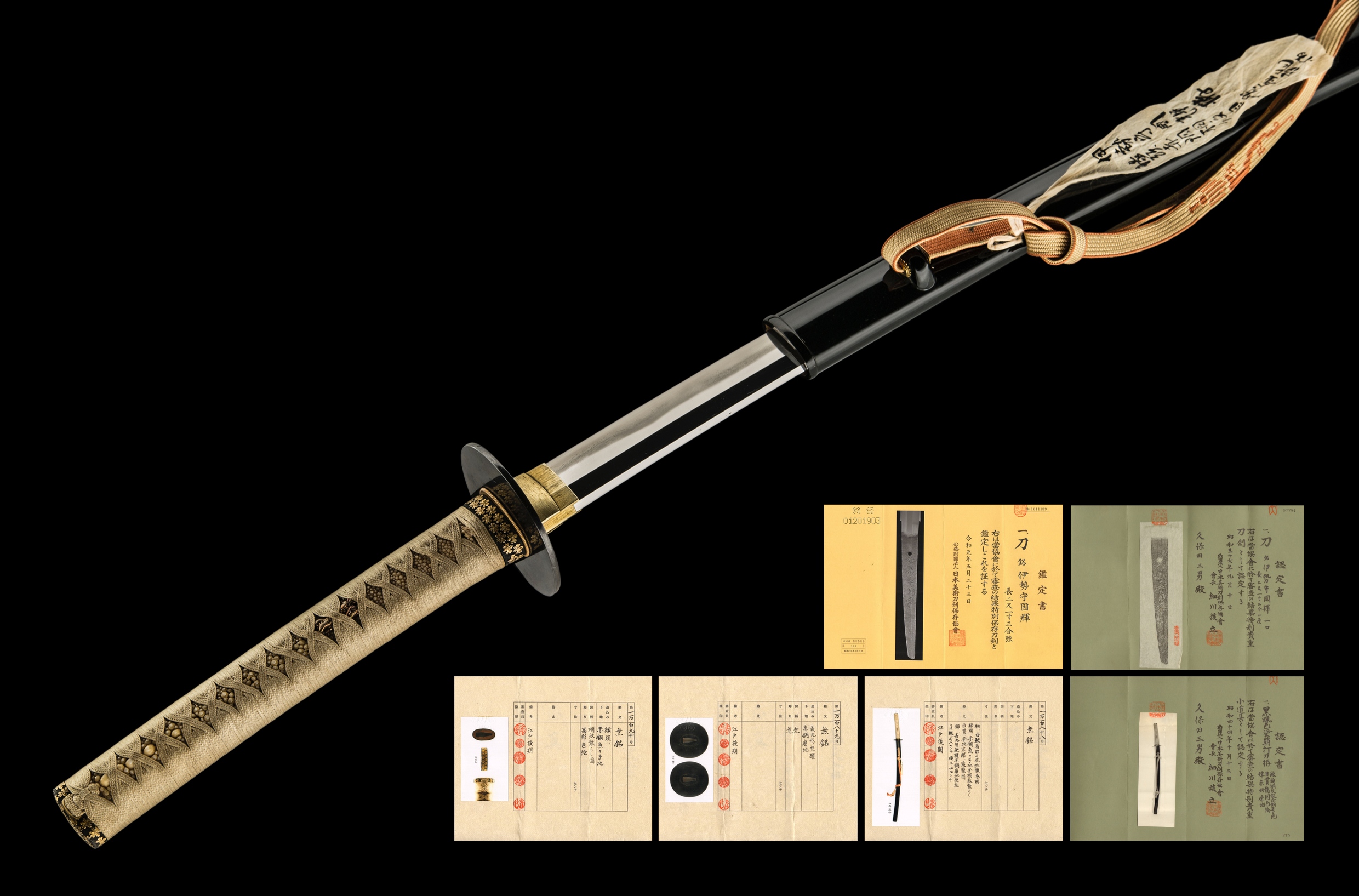
Born Kobayashi Hayanoshin, Kuniteru studied under first-generation shodai Kunisuke of the Kunisuke School – becoming not only one of his star pupils but also his adopted son-in-law by marrying his sensei’s daughter. Granted the title of Ise Daijô in 1671 and upgraded to Ise no Kami (Lord of Ise province) the following spring, Kuniteru went on to be considered the finest swordsmith working in Osaka after Tsuda Sukehiro and Inoue Shinkai – a remarkable position in the most competitive swordmaking city of the Shintô period.
The blade itself makes the case without argument. The steel is an expertly forged dense ko-itame hada with strong masame-hada running through the shinogi-ji, animated throughout by chikei and a touch of utsuri. The deep gunome-midare hamon carries a full, consistent nioguchi alive with kinsuji and sunagashi, reminiscent of the great works of Kotetsu and Inoue Shinkai. A lavish ko-maru boshi fills the kissaki with confidence. The ubu nakago bears the full five-character signature in Kuniteru’s characteristic chiselled hand and retains a beautifully clean patina – preserved over 300 years in exceptional condition.
The koshirae is a statement of rank. A late Edo period uchigatana-koshirae lacquered in glossy black, it is fitted with a pure shakudô tsuba attributed to Yoshioka Inaba no Suke of the Yoshioka school – a matching fuchi-kashira set of the same attribution carrying the gold kiri-mon (paulownia crest), and menuki of golden dragon motif. Daimyô and high-ranking samurai were required to present themselves at the Shôgun’s castle in exactly this form of formal attire: glossy black saya, plain shakudô tsuba, white same tsuka. This is that koshirae. Six certificates accompany the sword, including a sayagaki by Dr. Satô Kanzan inscribed in 1966.
| Item Number | UJKA306 |
| Sword Type | Katana |
| Swordsmith | Ise no Kami Kuniteru (first generation) |
| Swordsmith (JP) | 伊勢守国輝 |
| Signature | Ise no Kami Kuniteru |
| School | Kunisuke School |
| Province | Settsu (resident of Osaka) |
| Period | Shintô – Early Edo period (Enpô era: 1673-1681) |
| Nagasa | 64.5 cm |
| Sori | 1.45 cm |
| Moto-haba | 3.17 cm |
| Weight | 620 g |
| Nakago | Ubu, sujikai-yasurime, ha-agari kuriji, one mekugi-ana |
| Jihada | Ko-itame with masame-hada in shinogi-ji, chikei and light utsuri |
| Hamon | Deep gunome-midare with kinsuji and sunagashi |
| Boshi | Ko-maru |
| Certificates | NBTHK Tokubetsu Hozon (sword); NBTHK Tokubetsu Kichô (sword & koshirae); NTHK-NPO Kanteishô (koshirae, tsuba and fuchi-kashira) |
| Fujishiro Rank | Jo-saku |
| Sharpness Rating | Wazamono |
| Sayagaki | Dr. Satô Kanzan – Ise no Kami Kuniteru, dated Shôwa hinoe uma year, middle of autumn (1966) |
| Koshirae | Uchigatana-koshirae (kuro-nuri saya), Late Edo period (1780-1867) |
| Tsuba | Pure shakudô, attributed to Yoshioka Inaba no Suke, Yoshioka school; NTHK-NPO Kanteishô |
| Fuchi-kashira | Shakudô with gold kiri-mon (paulownia crest), attributed to Inaba no Suke Yoshioka (1700s); NTHK-NPO Kanteishô |
| Menuki | Golden dragon motif |
| Tsuka | White same (ray skin), cream linen braid |
| Habaki | Gold ni-ju habaki with finely crafted file marks |
| Catalogue | Catalogue 32 |
| Status | Sold |
| Includes | Shirasaya, Edo koshirae, bags, stand, kit, DVD, booklet, printed description |