
ITEM# UJKA366 – Catalogue 35 – Sold
A Shodai Tadakuni Katana (肥前住播磨大掾藤原忠国)
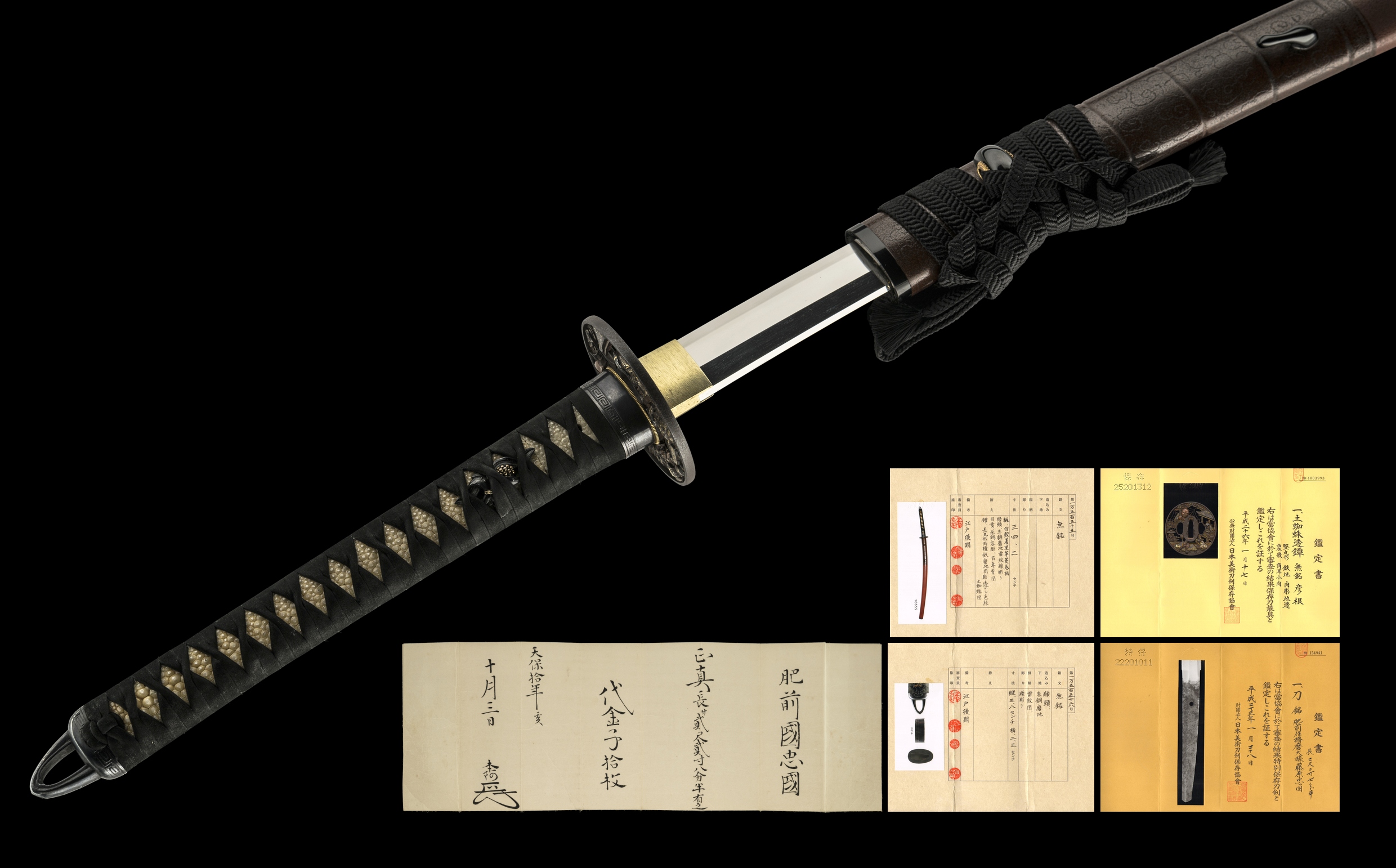
First generation Tadakuni was born Hashimoto Rokurôzaemon in 1598, the second son of Hirosada. He first signed Hironori before receiving the honorary title Harima no Daijô in the eleventh year of Kan’ei era (1634), at which point he adopted the name Tadakuni. Towards the end of his celebrated career he took Buddhist vows under the name Kyûtetsu, dying at the remarkable age of 94 in 1691 during the Genroku era. Respecting the esteemed Hizen tradition, Tadakuni forged a densely packed ko-itame hada that presents as the luminous konuka-hada (pear skin finish) so prized in this school, alive with sparkling ji-nie and the dark threads of chikei running through the steel.
While Tadakuni is most celebrated for his flamboyant chôji-midare and gunome-chôji hamon, this katana represents a rarer and more considered side of his genius – a crisp chû-suguha of medium width with fine kinsuji, delicate ashi, and scattered yô. The restraint is deliberate and the effect quietly commanding. It takes confidence and mastery to forgo the exuberant and instead deliver a hamon of such controlled clarity. The boshi carries wisps of kinsuji into the kissaki, tying the whole blade together with elegant consistency. Fujishiro ranked Tadakuni jô-saku and wazamono for the notable sharpness of his work.
The sword is accompanied by an exceptional late Edo-period koshirae whose thematic programme mirrors the blade’s finest feature. The saya is lacquered in dry red-brown (akacha kanshitsu-nuri) with ribbed cloud patterning at the koshi setting a stormy scene, while the iron tsuba by the Hikone school depicts the celebrated tsuchigumo legend in richly worked gold inlay. The fuchi-kashira carries the raimon lightning pattern, an echo of the kinsuji on the blade, and the hook-shaped kashira – said to be favoured by Miyamoto Musashi – serves as both a weapon and a statement. Completing the ensemble is a rare ontô origami issued by Hon’ami Kôkan on October 3, 1839, valuing the katana to ten gold pieces – a small miracle of survival that adds an irreplaceable layer of provenance to this remarkable sword.
| Item Number | UJKA366 |
| Sword Type | Katana |
| Swordsmith | Tadakuni (1st gen.) |
| Swordsmith (JP) | 忠国 (初代) |
| Signature | Hizen jû Harima Daijô Fujiwara Tadakuni |
| School | Hizen |
| Province | Hizen |
| Period | Shintô – Early Edo period (Keian era: 1648-1652) |
| Nagasa | 68.9cm |
| Sori | 2.0cm |
| Moto-haba | 2.93cm |
| Weight | 685g |
| Nakago | Ubu, sujikai-yasurime, 1 mekugi-ana |
| Jihada | Superbly forged konuka-hada with sparkling ji-nie and chikei |
| Hamon | Crisp chû-suguha with kinsuji, ashi and yô |
| Boshi | Suguha with wisps of kinsuji |
| Certificates | NBTHK Tokubetsu Hozon (sword); NBTHK Hozon (tsuba); NTHK-NPO Kanteisho (koshirae and fuchi-kashira) |
| Fujishiro Rank | Jô-saku |
| Sharpness Rating | Wazamono |
| Koshirae | Akacha kanshitsu-nuri koshi-issun-kizami saya uchigatana-koshirae, Late Edo period (1780-1867) |
| Tsuba | Hikone school, iron, depicting tsuchigumo legend with gold inlay, NBTHK Hozon |
| Fuchi-kashira | Raimon (lightning) pattern, iron, NTHK-NPO Kanteisho |
| Menuki | Omoto (Japanese Sacred Lily), wrapped in black leather over white samekawa |
| Habaki | Gold-wrapped, straight file marks |
| Catalogue | Catalogue 35 |
| Status | Sold |
| Includes | Shirasaya, Edo koshirae, stand, kit, DVD, booklet, printed description, Hon’ami Kôkan origami (1839) |