
ITEM# UJWA251 – Catalogue 36 – Sold
A Tadayuki Wakizashi (大和守藤原忠行)
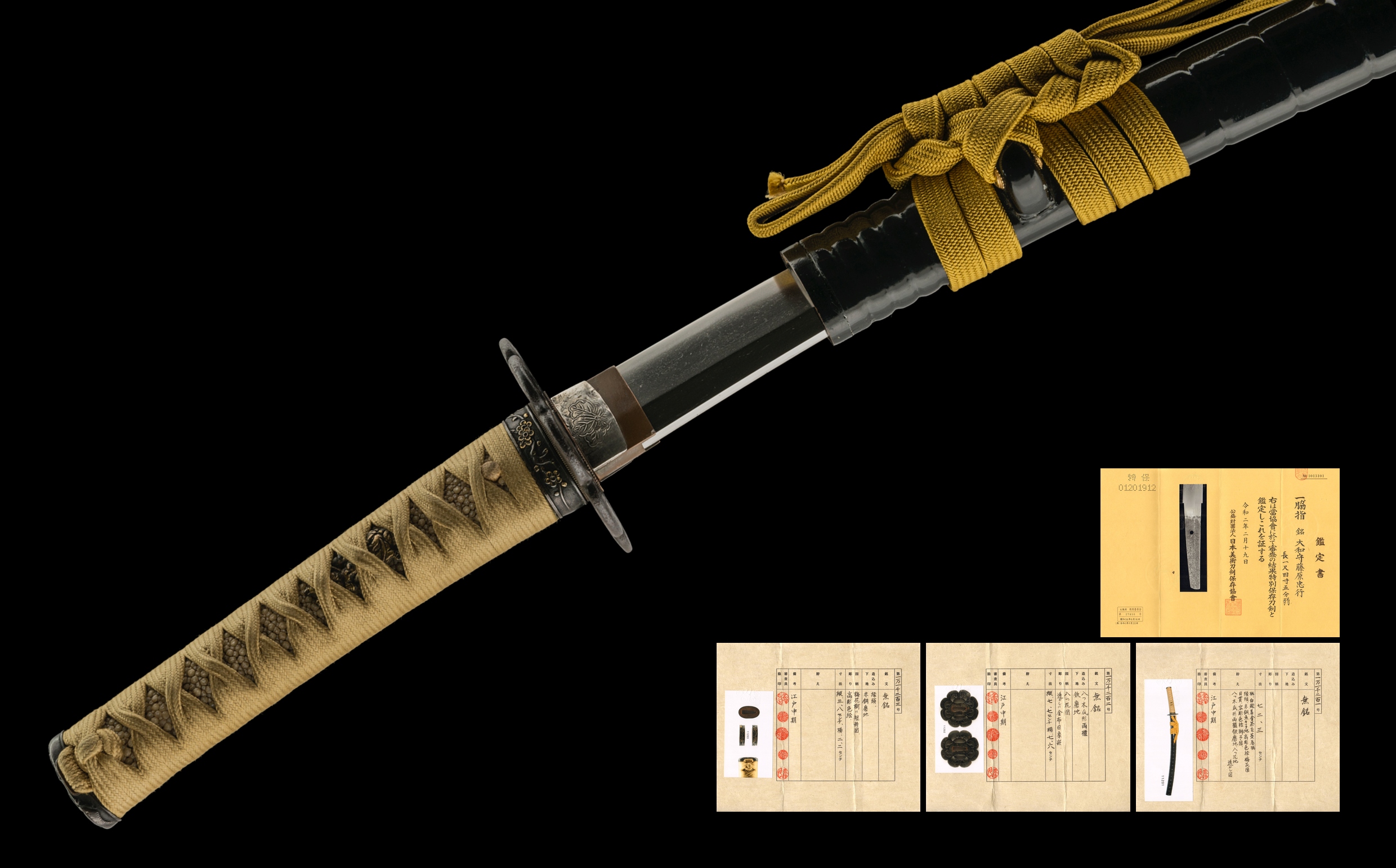
This striking wakizashi was crafted by Yamato no Kami Fujiwara Tadayuki, the first-generation smith who worked in Bungo province during the Hôei era (1704~1711). Born Nakama Banpei, he later changed his given name to Shingobei and earned a stipend capable of supporting ten people from the notable Hosokawa Daimyô family. He produced blades in both Tsurusaki Takada and Kumamoto in Higo province, and his work is rated ryô-wazamono for its exceptional cutting performance.
This blade is relatively wide for a wakizashi and carries impressive curvature that gives it a commanding presence. The jigane is dark in tone, with well-forged itame-hada threaded through with chikei. The flowing notare hamon, mixed in with ko-gunome and accented by kinsuji, produces an effect reminiscent of snowy mountain tops seen from a distance – a quality that made Tadayuki’s blades particularly admired.
The sword is housed in a remarkable Inrô-kizami koshirae that dates to the same mid-Edo period as the blade itself, the chance that the two have remained together faithfully for over 300 years is very real. The ribbed lacquer saya takes its design from the decorative inrô containers cherished by the aristocracy, giving the mounting a distinctive rhythmic beauty. The ensemble is completed by an eight-lobed Shôami school tsuba with auspicious floral design, and Mino school fuchi-kashira bearing tanzaku and plum blossom decoration – both holding NTHK-NPO Kanteisho certificates of authenticity.
| Item Number | UJWA251 |
| Sword Type | Wakizashi |
| Swordsmith | Yamato no Kami Fujiwara Tadayuki (Shôdai, first generation) |
| Swordsmith (JP) | 大和守藤原忠行 |
| Signature | Yamato no Kami Fujiwara Tadayuki |
| School | Tadayuki school |
| Province | Bungo |
| Period | Shintô – Middle Edo period (Hôei era: 1704~1711) |
| Nagasa | 44.0cm (ubu) |
| Sori | 1.60cm |
| Moto-haba | 2.89cm |
| Weight | 390g |
| Nakago | Ubu-nakago (original, unaltered tang); katte-sagari yasurime (slanting file marks); 12.7cm |
| Jihada | Itame-hada with chikei and a darkish jigane |
| Hamon | Bright notare with ko-gunome and kinsuji |
| Boshi | Ko-maru |
| Certificates | NBTHK Tokubetsu Hozon; NTHK-NPO Kanteisho (tsuba, fuchi-kashira & koshirae designated as Authentic) |
| Fujishiro Rank | Chû-saku (ranked as an average swordsmith) |
| Sharpness Rating | Ryô-Wazamono (maker of very sharp swords) |
| Koshirae | Mid-Edo period (1700~1780) Inrô-kizami chisagatana-koshirae; koshi-sambu-kizami shita-issun-kizami kuro-ro-nuri saya – lacquered in gloss black with 3-bu (0.9cm) ribs on the lower part and 1-sun (3.0cm) ribs on the upper part |
| Tsuba | Shôami school, polished iron, eight-lobed design with eight flowers; NTHK-NPO Kanteisho |
| Fuchi-kashira | Mino school, mid-Edo; tanzaku and baika (plum blossom) motif; NTHK-NPO Kanteisho |
| Menuki | Shishi (guardian lions) |
| Tsuka | Natural/cream silk braid (katate-maki) |
| Habaki | Copper and silver with kiri (paulownia leaf) design |
| Catalogue | Catalogue 36 |
| Status | Sold |
| Includes | Shirasaya, mid-Edo koshirae, fabric bags, stand, kit, booklet, description |