
ITEM# UJWA153 – Catalogue 37 – Sold
A Yoshitake Wakizashi (出雲大掾藤原吉武)
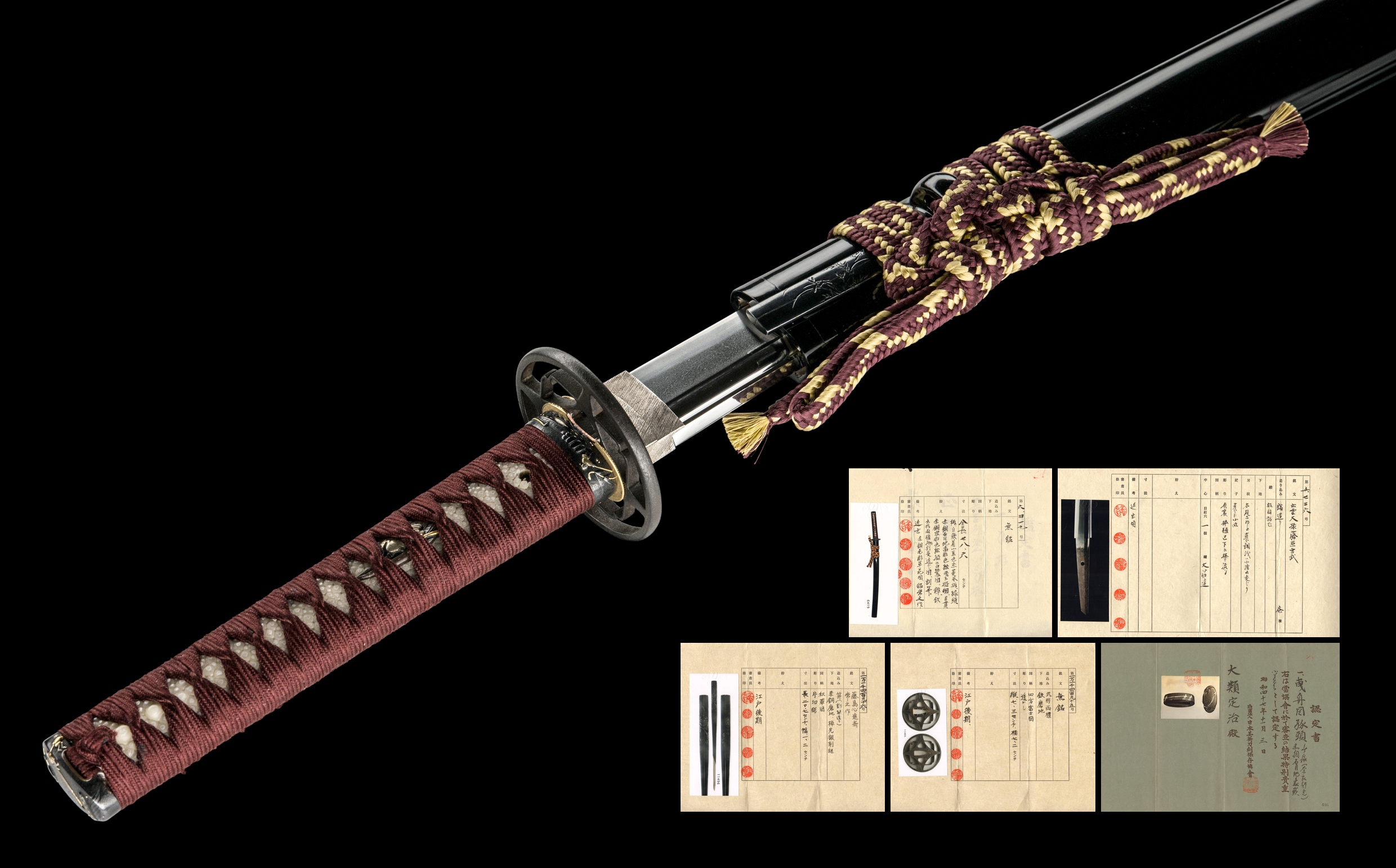
A fine and healthy wakizashi by Shodai Izumo Daijô Yoshitake – a leading swordsmith of the early Edo period who worked in Yamashiro province, the cultural heart of Japan centred on Kyôto. Yoshitake was the son of Horikawa Kunitake, himself a skilled smith from the lineage of Sanjô Yoshinori, and his work reflects that distinguished pedigree in every aspect of its forging. He signed his blades under several titles over the course of his career, and this piece bears the elegant signature Izumo no Daijô Fujiwara Yoshitake on a perfectly preserved ubu nakago – the original, unaltered tang, exactly as it left his hands in the Enpô era (1673-1681). Yoshitake is formally ranked jô-saku by Fujishiro and wazamono for the exceptional sharpness of his blades.
The blade itself is a pleasure to examine. The jihada is a tightly worked ko-mokume hada with attractive chikei running through the steel – dense, lively, and precisely controlled. The hamon is a bright and confident suguha with subtle ko-midare activity along its length, enriched by the splitting parallel line of nijuba that is a hallmark of top-quality blades tempered in this tradition. Nie crystals are visible throughout. A bo-higroove runs on both the omote and ura, tapering in kaki-nagashi style into the nakago – a refined detail that lightens the blade without sacrificing any of its considerable presence. At an extra-wide moto-haba of 3.05cm and 540g, this is a substantial wakizashi with real authority in the hand.
The koshirae assembled for this sword is exceptional. Unique Japan commissioned a custom chiisagatana-koshirae in kuro-roiro-nuri (glossy black lacquer), fitted with a polished iron tsuba from the Owari school bearing four elegant silhouettes of Mount Fuji – an NTHK-NPO authenticated piece from the late Edo period. The fuchi-kashira is attributed to Nara Toshimitsu, rendered in shakudô with a stone surface texture depicting figures towing a boat – a vintage piece carrying its own Tokubetsu Kichô certificate from 1972. The menuki celebrate the 1,300-year-old Ukai cormorant fishing festival, with wari kôgai by Fujishima Shin’ensai Tsuneyuki in an autumn leaves design completing the set. The sword holds top honours from the NTHK-NPO – Yûshû-saku, their designation for a Highly Excellent Masterwork – alongside an NBTHK Tokubetsu Kichô certificate for the blade.
| Item Number | UJWA153 |
| Sword Type | Wakizashi |
| Swordsmith | Shodai Izumo Daijô Fujiwara Yoshitake (first generation) |
| Swordsmith (JP) | 出雲大掾藤原吉武 |
| Signature | Izumo no Daijô Fujiwara Yoshitake |
| School | Horikawa |
| Province | Yamashiro |
| Period | Shintô – Early Edo period (Enpô era: 1673-1681) |
| Nagasa | 49.6cm |
| Sori | 0.80cm |
| Moto-haba | 3.05cm |
| Weight | 540g |
| Nakago | Ubu (original, unaltered tang); sujikai-yasurime (diagonal file marks) |
| Jihada | Ko-mokume hada with chikei |
| Hamon | Suguha mixed with ko-midare; nijuba; nie |
| Certificates | NTHK-NPO Yûshû-saku (Highly Excellent Masterwork); NBTHK Tokubetsu Kichô; NTHK-NPO Kanteishô (tsuba, kogai & koshirae authenticated) |
| Fujishiro Rank | Jô-saku |
| Sharpness Rating | Wazamono |
| Koshirae | Kuro-roiro-nuri chiisagatana-koshirae (黒呂色塗小さ刀拵え) – modern period; glossy black lacquer saya |
| Tsuba | Polished iron, Owari school, Mount Fuji silhouette design, late-Edo period (circa 1780-1867); NTHK-NPO Kanteishô authenticated |
| Fuchi-kashira | Shakudô with stone surface, attributed to Nara Toshimitsu, Edo period (1800s); depicting figures towing a boat; NBTHK Tokubetsu Kichô (1972, serial no. 406) |
| Menuki | Ukai cormorant fishing festival design |
| Tsuka | Red silk over white same |
| Habaki | Silver with diagonal file marks |
| Catalogue | Catalogue 37 |
| Status | Sold |
| Includes | Shirasaya, koshirae, bag, stand, kit, booklet, printed description |