
ITEM# UJTA056 – Catalogue 38 – Sold
A Ko-Gassan Tantô (古月山)
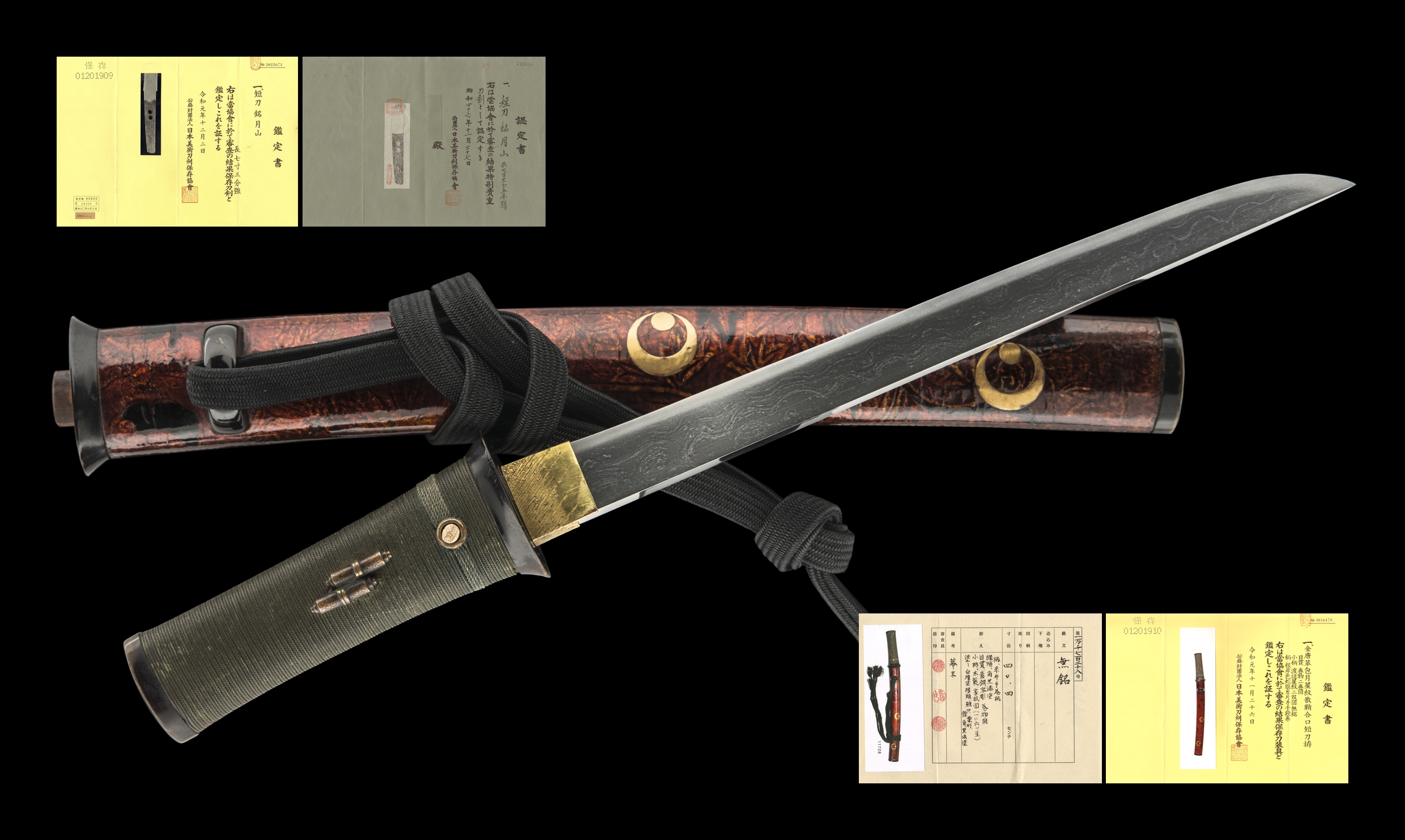
The Gassan school is one of the most prestigious lineages in Japanese sword-forging, its roots reaching back to the sacred slopes of Mount Gassan in Dewa province (present-day Yamagata prefecture) in the 1100s. Because this tanto pre-dates the Edo period, it is referred to as Ko-Gassan – ancient Gassan – placing it among the oldest survivng examples of the school’s work. The blade dates to approximately 1500, during the middle Muromachi period, and it carries the school’s most iconic hallmark: a vibrant ayasugi-hada (also called Gassan-hada) that pulses like a sound wave across the steel. A crisp chû-suguha hamon runs cleanly alongside it, with fine uchinoke and nezumi-ashi adding quiet detail to the temper line. The original ubu-nakago is signed with the two-character mei 月山 (Gassan), and the katte-sagari yasurime file marks remain clearly visible.
The aikuchi-koshirae is an extraordinary late Edo period ensemble that pays tribute to the spiritual world of the Yamabushi – mountain monks of the Dewa Sanzan, the three sacred mountains of Mount Haguro, Mount Gassan, and Mount Yudono. The saya is wrapped in rare kinkarakawa decorated leather – cow hide embossed with floral patterns and impressed with gold – a technique introduced to Japan from the Dutch in the 17th century and eventually banned by the emperor due to its popularity. It is lacquered over for preservation. Applied in gold to the surface are the gessei (moon and star) kamon of the Chiba clan, a powerful samurai family that helped establish the Kamakura shogunate. The connection to the moon is fitting: the kanji of the Gassan name itself means “moon mountain.”
The tsuka is braided in olive-green jabara silk in a vertical katate-sendan-maki style, with buffalo horn fittings, and the menuki depict paired makimono scrolls – a reference to the Buddhist mantras carried and recited by the Yamabushi as they traversed the mountains. A wooden kôzuka utility knife bears two carved kamon of the Watanabe clan. Every element of this ensemble has been assembled with purpose. The blade holds NBTHK Hozon certificates for both sword and koshirae, an older NBTHK Tokubetsu Kicho for the sword, and an NTHK Kanteisho for the aikuchi koshirae.
| Item Number | UJTA056 |
| Sword Type | Tantô |
| Swordsmith | Ko-Gassan |
| Swordsmith (JP) | 古月山 |
| Signature | Gassan |
| School | Gassan |
| Province | Dewa (Yamagata) |
| Period | Kotô – Middle Muromachi (early 1500s) |
| Nagasa | 22.1cm |
| Sori | 0cm |
| Moto-haba | 1.95cm |
| Moto-kasane | 6.7mm |
| Nakago | 9.16cm (ubu, katte-sagari yasurime, 2 mekugi-ana) |
| Weight | 125g |
| Jihada | Spectacular ayasugi-hada (Gassan-hada), ô-hada with plentiful chikei |
| Hamon | Crisp chû-suguha mixed with uchinoke and nezumi-ashi |
| Habaki | Gold-wrapped, diagonal file marks |
| Koshirae | Late Edo aikuchi tanto-koshirae (kinkarakawa-tsutsumi gesseimon-chirashi saya) – crafted c.1780-1867 |
| Tsuka | Olive-green jabara silk, katate-sendan-maki style, buffalo horn fittings |
| Menuki | Paired makimono (Buddhist scroll) motifs |
| Certificates | NBTHK Hozon (sword), NBTHK Hozon (koshirae), NBTHK Tokubetsu Kicho (sword), NTHK Kanteisho (aikuchi koshirae) |
| Catalogue | Catalogue 38 |
| Status | Sold |
| Includes | Shirasaya, Edo aikuchi koshirae, fabric bags, stand, kit, booklet, description |