
ITEM# UJKA414 – Catalogue 39 – Sold
A Shigezane Katana (重真)
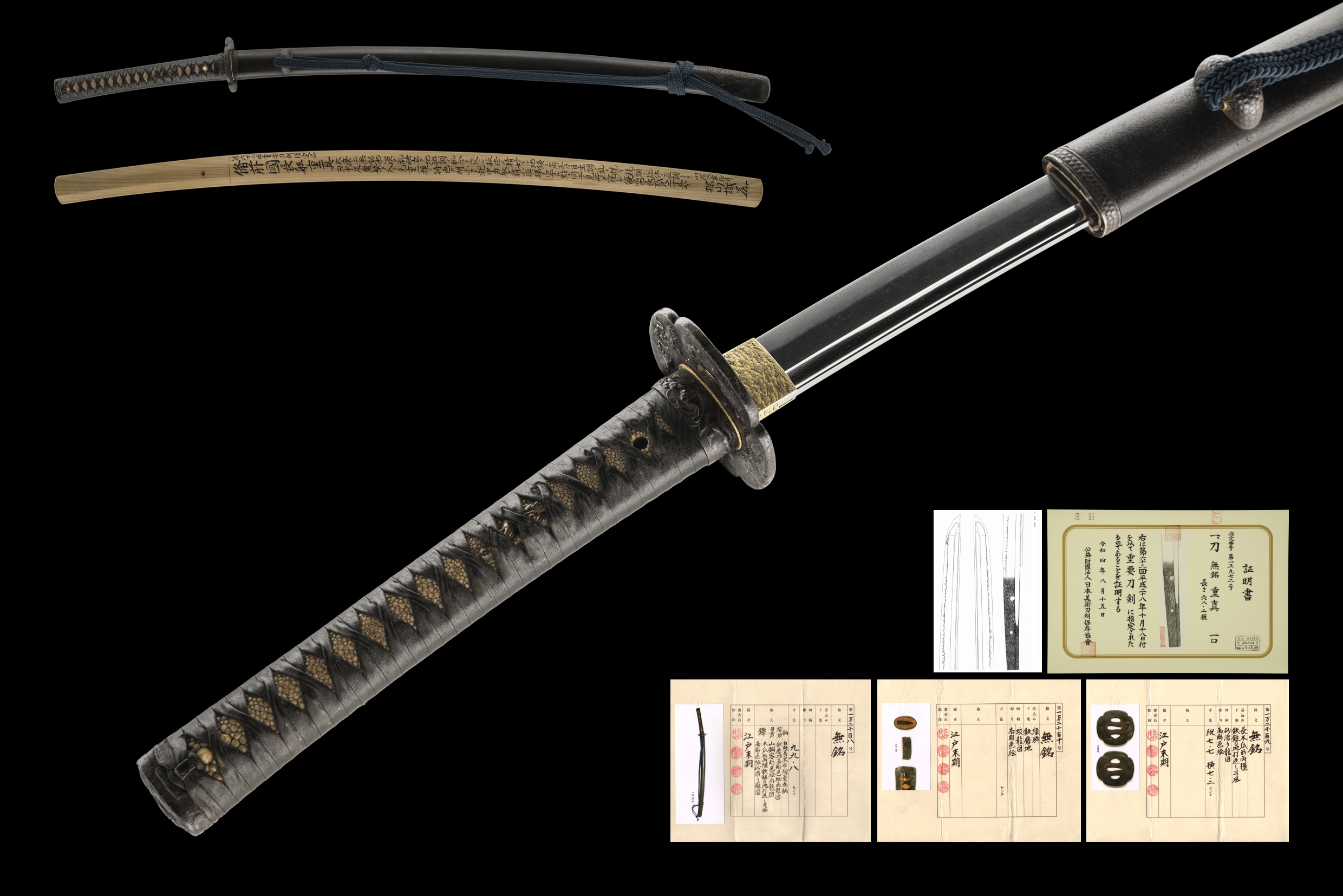
Shigezane’s family name is Jirôbei, and he is said to be the son of the first generation Hatakeda Morishige and the younger brother of Motoshige of the Motoshige school. His work spans from the Karyaku era (1326~1329) through to the Enbun era (1356~1361) – an active period of some 35 years. In the later years of the turbulent Nambokuchô period, his blades took on the era’s characteristic form: wide mihaba, thick kasane, and an elongated kissaki built for battle. This sword was once a very long tachi, now ô-suriage – greatly shortened at least twice over subsequent centuries to suit the changing requirements of the battlefield. The nakago retains its distinctive kaki-nagashi grooves, extending down to the middle of the butt end of the tang.
The jihada is an eye-catching mix of itame, mokume and flowing itame-nagare, alive with ji-nie, dark chikei, and a faint utsuri – steel of exceptional quality and visual fascination. The hamon is chû-suguha in nioi-deki, angular in character, with ashi, falling-leaf yô, and sunagashi threading through. The bôshi features brushed hakikake. The NBTHK certificate is unequivocal: the jiba is perfectly healthy, and this blade is a masterwork among all works attributed to Shigezane.
The blade is housed in a superb Late Edo period uchigatana-koshirae in kuro-ishime-ji-nuri – black lacquer with a stone-like surface – from the Kumagai school of Edo. The tsuba is a mysterious mokkô-gata hammered iron guard with gold accents and a sunamoguri-ryû (sand-lurking dragon) theme – quintessential wabi-sabi. Matching fuchi and kashira carry rain and water dragon decoration; the menuki are gilt rain dragons, uniquely wrapped in linen over antique samekawa. A gold habakiwith Botan-Yûjô file marks completes the mounting. The accompanying sayagaki by Tanobe Michihiro confirms this as one of Shigezane’s finest blades.
| Item Number | UJKA414 |
| Sword Type | Katana |
| Attribution | Attributed to Shigezane (mumei, ô-suriage nakago) |
| School | Osafune-Motoshige |
| Province | Bizen |
| Period | Kôtô – Nambokuchô period (Enbun era: 1356~1361) |
| Nagasa | 68.2 cm |
| Sori | 1.40 cm |
| Moto-haba | 2.78 cm |
| Weight | 615 g |
| Nakago | Ô-suriage mumei; kaki-nagashi grooves; 2 mekugi-ana |
| Jihada | Itame, mokume and nagare-hada with ji-nie, chikei and light utsuri |
| Hamon | Chû-suguha in nioi-deki with angularity, ashi, yô and sunagashi |
| Boshi | Hakikake |
| Certificates | NBTHK Juyo Token (62nd session, October 18th 2016; Shômeisho reissue August 15th 2022) |
| Fujishiro Rank | Jo-saku |
| Sharpness Rating | Ryo-Wazamono |
| Sayagaki | Tanobe Michihiro — Bizen no Kuni Osafune Shigezane, dated December, Year of the Boar (2019) |
| Koshirae | Kuro-ishime-ji-nuri uchigatana-koshirae, Late Edo period (1780~1867), Kumagai school |
| Tsuba | Mokkô-gata hammered iron with gold accents, sunamoguri-ryû (sand dragon) theme; NTHK-NPO Kanteisho certified |
| Fuchi-kashira | Iron, rain dragon (fuchi) and water dragon kôryû no zu (kashira) decoration; Kumagai school |
| Menuki | Gilt rain dragons, linen-wrapped over antique samekawa |
| Habaki | Gold habaki with Botan-Yûjô file marks |
| Catalogue | Catalogue 39 |
| Status | Sold |
| Includes | Shirasaya, Edo koshirae, stand, kit, booklet, printed description |