
ITEM# UJKA421 – Catalogue 40 – Sold
A Nidai Tadahiro Katana (肥前国住近江大掾藤原忠広)
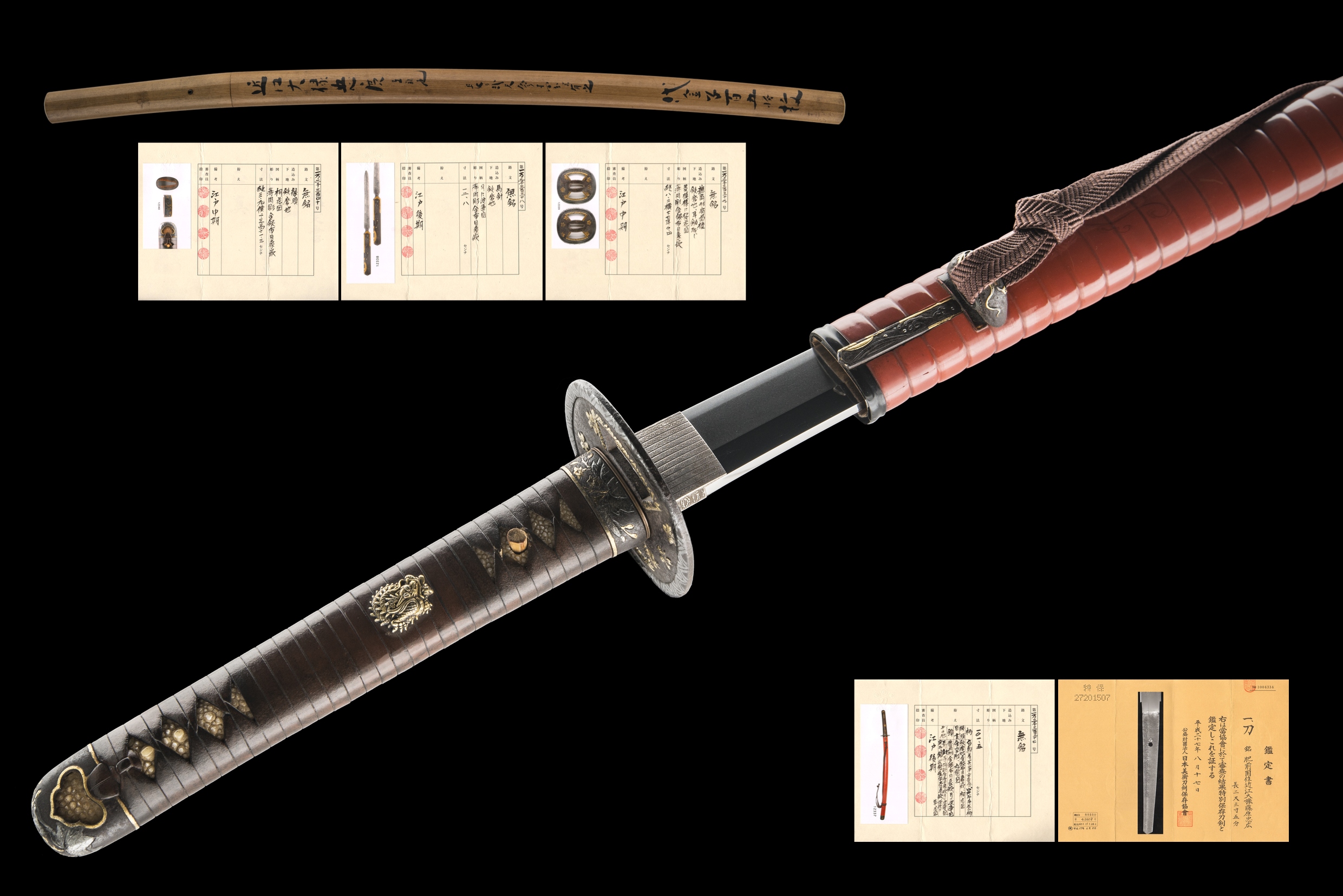
Born Hashimoto Heishirô in Saga, Hizen province in 1614, nidai (second generation) Tadahiro began training under his father, the legendary shodai Tadayoshi, at the age of ten. When his father died in 1632, the nineteen-year-old Tadahiro assumed leadership of the school – and in 1641, only nine years later, was awarded the prestigious honorific title of Ômi Daijô. He was just 28. He would go on to work for sixty years, dying in 1693 at the age of 81, and is ranked jôjô-saku – a highly superior swordsmith – among all Japanese smiths.
This fine Keian-era katana shows exactly why Nidai Tadahiro commands such respect. The jihada is a beautifully tight, finely forged konuka-hada – the powdery rice-bran surface texture that is the hallmark of the Hizen tradition – alive with ji-nie. Above it, the hamon runs in a pure, bright white chû-suguha in nie-deki, precise and luminous, like fallen snow on still water. The ubu-nakago retains its full original tang with sujikai-yasurime diagonal file marks and the smith’s complete signature.
Accompanying the blade is a magnificent set of Higo koshirae dated to the Middle Edo period (1700-1780): a glossy brown lacquered cha-roiro-nuri saya, a tsuba attributed to the late generation of Nishigaki Kanshirô with a diamond-and-cherry-blossom gold overlay, fuchi-kashira attributed to Suwa Ikuhira of Higo province with a paulownia design, curled-dragon menuki, and a distinctive bashin (horse needle) in place of a kozuka. The shirasaya carries an antique sayagaki by Hon’ami Kôhaku, written in June 1944. A silver habakiwith criss-cross file marks completes the blade fittings. This is Kyûshû history at its finest.
| Item Number | UJKA421 |
| Sword Type | Katana |
| Swordsmith | Ômi Daijô Tadahiro (2nd gen.) |
| Swordsmith (JP) | 近江大掾忠広 (二代) |
| Signature | Hizen no Kuni jû Ômi Daijô Fujiwara Tadahiro |
| School | Hizen (Tadayoshi school) |
| Province | Hizen |
| Period | Shintô – Early Edo period (Keian era: 1648-1652) |
| Nagasa | 71.2 cm |
| Sori | 1.3 cm |
| Moto-haba | 3.25 cm |
| Weight | 780 g |
| Nakago | Ubu (original, unaltered); sujikai-yasurime (diagonal file marks); 1 mekugi-ana |
| Jihada | Tight, finely forged konuka-hada with ji-nie |
| Hamon | Bright white chû-suguha in nie-deki |
| Certificates | NBTHK Tokubetsu Hozon (issued Heisei 27, August 2015); NTHK-NPO Kanteisho (koshirae, tsuba, fuchi-kashira, bashin designated as Authentic) |
| Fujishiro Rank | Jôjô-saku |
| Sayagaki | Hon’ami Kôhaku — Ômi Daijô Tadahiro, signed, blade length ~71.2 cm, valued at 150 mai, dated middle of the sixth month of Shôwa 19 (June 1944) |
| Koshirae | Higo uchigatana-koshirae (cha-roiro-nuri saya, lacquered in glossy brown), Middle Edo period (1700-1780) |
| Tsuba | Attributed to the late generation of Nishigaki Kanshirô; iron, Mid Edo period; diamond pattern with cherry blossom motif in gold overlay |
| Fuchi-kashira | Attributed to Suwa Ikuhira, Higo province (1700s); paulownia design in gold and silver on shakudô |
| Menuki | Curled dragons in gold |
| Habaki | Silver habaki with criss-cross file marks |
| Catalogue | Catalogue 40 |
| Status | Sold |
| Includes | Shirasaya with Hon’ami sayagaki, Higo koshirae, fabric bags, stand, kit, booklet, description |