
ITEM# UJKA415 – Catalogue 40 – Sold
A Rai Kunizane Katana (来国真)
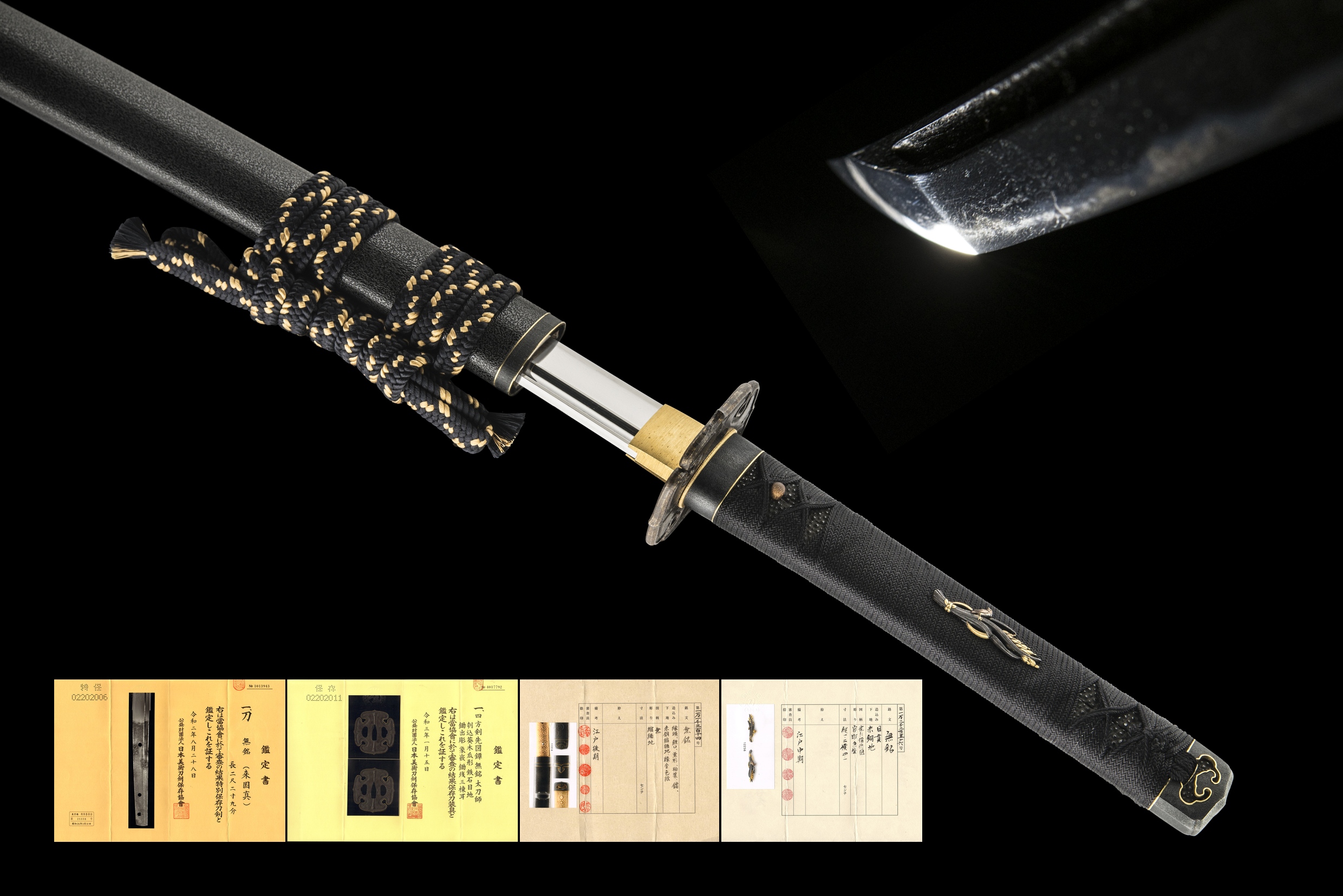
This impressive blade from the golden age of the Kamakura period has been attributed to Rai Kunizane, a celebrated member of the famed Rai school of Yamashiro province. Born with the given name Tôgorô, Kunizane was either the son or student of grandmaster Rai Kunitoshi, with national treasure swordsmith Rai Kunimitsu as his older brother and Rai Tomokuni as his younger sibling. He flourished circa the Shôwa era (1312-1317) and continued working into the Nambokuchô period that began in 1333. The character 来 – meaning “to come” – is said to reflect the school’s founder having arrived from Korea, though it is Kuniyoshi’s son Kuniyuki who is now credited as the true founder of the line.
The blade carries a torii-zori profile, with curvature centred in the middle section and a substantial chû-kissaki that lends the sword a commanding, statuesque presence. A full-length bo-higroove runs on both the omote and ura, tapering to a point part-way down the nakago in classic kaki-nagashi form. The jihada is a rich mix of ko-mokume and itame, shot through with the characteristic dark-and-sticky textural patches that define Rai-hada – a school signature that reveals itself beautifully under good light. Vivid chikei and kinsuji run through the steel, confirming the quality of the forging. The hamon is a bright ko-chôji midare in nie-deki, thickening in areas that recall the fluid energy of sumi-e brushwork, transitioning into passages of chû-suguha as it approaches the point.
Unique Japan commissioned an outstanding handachi koshirae for this sword, completed in 2023-24 by master craftsmen in Japan. The set features an iron tachi tsuba with a stone-surface finish and a sword-tipped corner motif, crafted by a tachi smith during the Edo period and now bearing its own NBTHK Hozon certificate. Menuki in a bird-and-rice theme – attributed to Inagawa Naokatsu of the mid-Edo period – are set onto an expertly wrapped tsuka balanced for a one-handed grip, and certified authentic by NTHK-NPO Kanteishô. The habakiis gold with horizontal file marks. This is a 700-year-old blade presented in a manner befitting its lineage.
| Item Number | UJKA415 |
| Sword Type | Katana |
| Attribution | Attributed to Rai Kunizane (mumei) |
| School | Rai |
| Province | Yamashiro |
| Period | Late Kamakura (circa 1312-1317) |
| Nagasa | 69.4cm |
| Sori | 1.3cm |
| Moto-haba | 2.72cm |
| Weight | 630g |
| Nakago | Mumei (unsigned), o-suriage (greatly shortened), 17.8cm, 3 mekugi-ana; bo-hi kaki-nagashi on omote, kaki-tôshi on ura |
| Jihada | Ko-mokume and itame with Rai-hada, channels of chikei and kinsuji |
| Hamon | Ko-chôji midare mixed with suguha-chôji in nie-deki |
| Boshi | Chû-kissaki, healthy and extended |
| Certificates | NBTHK Tokubetsu Hozon (sword); NBTHK Hozon (tsuba); NTHK-NPO Kanteishô (handachi fittings and menuki) |
| Fujishiro Rank | Jo-saku |
| Koshirae | Handachi koshirae, completed 2023-24, produced by Unique Japan |
| Tsuba | Iron, stone-surface finish with sword-tipped corner motif; crafted by a tachi smith, Edo period; NBTHK Hozon |
| Menuki | Bird and rice theme; attributed to Inagawa Naokatsu, mid-Edo period; NTHK-NPO Kanteishô |
| Tsuka | Black ito wrap, traditionally balanced for one-handed grip |
| Habaki | Gold, horizontal file marks |
| Catalogue | Catalogue 40 |
| Status | Sold |
| Includes | Shirasaya, fabric bag, stand, kit, description |