
ITEM# UJKA403 – Catalogue 40 – Sold
A Naotane Tameshigiri Katana (大慶庄司直胤)
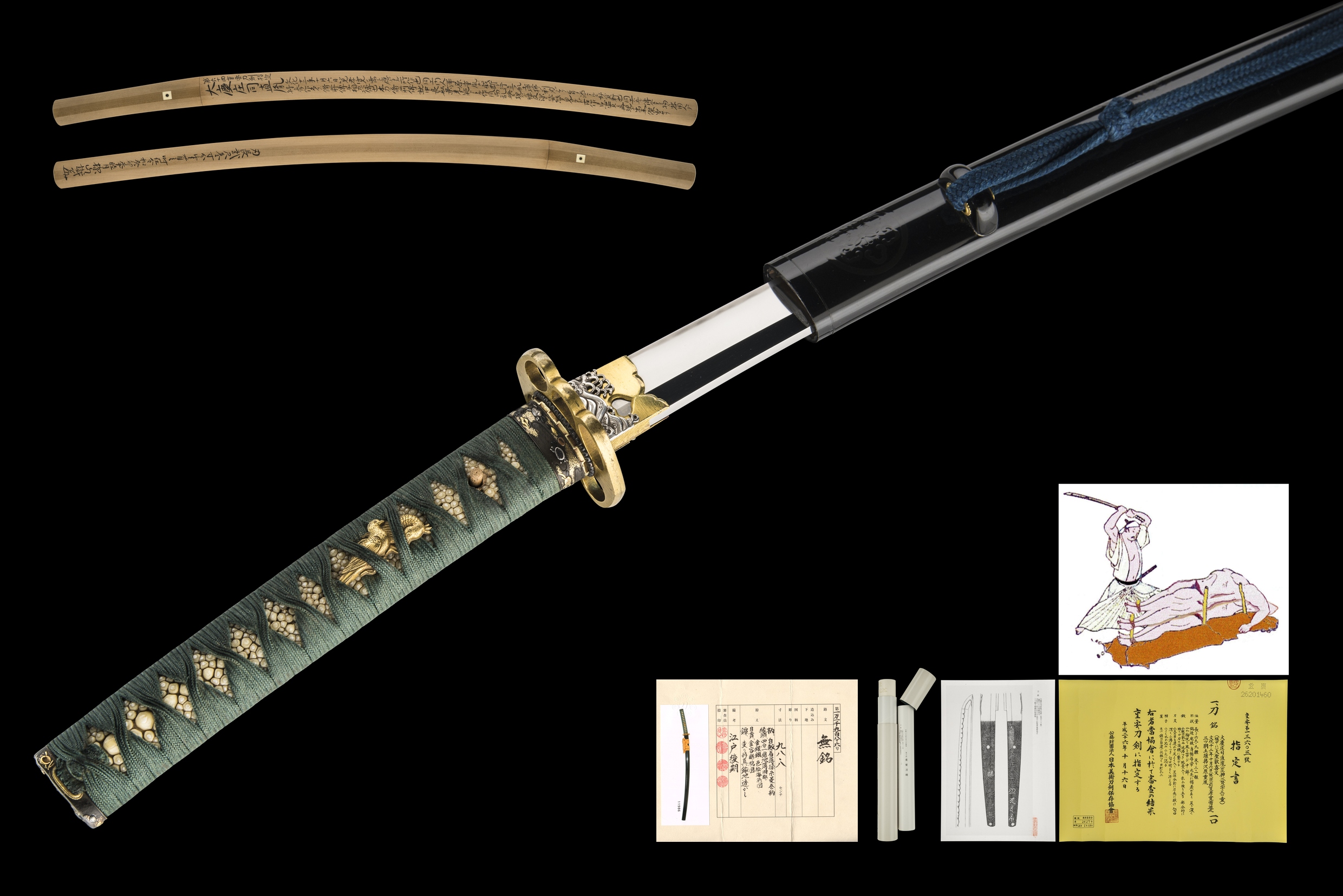
Taikei Shôji Naotane was born in Yamagata city, Dewa province, in 1778, of samurai lineage – his family carried the name Shôji at a time when most Japanese had no surname at all. Moving to Edo as a young man, he became an apprentice of the hugely influential saijô-saku grandmaster Suishinshi Masahide, quickly mastering his teacher’s methods and adopting the crafting name Taikei. Like Masahide, he was retained by Lord Akimoto of Tatebayashi in Kozuke province. In 1821 he received the honorary title of Chikuzen Daijô, and in 1848 the further title of Minosuke. When Masahide and his son both died in 1825, Naotane took over leadership of the school – a smith whose talents, by all accounts, had already surpassed those of his master. He remained active for some 55 years, dying on February 22nd, 1858, at the age of 79.
Naotane was one of only three smiths ranked saijô-saku (grandmaster) during the shinshintô period. He was a master of all five traditions, with particular distinction in the Bizen and Sôshû disciplines. This katana, dated to October 6th, 1815, demonstrates the full depth of his achievement in the fukkotô movement – the revival of early Kotô-era forging methods championed by Masahide. The blade follows the Bizen tradition in the specific manner of Osafune Kagemitsu, and as Tanobe Michihiro writes on his sayagaki, with the presence of midare-utsuri and the deep koshizori characteristic of that tradition, this is a very faithful recreation of a Kotô-era work. The result has a genuine early-14th-century feel – a master-class achievement in historical reproduction.
What sets this katana apart even among the approximately 130 jûyô tôken-ranked swords bearing a tameshigiri cutting test inscription is the identity of the tester. The test was performed by Naotane’s own master student, Sawara Shigetane – a swordsmith, not a professional tester. According to Markus Sesko, author of Tameshigiri: The History and Development of Japanese Sword Testing, who personally researched this blade, NAO60 appears to be the only jûyô-ranked sword bearing a cutting test explicitly recorded as having been carried out by a swordsmith. All others go back to professional testers such as the Yamano or Yamada families. The sword was commissioned by Kakei Takahiro, a Hatamoto-ranked samurai and devout Buddhist – the nakago bears carved bonji (Sanskrit characters) invoking Kangiten (Nandikesvara), Nikkô Bosatsu, Dainichi Nyorai, and Kongô Rikishi. The accompanying Edo-period uchigatana koshirae – lacquered in glossy black with kamon maki-e, certified authentic by NTHK-NPO, and fitted with a spectacular gold and silver wave habaki – is a museum-worthy complement to the blade.
| Item Number | UJKA403 |
| Sword Type | Katana |
| Swordsmith | Taikei Shôji Naotane (shodai, first generation) |
| Swordsmith (JP) | 大慶庄司直胤 |
| Signature | Taikei Shôji Naotane + kaô + three bonji (Daisho Kangiten: Nandikesvara, Nikkô Bosatsu, Dainichi Nyorai, Kongô Rikishi) |
| Date | Bunka 12 (October 6, 1815) |
| School | Suishinshi / Taikei school (shinshintô) |
| Province | Musashi |
| Period | Shinshintô – Bunka era (1804-1818) |
| Nagasa | 69.9cm |
| Sori | 2.1cm |
| Moto-haba | 2.97cm |
| Weight | 685g |
| Nakago | Ubu, sujikai-yasurime with kesshô, 2 mekugi-ana (21.4cm) |
| Jihada | Densely forged ko-itame with ji-nie, fine chikei, and midare-utsuri |
| Hamon | Ko-nie-laden gunome with a wide, bright, and clear nioiguchi mixed with many ashi |
| Boshi | Slight midare-komi with ko-maru kaeri |
| Certificates | NBTHK Juyo Token (60th session, Certificate No. 13603) / NTHK-NPO Kanteisho (koshirae, designated Authentic) |
| Fujishiro Rank | Saijo-saku (grandmaster swordsmith, highest rank) |
| Sayagaki | Tanobe Michihiro — Bizen tradition in the style of Osafune Kagemitsu; excellent deki, faithful Koto-era recreation; dated Reiwa 5, mutsuki (January 2023) |
| Tameshigiri (JP) | 三ツ胴土壇拂 沢原重胤 |
| Koshirae | Late Edo period (1780-1867) uchigatana koshirae; kuro-ro-urushi sumi-maki-e nuri saya lacquered in glossy black with kamon maki-e (fusenryô ni karahana mon / karakan mon); NTHK-NPO Kanteisho certified |
| Tsuba | Kawari-gata (uniquely shaped), brass, openwork design |
| Fuchi-kashira | Polished shibuichi, bas-relief with gold, silver, and copper accents; ocean beach motif with crabs and sea creatures |
| Menuki | Golden hata (pigeons); spiritual messengers symbolising luck, companionship, and prosperity |
| Tsuka | Green silk braid (hishi-maki) over same |
| Habaki | Gold with Hokusai-esque silver wave design |
| Catalogue | Catalogue 40 |
| Status | Sold |
| Includes | Shirasaya (with Tanobe sayagaki), Edo-period uchigatana koshirae, stand, kit, booklet, printed description, original torokusho (registration card, Showa 26 / 1951, serial no. 2627) |