
ITEM# UJKA444 – Catalogue 41 – Sold
A Kanabô Masatsugu Katana (金房政次)
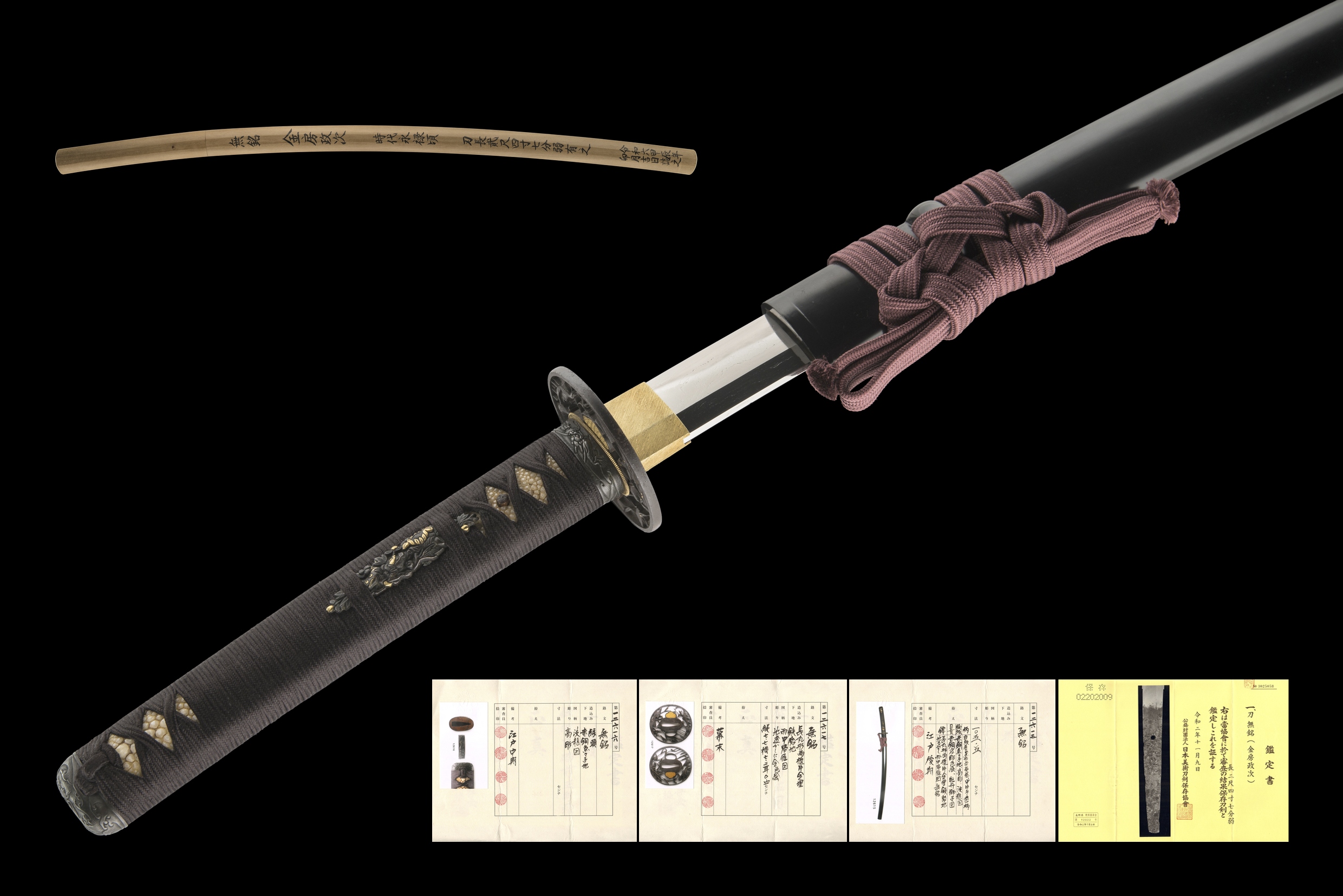
The Kanabô school is said to have begun producing swords in the Daiei era (1521-1528), with its roots in the Yamato Sue-Tegai tradition. Founding influences trace back to Shinya Masanaga and Fujiwara Masanaga, and the school’s leading smiths included Masashige, Masasada, Masakiyo and Masatsugu. The Kanabô smiths built a strong reputation as expert makers of spears, particularly the jumonji-yari, and their swords were equally valued by samurai warriors as dependable battle-tested blades.
This long, powerful katana attributed to Kanabô Masatsugu is a textbook example of why Kanabô swords were prized on the battlefield. Strong and stout in shape, shallow in curvature, with a wide mihaba, thick kasane, and a massive ô-kissaki just shy of 10cm in length – this blade means business. The steel shows wonderful straight-grain masame-hada with pools of rounded mokume-hada and striking streams of sunagashi running throughout. The hamon is a wild mix of styles closest to Sue-Bizen and Mino in flavour, with characteristic spiking togari-ba peaks that reflect the turbulence of the late Muromachi period.
The sword comes with a fine set of late Edo period koshirae centred on a splendid polished iron sukashi tsuba attributed to Sunagawa Masachika of Edo province, depicting a flock of geese flying in the rain with one hitsu-ana filled in gold with an exquisite floral design. The fuchi-kashira is a superb shakudô piece attributed to the Bizen Shôami school, featuring a dragon swimming in waves. Oversized menuki depict protective shishi lions enveloped with peonies – symbols of wealth, prosperity, and spiritual guardianship – wrapped in katate-maki so they can be fully appreciated. This is a sword that will stand tall in any nihonto collection.
| Item Number | UJKA444 |
| Sword Type | Katana |
| Attribution | Attributed to Kanabô Masatsugu (mumei) |
| School | Kanabô |
| Province | Yamato |
| Period | Koto – Late Muromachi period (Eiroku era: 1558-1570) |
| Nagasa | 74.7cm |
| Sori | 1.60cm |
| Moto-haba | 3.29cm |
| Weight | 800g |
| Nakago | Ubu, 22.3cm, one mekugi-ana |
| Jihada | Masame-hada with mokume-hada, ji-nie and chikei |
| Hamon | Bright mixture of ko-midare, ko-chôji and togari-ba with sunagashi and kinsuji |
| Certificates | NBTHK Hozon |
| Sayagaki | Nozomi-san (shodô artist) — inscribed in the 4th month, Reiwa 6 (April 2024) |
| Koshirae | Edo uchigatana-koshirae (kuro-ro-nuri saya), late Edo period (1780-1867) |
| Tsuba | Polished iron sukashi tsuba, geese in the rain, attributed to Sunagawa Masachika (Edo province), NTHK-NPO Kanteishô certified, late Edo period (1853-1868) |
| Fuchi-kashira | Shakudô, dragon in waves, attributed to Bizen Shôami school, NTHK-NPO Kanteishô certified, middle Edo period (1700-1780) |
| Menuki | Shishi lions with peonies, oversized, katate-maki presentation |
| Habaki | Gold habaki with diagonal file marks |
| Catalogue | Catalogue 41 |
| Status | Sold |
| Includes | Shirasaya, Edo koshirae, fabric bags, stand, kit, printed description |