
ITEM# UJKA443 – Catalogue 41 – Sold
A Masashige Katana (肥前国佐賀住正重)
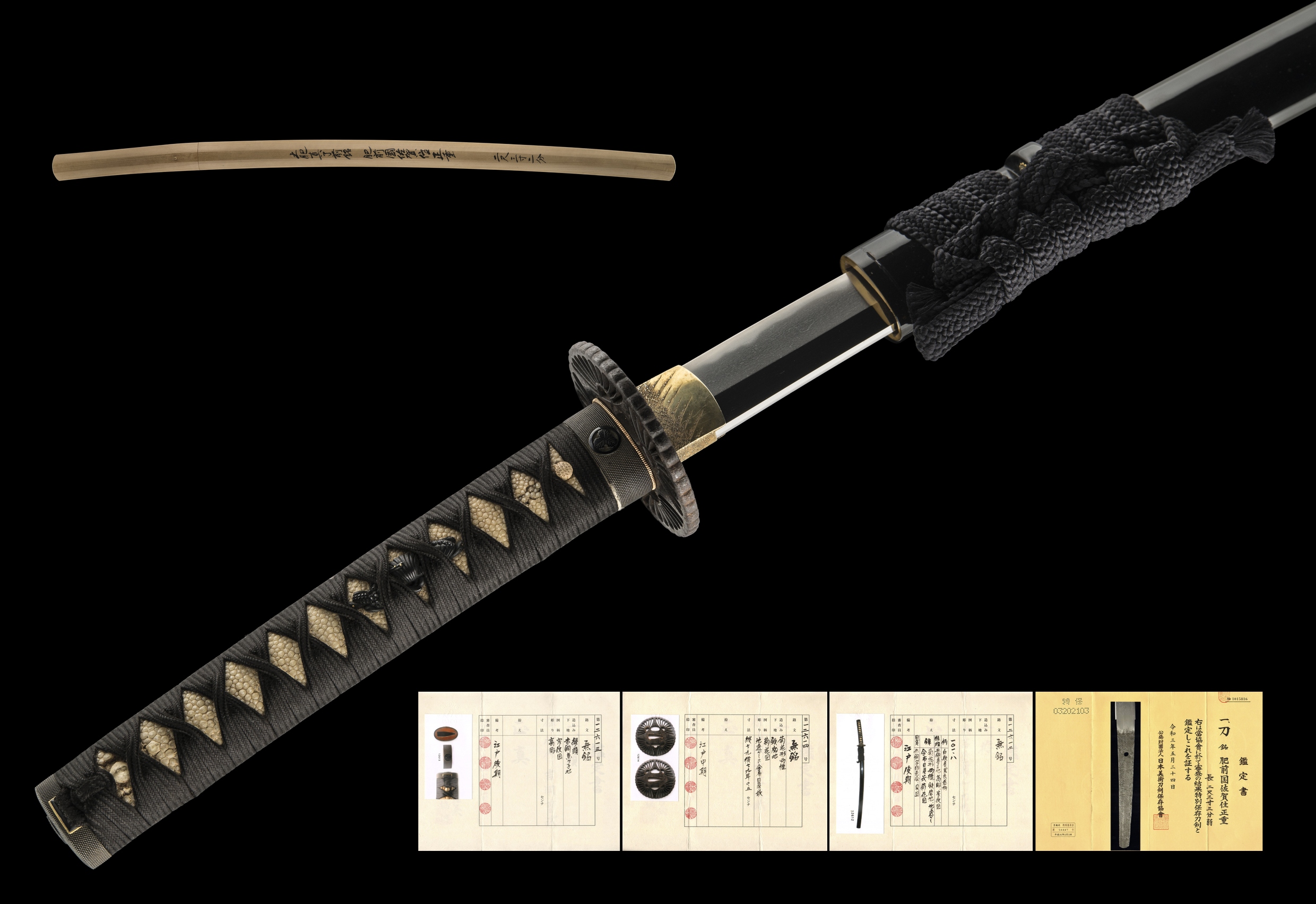
Born Doi Sakuzaemon, Masashige was the son of Hizen Hirado Doi Masanori and signed his earliest swords under the name Masashige while resident in the city of Saga in Hizen province. In 1680 he undertook the remarkable journey of over 700 km to Settsu (Ôsaka) to study under grandmaster swordsmith Inoue Shinkai. Two years into his apprenticeship, Shinkai – revered as Ôsaka Masamune – died unexpectedly at the age of 53 in the second year of the Tenna era (1682). In honour of his teacher, Masashige took the name Shinryô, returned to Hirado, and adopted Shinkai’s style of workmanship. Six generations of swordsmiths would follow in his footsteps in Hizen.
This katana predates that famous apprenticeship. The absence of Ôsaka-yakidashi in the hamon confirms the blade was forged before Masashige departed for Ôsaka – it is a rare document of his independent early work. The steel is forged in a lively mixture of masame and ko-itame-hada with plentiful dark lines of chikei throughout the ground. Under strong light the sword opens into a brilliantly bright gunome-midare hamon with surging peaks and valleys, swept through with heavy sunagashi – particularly spectacular in the monouchi – and fine threads of kinsuji. The skills that would later absorb Shinkai’s influence were already well and truly formed.
A classic black-lacquered Late Edo period uchigatana-koshirae houses the sword. The sukashi tsuba is a polished iron piece with an elegantly arranged chrysanthemum openwork design, attributed to the Kyô-Shôami school of Yamashiro (Kyôto) province, dated to the Middle Edo period. The fuchi-kashira is attributed to Yoshioka Shigetsugu and displays the Mitsu-kashiwa-mon (oak leaves), a kamon favoured by daimyô families including the Yamauchi of Tosa and the Makino of Nagaoka. The menuki are a rare set of shakudô pieces depicting a snake entwined around a shell – a fitting coastal motif for a smith from Hiradô. Koshirae, tsuba and fuchi-kashira are each individually certified by the NTHK-NPO.
| Item Number | UJKA443 |
| Sword Type | Katana |
| Swordsmith | Shodai Masashige (Doi Shinryô zenmei) |
| Swordsmith (JP) | 正重 (土肥真了 前銘) |
| Signature | Hizen no Kuni Saga jû Masashige |
| School | Hizen school (Shinryô lineage) |
| Province | Hizen |
| Period | Shinto – Early Edo period (Enpô era: 1673-1679) |
| Nagasa | 70.5 cm |
| Sori | 1.20 cm |
| Moto-haba | 2.96 cm |
| Weight | 780 g |
| Nakago | Ubu (original, unaltered); sujikai-yasurime (diagonal file marks); kurijiri nakagojiri (chestnut shaped); 1 mekugi-ana |
| Jihada | Ko-itame-hada with masame-hada and plentiful chikei |
| Hamon | Bright gunome-midare with heavy sunagashi and kinsuji |
| Certificates | NBTHK Tokubetsu Hozon; NTHK-NPO Kanteishô (koshirae, fuchi-kashira and tsuba each certified as Authentic) |
| Fujishiro Rank | Chûjô-saku |
| Sharpness Rating | Wazamono |
| Koshirae | Uchigatana-koshirae, kuro-ro-nuri (glossy black lacquer) saya; Late Edo period (1780-1867); NTHK-NPO certified |
| Tsuba | Polished iron sukashi tsuba, chrysanthemum design; attributed to Kyô-Shôami school, Yamashiro province; Middle Edo period (circa 1700s); NTHK-NPO certified |
| Fuchi-kashira | Attributed to Yoshioka Shigetsugu; Mitsu-kashiwa-mon (oak leaves) kamon; Late Edo period (1780-1867); NTHK-NPO certified |
| Menuki | Shakudô; snake entwined around a shell |
| Habaki | Gold habaki with falling-rain file marks |
| Catalogue | Catalogue 41 |
| Status | Sold |
| Includes | Shirasaya, Edo-koshirae, fabric bags, stand, kit, printed description |