
ITEM# UJKA448 – Catalogue 42 – Sold
A Kanezumi Tachi (兼住 (関))
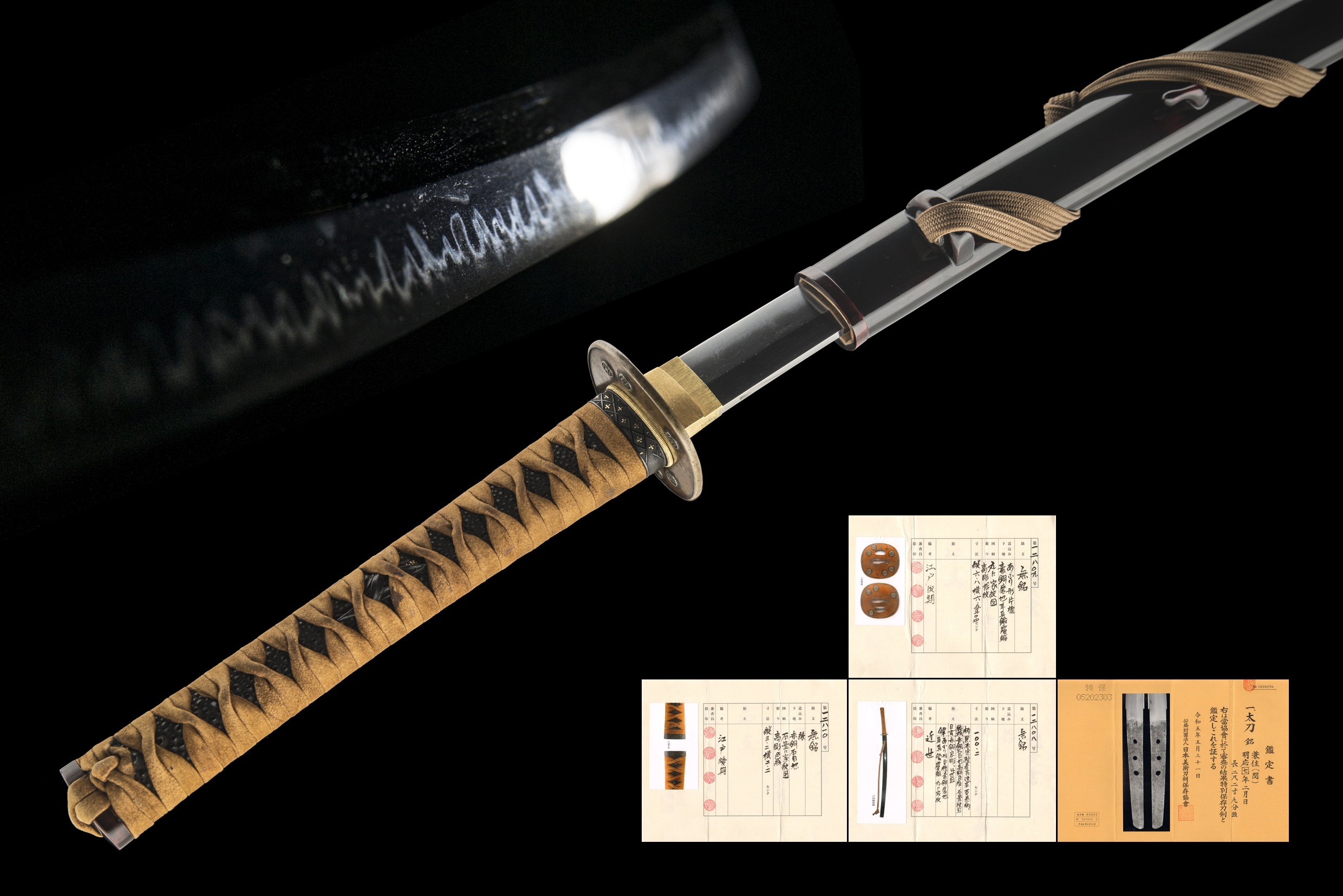
We travel back to February 1498 with the creation of this fiery tachi by Kanezumi (also read Kanesumi), who worked in Seki during the tumultuous Muromachi period. Born Jûrôzaemon, Kanezumi was the younger brother of Kaneyuki, who is said to have worked in the Nara school. Relatively little is known of Kanezumi beyond this, which makes this dated, signed blade a genuinely rare reference piece – one of the more elusive names to surface from late Sue-Kotô Mino.
Examined closely, this is a classic Mino-tradition creation with a Kanesada school influence that is superior to the average Sue-Seki blade of the 1500s. The jihada is a finely forged mixture of mokume, itame-nagare and straight-grain masame-hada, with ji-nie and chikei throughout. Its dazzling gunome-chôji-midare hamon features areas reminiscent of the great ôbusa-chôji of the Fukuoka-Ichimonji school – tall, tasselled buds stretching high to the shinogi line. Spots of tobiyaki and yô add further depth, and the bôshi terminates in a striking Jizo-form that heads its way through the kissaki.
The sword is housed in a tasteful set of koshirae lacquered in blurred black and red by a master Japanese artisan of the modern period. The tsuba has been attributed to the Nishigaki school of Higo province and features three family kamon – kuyo-mon, sumitate-yotsume and shihô-hanabishi – each with its own rich story. The eye-catching fuchi, attributed to the Edo branch of the Yoshioka school, carries a jûji-mon cross-diamond pattern that cleverly pays tribute to the swordsmith’s own name, Jûrôzaemon. A 526-year-old dated blade in this condition, with this quality of fittings and four certificates, is a serious acquisition on every level.
| Item Number | UJKA448 |
| Sword Type | Katana (originally tachi, shortened via machi-okuri) |
| Swordsmith | Kanezumi (Seki) |
| Swordsmith (JP) | 兼住(関) |
| Signature | Kanezumi (Seki) / Meiô nananen nigatsu hi |
| Date | Meiô 7 (February 1498) |
| School | Seki (Mino tradition, Kanesada influence) |
| Province | Mino |
| Period | Sue-Kotô (Meiô era: 1492-1501) |
| Nagasa | 69.6cm (machi-okuri) |
| Sori | 1.2cm |
| Moto-haba | 2.82cm |
| Weight | 620g |
| Nakago | Machi-okuri-nakago (18.5cm), sujikai-yasurime, 3 mekugi-ana |
| Jihada | Finely-forged itame-nagare, mokume, masame-hada with ji-nie and chikei |
| Hamon | Gunome-chôji-midare with tobiyaki and yô |
| Boshi | Jizo-bôshi |
| Certificates | NBTHK Tokubetsu Hozon; NTHK-NPO Kanteishô (koshirae); NTHK-NPO Kanteishô (fuchi); NTHK-NPO Kanteishô (tsuba) |
| Koshirae | Kuro-shu bokashi-nuri saya uchigatana-koshirae (black and red blurred lacquer), modern period |
| Tsuba | Attributed to Nishigaki school, Higo province; iron, three family kamon (kuyo-mon, sumitate-yotsume, shihô-hanabishi); NTHK-NPO Kanteishô |
| Fuchi-kashira | Fuchi: attributed to Edo branch of Yoshioka school, Late Edo (1780-1867), jûji-mon cross-diamond design, gold inlay, NTHK-NPO Kanteishô. Kashira: buffalo horn, lacquered to match saya |
| Menuki | Omoto no zu (Rohdea japonica / Japanese sacred lily), gilt |
| Tsuka | Raw leather (suede) wrap, black samegawa |
| Habaki | Gold ni-ju habaki with straight file marks |
| Catalogue | Catalogue 42 |
| Status | Sold |
| Includes | Shirasaya, koshirae, fabric bags, stand, kit, printed description |