
ITEM# UJKA469 – Catalogue 43 – Sold
An Ietada Tameshigiri Katana (賀州住藤原家忠)
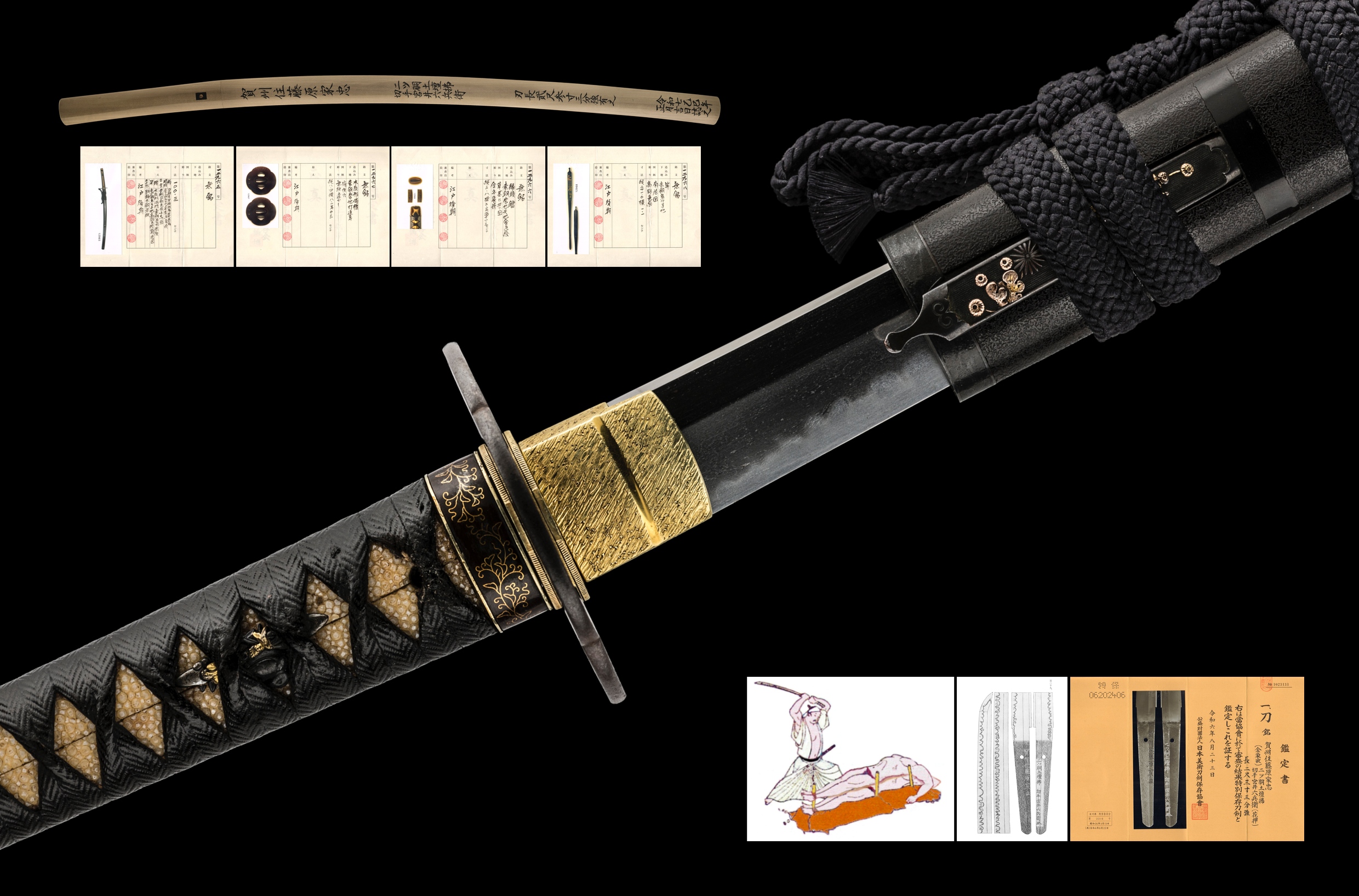
This magnificent katana was forged by shodai (first generation) Ietada, born Suzuki Kichibei, who lived in the city of Kanazawa in Kaga province during the early to mid-1600s. The younger brother of Katsukuni, Ietada became a prominent smith of the Kaga Darani school and died in the first year of Meireki era (1655). Ranked wazamonô for his razor-sharp sword-making, Ietada is listed as jô-saku in the revised 1990 edition of Fujishiro’s Nihon Shintô Jiten – an upgrade from the earlier chûjô-saku designation, and one look at this blade makes clear he deserves it. The katana is documented in Kashû Shintô Shû (加州新刀集), an important reference book highlighting notable swords of the Kaga shintô period.
The nakago bears a gold-inlaid tameshigiri inscription recording one of the most demanding cutting tests in the tradition: futatsu-dô dodanbarai, severing through two bodies stacked on a mound before embedding in the earthen ground below – all in a single stroke. The tester, Miyai Rokubê, has been identified on the official Kaga domain samurai name list from 1670, where he is listed as an archer who was evidently promoted to the sword-testing branch. This is not a decorative flourish – it is historical proof of the blade’s extraordinary cutting ability, preserved in gold for nearly four centuries. The nakago also conceals a remarkable secondary discovery: beneath the habaki, the celebrated polisher Hon’ami Kôho (本阿弥光甫) left his signature and kaô, dated August 1936 – a rare honour rarely found in this position.
The hamon is a brilliant gunome-chôji midare with a wide nioiguchi, punctuated by the distinctive tadpole-shaped formations known as kawazu no ko-chôji – a pattern made famous by the Bizen Hatakeda masters Moriie and Sanemori during the golden Kamakura period. Ietada was clearly aiming to reproduce those masterworks, and succeeds handsomely. The jihada is ko-itame mixed with mokume-hada, rich with ji-nie and swirling chikei. The bôshi is midare-komi with a slight togari (pointed) turn back. Mounted in an elegant Late Edo period handachi-koshirae lacquered in black Sendai-shibonuri with rich shakudô fittings, a kogai attributed to the Katsuki school, and a fuchi-kashira attributed to Inoue Shigeyasu featuring gold vine inlay – this is a complete, museum-quality ensemble of pure samurai class.
| Item Number | UJKA469 |
| Sword Type | Katana |
| Swordsmith | Shodai Ietada (Kaga province) |
| Swordsmith (JP) | 賀州住藤原家忠 |
| Signature | Gashû-jû Fujiwara Ietada |
| School | Kaga Darani |
| Province | Kaga (Gashû) |
| Period | Shintô – Early Edo period (Jôô era: 1652-1655) |
| Nagasa | 70.7cm (ubu) |
| Sori | 1.5cm |
| Moto-haba | 3.03cm |
| Weight | 720g |
| Nakago | Ubu-nakago, kurijiri tending to ha-agari, sujikai-yasurime, one mekugi-ana; omote bears long signature; ura bears gold-inlaid tameshigiri inscription |
| Jihada | Ko-itame mixed with mokume-hada, plentiful ji-nie and swirling chikei |
| Hamon | Gunome-chôji midare with wide nioiguchi, kawazu no ko-chôji, ashi, tobiyaki and kinsuji |
| Boshi | Midare-komi with slight togari (pointed) turn back |
| Certificates | NBTHK Tokubetsu Hozon; NTHK-NPO Kanteishô (koshirae, fuchi-kashira, kogai and tsuba certified as Authentic) |
| Fujishiro Rank | Jô-saku |
| Sharpness Rating | Wazamonô |
| Sayagaki | Nozomi-san (shodô artist) – inscribed in the first month, Reiwa 7 (January 2025) |
| Tameshigiri (JP) | 二ツ胴土壇拂 切手宮井六兵衛(花押) |
| Koshirae | Edo handachi-koshirae, kuro-ishime-ji Sendai-shibonuri saya (Late Edo period, 1780-1868) |
| Tsuba | Attributed to Kyô-Shôami school; polished copper ground, multiple-lobed round form with two hitsu-ana and udenuki-ana; Late Edo period (NTHK-NPO certified) |
| Fuchi-kashira | Attributed to Inoue Shigeyasu; flat gold inlay depicting vines on polished copper ground; Late Edo period (1780-1868) |
| Menuki | Frolicking water birds in mixed metals |
| Tsuka | Twill weave, lacquered black in hishimaki style |
| Habaki | Tall gold habaki, diagonal file marks with horizontal carving (Mito style) |
| Catalogue | Catalogue 43 |
| Status | Sold |
| Includes | Shirasaya with sayagaki, Edo handachi-koshirae, fabric bags, stand, kit, print description |