
ITEM# UJTA066 – Catalogue 46 – Sold
A Kanefusa Tantô (藤原兼房)
Fujiwara Kanefusa (藤原兼房), later known as Wakasa no Kami Ujifusa (若狭守氏房), was born in 1534 in Gifu as the third son of Zensai Kanefusa (善斎兼房), head of the great Mino Kanefusa lineage. In his early years he signed his work simply “Kanefusa,” before entering the service of Oda Nobunaga (織田信長) and eventually receiving the court title Wakasa no Kami. He became one of the most distinguished smiths in Nobunaga’s inner circle, forging at Azuchi and later working in Kiyosu until his death in 1590. The vigour of his early blades reflects a craftsman pushing the inherited techniques of his father while searching for a personal voice – the ambition visible in the steel of this period would eventually earn him the reputation he achieved under his later name. He is rated chûjô-saku by Fujishiro.
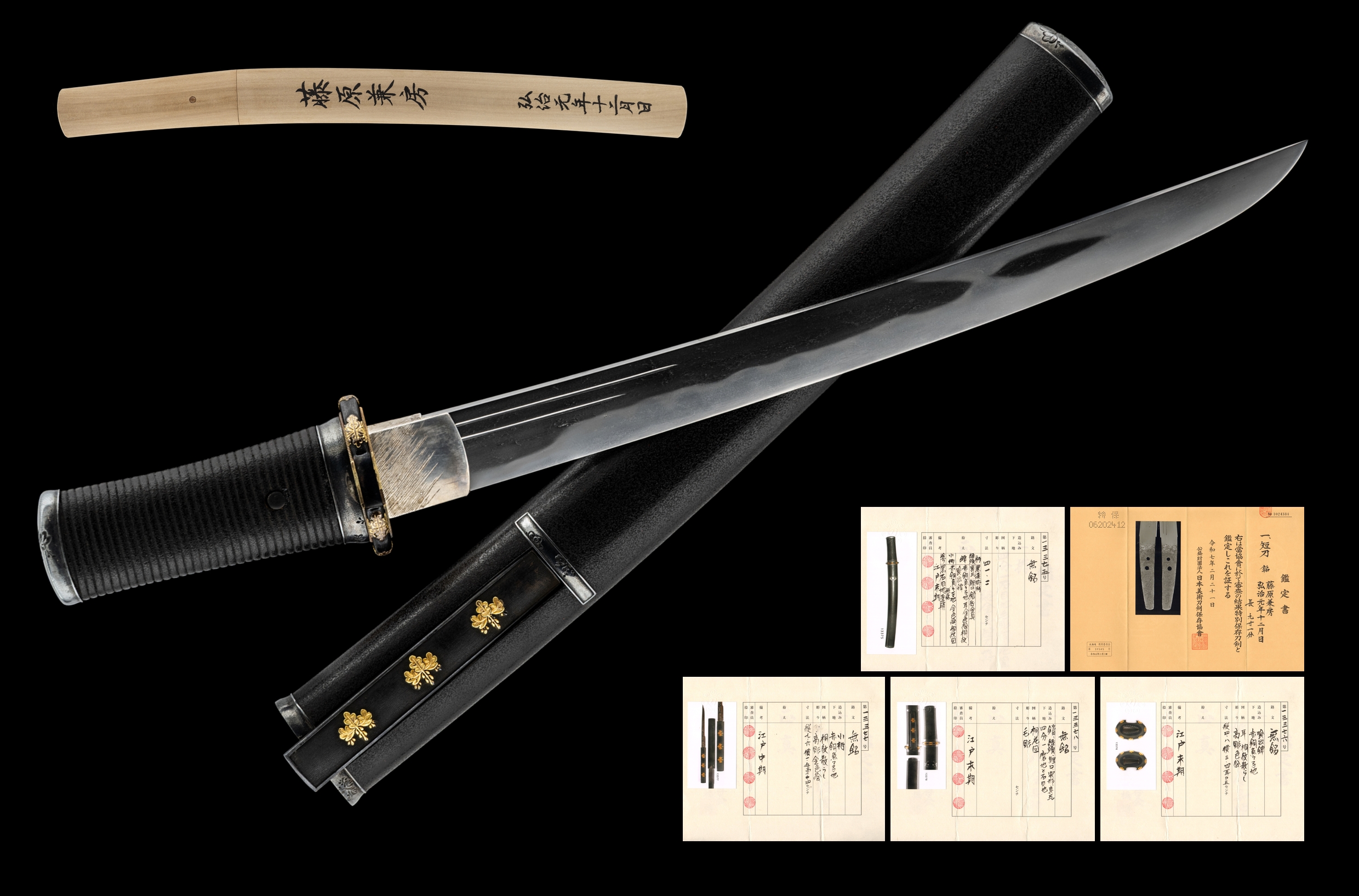
This tanto is signed and dated to the first year of the Kôji era, twelfth month (December 1555) – when Kanefusa was approximately twenty-one years old. December 1555 was a moment of particular violence in Mino province: the ruthless Saitô Yoshitatsu had recently seized power, and the young Oda Nobunaga was consolidating in neighbouring Owari with his eye firmly on Mino’s fertile lands. Swordsmiths worked day and night for armies that multiplied by the season. This tanto was born in that fire. At 27.6 cm with a graceful 0.4 cm curvature, it acts almost like a miniature katana in the hand. The jigane is tightly forged itame tending toward mokume, with icy ji-nie, delicate chikei, and shirake-utsuri rising gently through the steel. A pair of gomabashi grooves – evoking the chopsticks used in the Buddhist goma fire ritual – run partway up the blade on the reverse. The hamon is bold and dynamic: a $1 with large islands of tobiyaki, pointed togari characteristic of the Mino tradition, long ashi that reach dramatically toward the cutting edge, and kinsuji threading through the activity. Under the light, the experimental spirit of a young man testing the limits of his craft is entirely palpable.
The blade is accompanied by a refined Edo-period tanto-koshirae that speaks of high social standing. The saya is lacquered in rich black ishime-ji, and the hamidashi tsuba – fashioned in shakudô with a fine nanako surface and gold kirimon (paulownia crests) applied to the rim – is a work of compact ceremonial authority. The fittings form a sô-kanagu (matching set) in shibuichi with kebori paulownia-blossom engraving, crafted during the Late Edo period; the tsuka core has been carved in the style of a katate-maki wrap and finished with black lacquer, conveying a deliberate sense of formality. The kozuka is a highlight in its own right: a work of the Waki-Gotô school (脇後藤) executed on a shakudô nanako ground with brilliantly gilded kirimon, and inscribed with “Raiyoke” (雷除, “Lightning Repeller”) – a talisman tradition stemming from the fifth-generation Iga no Kami Kinmichi. Blade, koshirae and kozuka each carry their own NTHK-NPO Kanteishô certificates. Young fire in samurai formal attire.
| Item Number | UJTA066 |
| Sword Type | Tantô |
| Swordsmith | Fujiwara Kanefusa (Shodai Ujifusa) |
| Swordsmith (JP) | 藤原兼房 |
| Signature | Fujiwara Kanefusa / Kôji gannen jûnigatsu hi |
| Date | Kôji 1, 12th month (December 1555) |
| School | Mino Kanefusa |
| Province | Mino |
| Period | Kotô – Late Muromachi period (Kôji era: 1555) |
| Nagasa | 27.6 cm |
| Sori | 0.40 cm |
| Moto-haba | 2.46 cm |
| Moto-kasane | 4.9 mm |
| Nakago | 10.7 cm |
| Weight | 170 g |
| Nakago | Ubu; machi-okuri-nakago (slightly raised tang); higaki-yasurime (criss-cross file marks); kurijiri (rounded tip); 2 mekugi-ana; signed omote: 藤原兼房; dated ura: 弘治元年十二月日 |
| Jihada | Tightly forged itame tending to mokume; icy ji-nie; chikei; shirake-utsuri |
| Hamon | Gunome-midare; hitatura; kinsuji; pointed togari; long ashi; large tobiyaki |
| Horimono | Gomabashi (pair of parallel grooves, ura side) |
| Certificates | NBTHK Tokubetsu Hozon (Reiwa 7 / 2025, February 21st); NTHK-NPO Kanteishô (koshirae); NTHK-NPO Kanteishô (soroi kanagu); NTHK-NPO Kanteishô (kozuka); NTHK-NPO Kanteishô (tsuba) |
| Fujishiro Rank | Chûjô-saku |
| Sayagaki | Nozomi-san (shodô artist) – Fujiwara Kanefusa, Kôji gannen jûnigatsu hi (December 1555), blade length 27.6 cm; dated September 2025 (Reiwa 7, year of the Snake, lucky day) |
| Koshirae | Edo-period tanto-koshirae; shibuichi ishime-ji kebori tôka-no-zu sô-kanagu (四分一石目地毛彫桐花図総金具短刀拵); matching set of shibuichi fittings with kebori paulownia-blossom motif; saya in black ishime lacquer; Late Edo period (1780~1868); NTHK-NPO Kanteishô |
| Tsuba | Hamidashi-tsuba; shakudô with nanako surface; gold kirimon (paulownia crests) on rim; NTHK-NPO Kanteishô |
| Fuchi-kashira | Shibuichi; kebori paulownia-blossom motif; part of sô-kanagu matching set with kojiri, koiguchi and ura-gawara; NTHK-NPO Kanteishô |
| Kozuka | Waki-Gotô school (脇後藤); shakudô nanako ground; gilded kirimon; inscribed “Raiyoke” (雷除, Lightning Repeller) with chrysanthemum crest; mid-Edo period; NTHK-NPO Kanteishô |
| Tsuka | Carved wood in katate-maki style; black lacquer finish |
| Habaki | Silver habaki with rainfall file marks |
| Catalogue | Catalogue 46 |
| Status | Sold |
| Includes | Shirasaya, Edo koshirae, fabric bags, stand, kit, printed description |