
ITEM# UJDI010 – Sold
A Shikkake Daishô (尻懸)
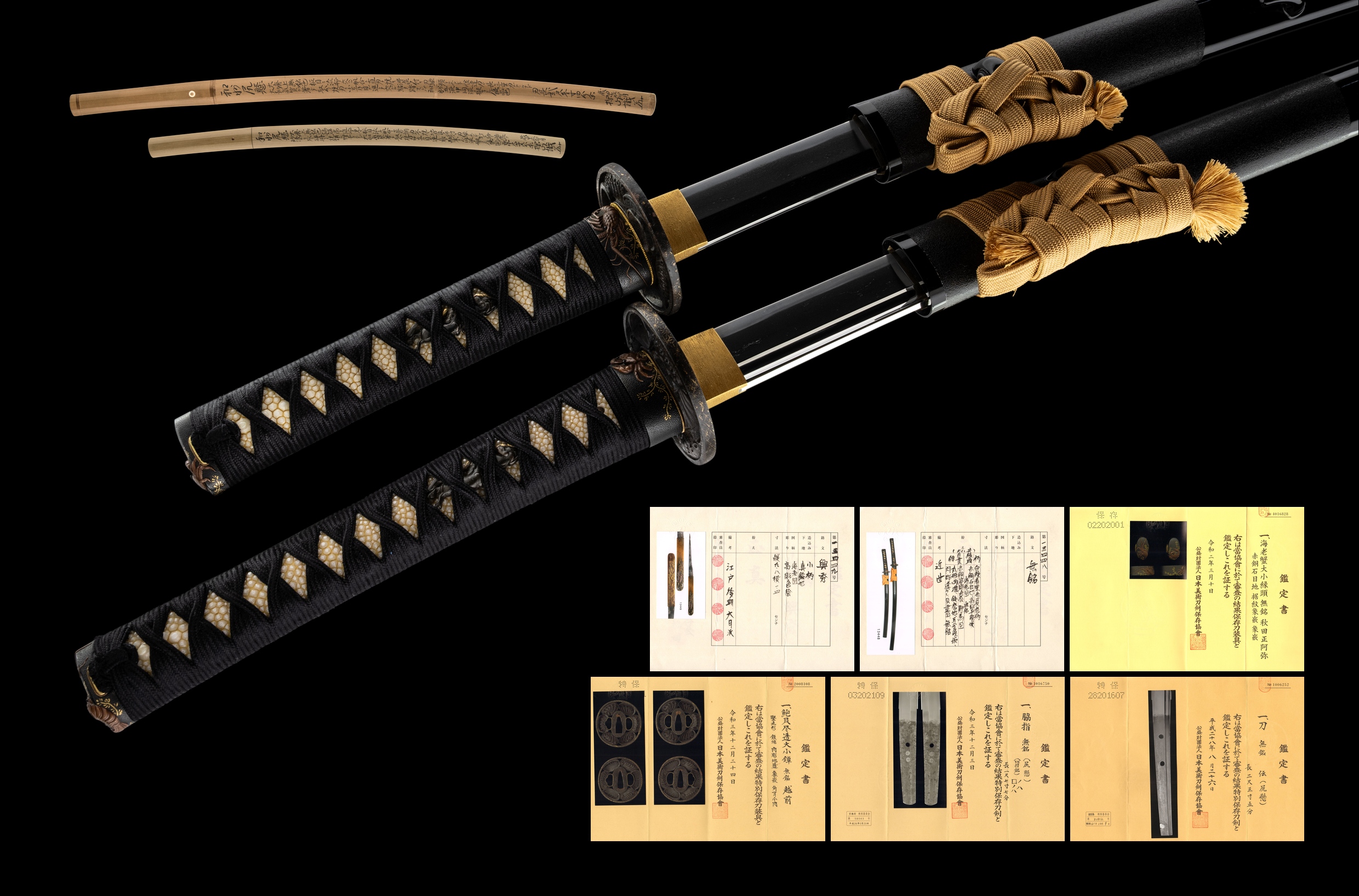
One of the five great Yamato schools, the Shikkake school was founded by swordsmith Norinaga in Yamato province and forged blades for generations in service to the great temple networks of central Japan. Working alongside Senjuin, Tegai, Taima, and Hôshô, the Shikkake smiths refined a style unmistakably rooted in the Yamato tradition: high shinogi, wide shinogi-ji, itame steel that flows into nagare, and a hamon built on suguha with the school’s signature connected ko-gunome woven through the ha. Both blades of this daishô exhibit that character in full – abundant kinsuji, clear masame-hada in the tempered zone, and the darkened, layered jihada that speaks of considerable age. Originally longer tachi, both were greatly shortened to their current ô-suriage form during the late Muromachi to early Edo period, losing their signatures in the process. Tanobe Michihiro (Tanzan-sensei) examined both blades and inscribed sayagaki in April 2024 attributing them to Washû Shikkake – Shikkake from Yamato province.
The katana presents a forging structure in itame mixed with nagare-masame, hardened in a nie-laden suguha with plenty of hotsure, kuichigai-ba, long nijûba, and strong kinsuji activity. The wakizashi shares the same Yamato pedigree: its itame-nagare jiba carries a suguha-chô hamon mixed with yubashiri and sunagashi, its boshi sweeping to a yakitsume with beautiful hakikake, and a magnificent long line of kinsuji ripping through the kissaki. Both nakago feature kaki-tôshi grooves extending through the butt end of each tang – a further Shikkake characteristic – alongside curious chiselled “No Ha” (ノ八) inventory marks from a Shôwa-era sword rental shop, a historical footnote that adds to rather than detracts from the blades’ long biography. The katana was awarded NBTHK Tokubetsu Hozon certification in 2016; the wakizashi followed in 2021.
Unique Japan was commissioned to build a daishô koshirae worthy of these ancient blades. A land and sea theme was chosen – abalone shells symbolising longevity, crabs evoking warrior armour, lobsters representing endurance, and paired horses embodying sessha-takuma, the spirit of growth through camaraderie. The daishô tsuba are the work of the Echizen school, rendered in superb three-dimensional abalone openwork on iron and awarded NBTHK Tokubetsu Hozon; the fuchi-kashira by the Akita Shôami school depict lobster and crab in fine carving on shakudô, holding NBTHK Hozon; the kozuka by Okihide of the Ôtsuki school features a lobster in high relief on a brass ground. The saya lacquerwork combines two tones of black – a matte kuro-ishime-ji stone finish and high-gloss kuro-ro-nuri – with gold sageo cords. The result is a deeply personal commission that honours both seven centuries of Japanese craft tradition and its owner’s New Zealand heritage.
| Item Number | UJDI010 |
| Sword Type | Daishô (katana & wakizashi) |
| Attribution | Shikkake school (mumei) |
| School | Shikkake |
| Province | Yamato |
| Period | Chû-Kotô – Late Kamakura ~ Nambokuchô period (1288~1342) |
| Nagasa (katana) | 71.2 cm (ô-suriage) |
| Sori (katana) | 1.4 cm |
| Moto-haba (katana) | 3.01 cm |
| Saki-haba (katana) | 1.90 cm |
| Moto-kasane (katana) | 5.9 mm |
| Saki-kasane (katana) | 4.2 mm |
| Weight (katana) | 585 g |
| Nagasa (wakizashi) | 53.6 cm (ô-suriage) |
| Sori (wakizashi) | 1.1 cm |
| Moto-haba (wakizashi) | 2.80 cm |
| Saki-haba (wakizashi) | 1.92 cm |
| Moto-kasane (wakizashi) | 5.7 mm |
| Saki-kasane (wakizashi) | 4.1 mm |
| Weight (wakizashi) | 555 g |
| Nakago | Ô-suriage mumei; kaki-tôshi grooves extending through the butt end of each tang; “No Ha” (ノ八) Shôwa-era rental shop inventory marks chiselled on both sides of each blade |
| Jihada | Itame mixed with nagare and masame; mokume-hada present; clear masame-hada in the yakiba |
| Hamon | Katana: suguha with connected ko-gunome, nie-laden habuchi, hotsure, kuichigai-ba, long nijûba, abundant kinsuji. Wakizashi: suguha-chô with yubashiri, sunagashi, hotsure, uchinoke |
| Boshi | Katana: kinsuji extending into the kissaki. Wakizashi: yakitsume with hakikake |
| Certificates | NBTHK Tokubetsu Hozon (katana, Heisei 28 / 2016); NBTHK Tokubetsu Hozon (wakizashi, Reiwa 3 / 2021); NBTHK Tokubetsu Hozon (daishô tsuba, Reiwa 3 / 2021); NBTHK Hozon (daishô fuchi-kashira, Reiwa 2 / 2020); NTHK-NPO Kanteishô (soroi kanagu, kozuka and koshirae) |
| Sayagaki | Tanobe Michihiro (Tanzan-sensei) – both blades attributed to Washû Shikkake; dated April, year of the dragon (2024), with kaô |
| Koshirae | Daishô uchigatana koshirae; two-tone black lacquer saya: upper three-tenths kuro-ishime-ji (stone finish), lower seven-tenths kuro-ro-nuri (high gloss); gold sageo cords |
| Tsuba | Echizen school (mumei); daishô tsuba with three-dimensional abalone shell openwork; iron with inlay; NBTHK Tokubetsu Hozon |
| Fuchi-kashira | Akita Shôami school (mumei); depicting lobster and crab; shakudô with stone-surface ground, set-in motif, inlay; NBTHK Hozon |
| Menuki | Paired horses on shakudô ground with gold accents; sessha-takuma theme |
| Kozuka | By Okihide (興秀) of the Ôtsuki school, late Edo period; lobster in high relief on brass ground; signed with monogram; NTHK-NPO Kanteishô |
| Tsuka | Hishimaki style; black silk ito over white samekawa; daishô set |
| Habaki | New gold-wrapped habaki with horizontal file marks (x2) |
| Status | Sold |
| Includes | Shirasaya x 2, daishô koshirae, stand, kit, booklet, printed description |